Equity Release Interest Rates: What They Cost in the UK in 2026

TL;DR
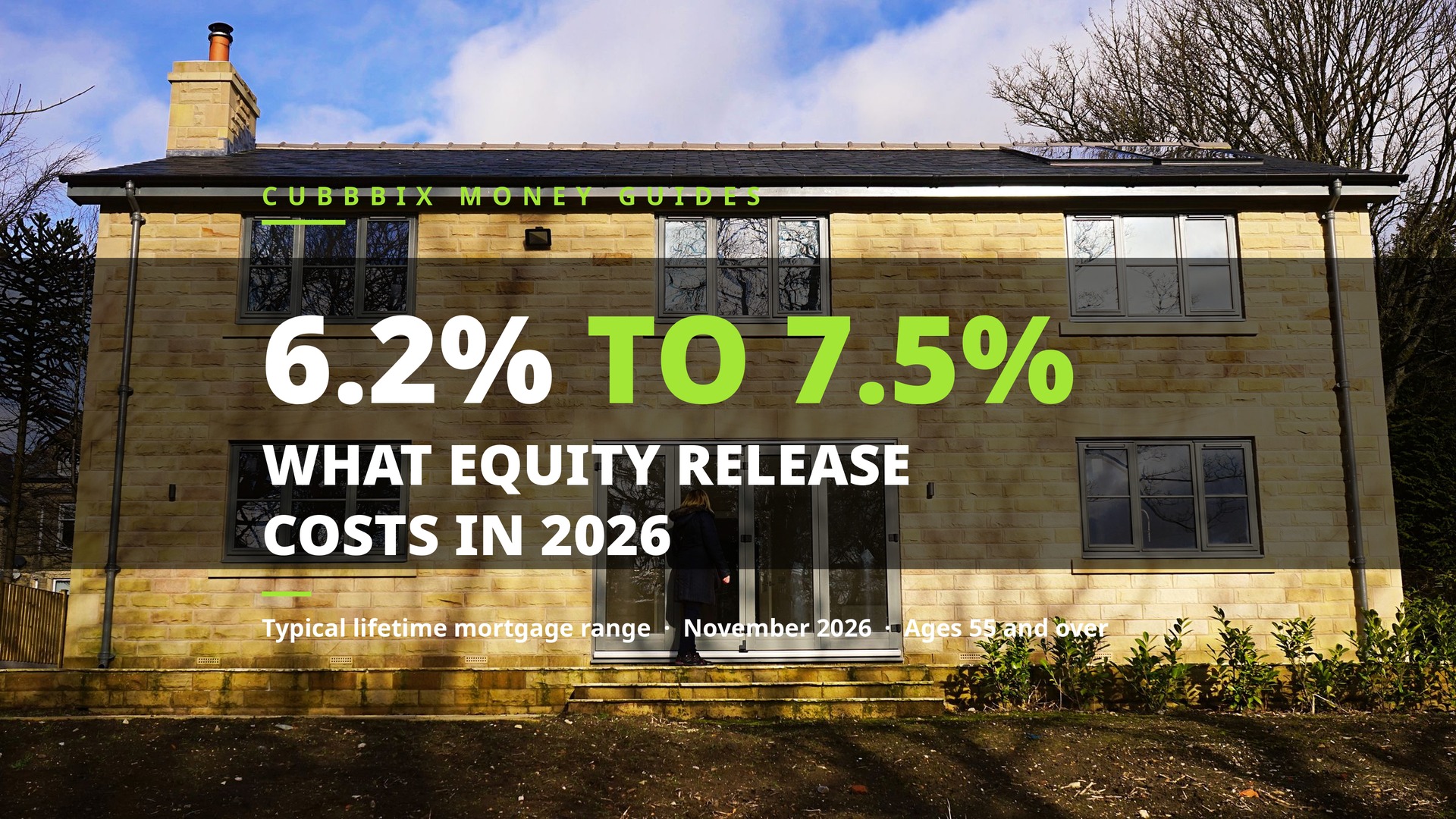
Equity release rates in the UK run 6.2% to 7.5% a year in November 2026. How lifetime mortgages work, what the debt grows to, the safeguards, and the risks.
Table of Contents
Equity release rates: the short version
Equity release in the UK costs 6.2% to 7.5% a year on a typical lifetime mortgage, based on rate guides checked on 14 November 2026. The best rates go lower for older borrowers, down to about 5.8%. Rates are usually fixed for life, and you pay nothing each month unless you choose to. The loan and all the interest are repaid from the sale of your home when you die or move into long-term care.
Figure 1: A home in the UK. Equity release lets owners aged 55 and over borrow against the value of a home like this one while they keep living in it.
What equity release is
Equity release is later-life borrowing secured on your home. You take cash out of the value of your property without selling it and without moving. The loan is repaid when the home is sold, which is normally after the last borrower dies or moves permanently into long-term care. Equity release is regulated by the Financial Conduct Authority, and you must take independent financial advice and independent legal advice before you take out a plan.
There are two kinds of plan. A lifetime mortgage is a loan secured on your home. You keep ownership, and interest is added to the loan each year. A home reversion plan works the other way: you sell all or part of your home to a provider for a lump sum or an income, and you keep the right to live there rent-free for life. Lifetime mortgages make up more than 99% of new equity release plans, according to the Equity Release Council.
| Plan | How it works | Who owns the home |
|---|---|---|
| Lifetime mortgage | A loan secured on your home. Interest rolls up and is repaid from the sale. | You keep full ownership. |
| Home reversion | You sell part or all of your home for a lump sum or income, and live there rent-free. | The provider owns the share you sold. |
What the rates are in November 2026
Lifetime mortgage rates depend on your age, how much you borrow against the value of your home, and the features of the plan. Older borrowers can borrow more and usually pay a lower rate. The table below shows indicative rates from Doulton Bridging Finance rate guides, checked in November 2026. MER means monthly equivalent rate, the standard way lifetime mortgage rates are quoted.
| Age | Most you can borrow | Rate from |
|---|---|---|
| 55 to 59 | Up to 25% of the home value | 6.49% MER |
| 60 to 64 | Up to 35% of the home value | 6.19% MER |
| 65 to 69 | Up to 45% of the home value | 5.99% MER |
| 70 to 74 | Up to 50% of the home value | 5.89% MER |
| 75 and over | Up to 55% of the home value | 5.79% MER |
Other rate trackers put the typical range a little higher. Seniorwise lists 6.2% to 7.8% for lifetime mortgages in November 2026, and Equity Release Wise reported a best rate of 7.05% MER on 1 November 2026 for a single borrower taking the maximum release against £200,000 of equity. The spread between the lowest rate and the rate for a maximum release shows why the headline rate is only part of the story: the rate you are offered depends on how much you borrow. The Bank of England base rate stood at 3.75% at the start of November 2026, when these guides were written, and lifetime mortgage rates sit above it because the loan runs for the rest of your life.

Figure 2: A brick home with green front doors. The amount you can borrow depends on your age and the value of the home.
What the debt grows to
Most lifetime mortgages charge no monthly payments, so the interest is added to the loan and then earns interest itself. This is compounding, and it is the single most important number in equity release. The table below is our own calculation, at a fixed rate of 6.5% a year with no payments made. At 6.5%, a £100,000 loan becomes £187,714 after 10 years, £257,184 after 15 years, and £352,365 after 20 years.
| After | Amount owed | Interest added |
|---|---|---|
| 10 years | £187,714 | £87,714 |
| 15 years | £257,184 | £157,184 |
| 20 years | £352,365 | £252,365 |
The same maths at 6.0% turns a £200,000 loan into about £358,000 after 10 years with no payments, a figure Doulton Bridging Finance quotes in its November 2026 guide. Two things slow the growth. Some plans let you pay some or all of the interest each month. And a drawdown plan only charges interest on the money you have taken, not on the reserve you leave untouched.
The safeguards
Most UK providers are members of the Equity Release Council, the trade body that sets product standards above the FCA baseline. Its standards, updated in May 2025, require every member lender to include these protections in a lifetime mortgage.
- No negative equity guarantee. You or your estate never owe more than the home sells for, as long as it is sold for the best price reasonably obtainable. Any shortfall is the lender's loss.
- Fixed or capped rate for life. The rate is set when you take out the plan and cannot rise. If it is variable, it must have a lifetime cap.
- Right to remain in your home for life, or until you move into permanent long-term care, as long as it stays your main home and you meet the terms.
- Portability. You can move the plan to a new home that meets the lender's criteria.
- Penalty-free partial repayments. Every Equity Release Council plan since March 2022 must allow voluntary repayments without an early repayment charge, within the lender's limits, commonly up to 10% of the loan each year.
- Early repayment charges waived on a permanent move into long-term care, with a medical certificate, under the May 2025 standards.
The risks
Equity release reduces the value of your estate, so there is less to leave to your family. It can affect your entitlement to means-tested benefits, because the money you release counts as savings. Early repayment charges apply if you repay the loan early for other reasons, and they can be large in the first years. If house prices fall, the loan can eat a bigger share of the home's value, even with the no negative equity guarantee. And once you take a plan, moving to a home that does not meet the lender's criteria can be hard. This page is general information, not financial advice. Speak to a regulated adviser before you decide.
Who it suits
Equity release suits homeowners aged 55 and over who want cash from their home without moving, who are comfortable with no monthly payments, and who accept a smaller inheritance for their family. It suits people who want to fund home improvements, help family, or top up retirement income. It does not suit people who want to leave the full value of their home to their children, who may need means-tested benefits, or who may want to move to a home a lender would not accept.
Sources: Doulton Bridging Finance rate guides, November 2026; Equity Release Wise and Advise Wise, 1 November 2026; Seniorwise, November 2026; Equity Release Council product standards, May 2025; Aviva, is equity release safe. Figures checked on 14 November 2026. Rates change, and the rate you are offered depends on your age, your home, and how much you borrow.
Frequently asked questions
What is the typical equity release interest rate in the UK?
Between 6.2% and 7.5% a year for a lifetime mortgage, based on rate guides checked in November 2026. The best rates go lower for older borrowers, down to about 5.8%, and the rate you are offered depends on your age and how much you borrow.
How much can I borrow with equity release?
It depends on your age and the value of your home. As a guide, borrowers aged 55 to 59 can borrow up to about 25% of the home value, rising to about 55% at age 75 and over. Some lenders lend more for health or lifestyle reasons.
Will I owe more than my house is worth?
No, not on a plan from an Equity Release Council member. The no negative equity guarantee means you or your estate never owe more than the home sells for, as long as it is sold for the best price reasonably obtainable.
Can I still leave my home to my children?
Yes, but there will be less to leave. The loan and the rolled-up interest are repaid from the sale of the home, and your estate gets what is left. Some plans let you ring-fence part of the home value as a guaranteed inheritance.
Do I need advice before taking equity release?
Yes. Equity release is regulated by the Financial Conduct Authority, and you must speak to a regulated financial adviser and take independent legal advice. The adviser has to show you the effect on your estate, your benefits, and your tax position before you sign.
More from the Blog
Cheapest Way to Liquidate a Company in the UK: Strike-Off vs MVL vs CVL
3 Types of Bankruptcies in the UK: Bankruptcy, DRO and IVA Explained
Surah Mulk Read Online: Full Text in Arabic with English Translation
Surah Muhammad PDF: Full Text in Arabic with English Translation



Was this article helpful?
Comments
Loading comments...