Bad Digital Hygiene: Why Your Silent Phone Drains Your Working Memory and How Top Executives Fix It

TL;DR
Bad digital hygiene reduces fluid intelligence and doubles task completion times. Here is the cognitive science behind brain drain and the exact protocol top executives use to protect their attention.
Table of Contents
Bad digital hygiene is having an undisciplined physical relationship with your digital devices and notifications. In a landmark study conducted at the University of Texas at Austin across 520 participants, people working with a powered-off smartphone face down on their desk scored significantly lower on working memory and general fluid intelligence tests than people whose phones sat in another room.
\n\nYour phone does not need to ring, vibrate, or light up to make you less capable. Its mere presence in your field of vision drains cognitive capacity because your brain expends continuous energy suppressing the impulse to check it. Top executives solve this through physical architecture rather than willpower. They rely on four clear operational rules: physical device segregation during focus blocks, zero desktop communication pings, a 15-minute digital buffer around sleep, and single-task batching.
\n\n\n The UT Austin "Brain Drain" Experiment
\n\nIn 2017, researchers Adrian Ward, Kristen Duke, Ayelet Gneezy, and Maarten Bos published a paper in the Journal of the Association for Consumer Research titled "Brain Drain: The Mere Presence of One's Own Smartphone Reduces Available Cognitive Capacity."
\n\nThe researchers brought undergraduate students into a laboratory to evaluate two core cognitive functions: general fluid intelligence (the ability to hold and process novel information to solve complex problems) and working memory capacity.
\n\nAll participants were instructed to turn their smartphones completely off. No silent mode. No Do Not Disturb. Powered off completely. The researchers then split participants into 3 distinct conditions:
\n\n- \n
- Other room condition: The participant left their powered-off phone in the waiting lobby with the research team. \n
- Pocket or bag condition: The participant kept their powered-off phone tucked away inside their pocket or backpack. \n
- Desk condition: The participant placed their powered-off phone face down on the corner of the testing desk. \n
The results showed a linear decline in available cognitive capacity. Participants with the phone on their desk performed significantly worse on both working memory and fluid intelligence tests compared to peers whose phones were in the other room. Participants with phones in their pockets or bags scored in the middle.
\n\nThe phone was an inert piece of metal and glass during the entire test. It received no messages. Yet the visual cue alone forced the prefrontal cortex to recruit active inhibition circuits. Because your phone holds your bank accounts, personal photos, family messages, work crises, and social validation, your brain automatically tracks it whenever it remains in your line of sight.
\n\nThe Biological Cost of Task Switching
\n\nMultitasking during knowledge work does not exist. The human brain contains a single attentional bottleneck. When you try to do two cognitive tasks at once, your brain performs rapid task switching.
\n\nYou can demonstrate the cost of task switching in 60 seconds with a pen and a sheet of paper:
\n\n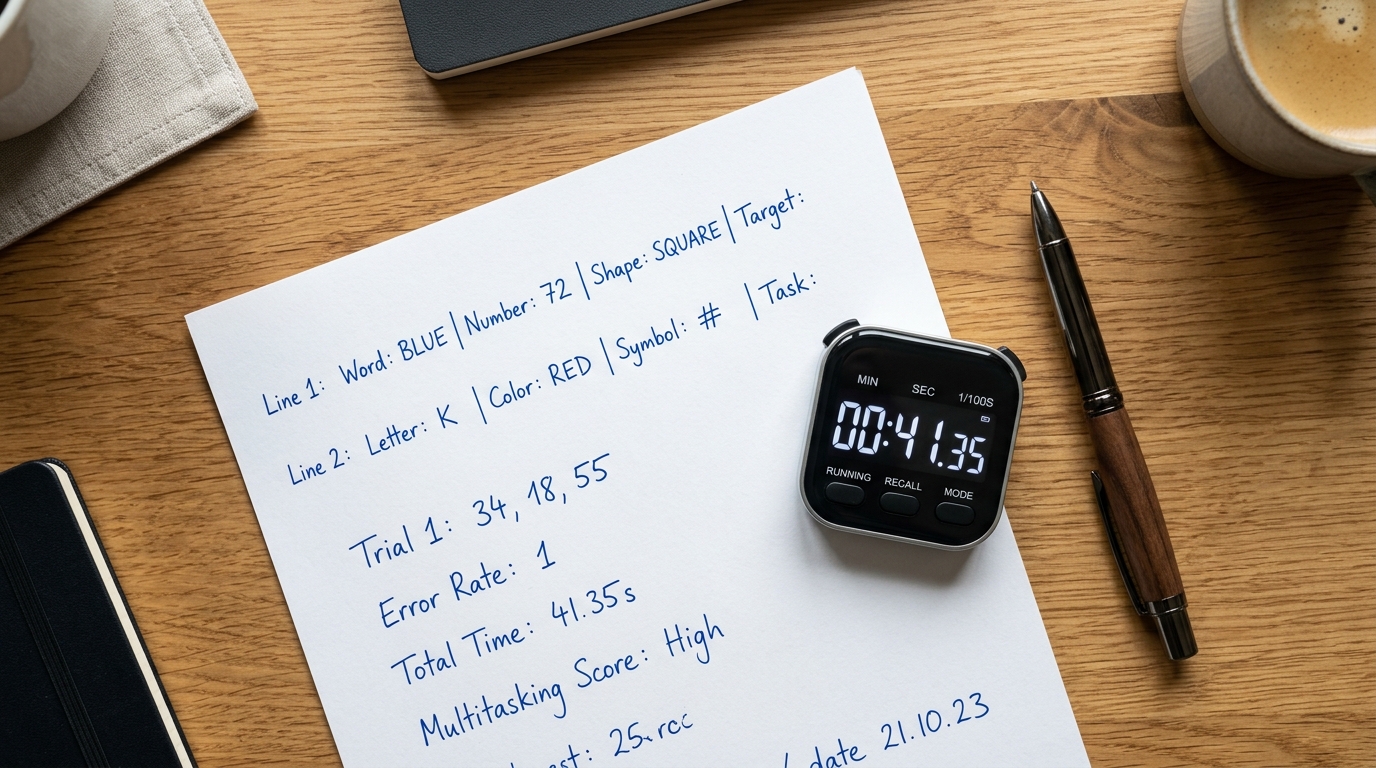 \n
\n Trial 1 (Sequential focus): Draw two lines on a piece of paper. On line 1, write the phrase I am a great multitasker. On line 2, write the numbers 1 through 20. Complete line 1 first, then complete line 2. Time yourself.
In practical demonstrations, most people finish both lines in roughly 17.7 seconds. The handwriting is clean. Errors are zero.
\n\nTrial 2 (Task switching): Turn the paper over and draw two lines. You will produce the exact same final text, but you must alternate after every single character. Write I on line 1, then drop down and write 1 on line 2. Write a on line 1, then drop down and write 2 on line 2. Continue alternating letter and number until both lines are complete.
The average time jumps to 41.35 seconds. The duration more than doubles. People make spelling mistakes, write the wrong number, and pause repeatedly as their brain reloads the alternate sequence.
\n\nEvery context switch costs time and metabolic energy. When an executive looks from a pitch deck to a Slack pop-up, looks down at a watch, and answers an incoming text, they pay that biological tax repeatedly throughout the day. By 3:00 PM, their glucose stores are depleted and their decision quality collapses.
\n\nThe Social Tax: Why Phones on the Table Destroy Trust
\n\nBad digital hygiene also damages interpersonal relationships. In studies by Przybylski and Weinstein (2013) at the University of Essex, pairs of strangers sat in a private room for 10 minutes to discuss an interesting event that happened to them recently.
\n\nIn half the pairs, a mobile phone rested on a nearby desk outside the direct line of conversation. In the other half, a notebook replaced the phone. The phone was never used and never rang.
\n\nPairs who had a phone visible in the room reported lower relationship quality, less trust, and lower perceived empathy from their partner. The effect was strongest when the conversation involved meaningful, personal topics.
\n\nPlacing a phone on a meeting table or dining table communicates a clear message to the person sitting across from you: You are not important enough to command my full attention. If someone more interesting pings me, I will pivot immediately.
\n\nThe Protocol: 4 Habits for 25 and 35-Year-Olds
\n\nIf you are 25 or 35, you are in the defining decade of your professional career and personal life. Your attention is your only non-renewable capital. Here is the operational framework used to coach leadership teams, adapted for everyday work:
\n\n1. Create a Physical "Parking Lot" Outside Your Field of View
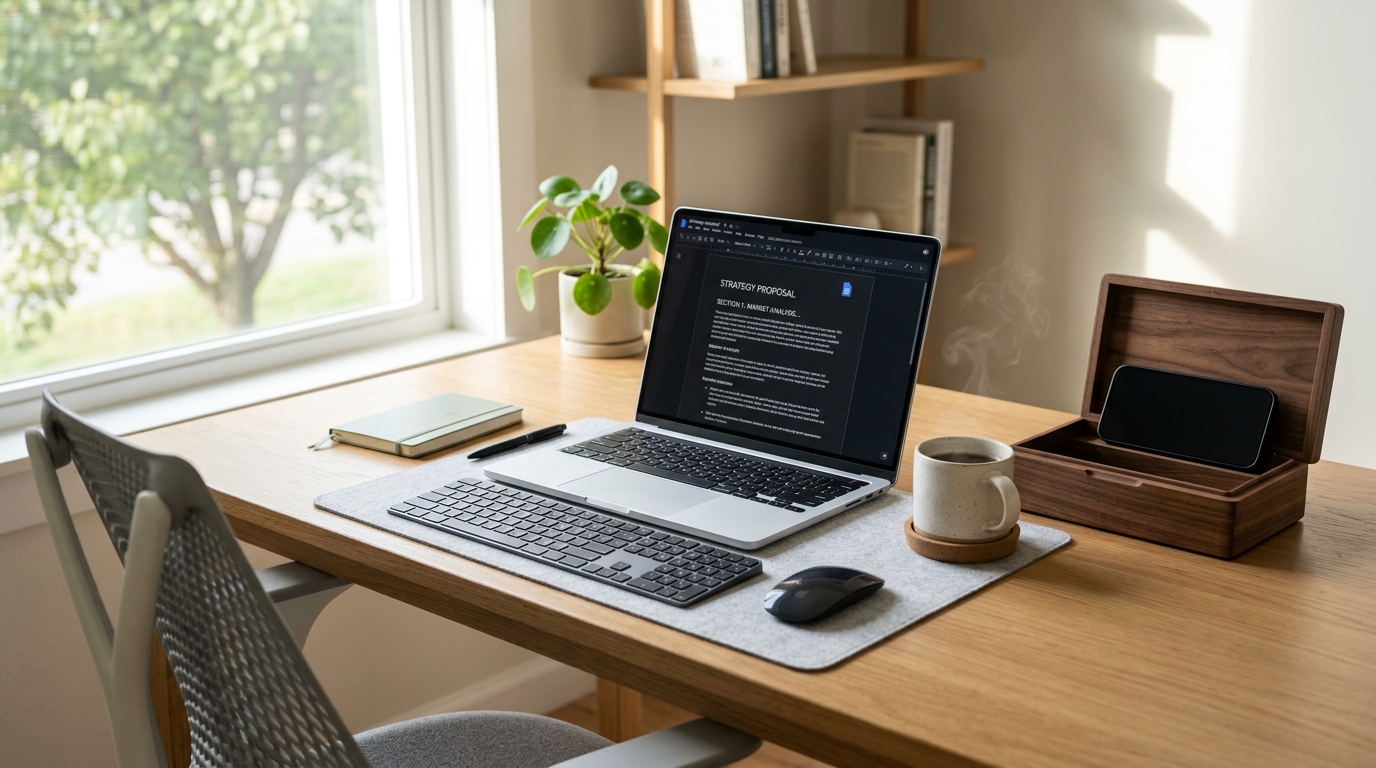
\n\nStop keeping your phone beside your keyboard. Buy a simple wooden box with a lid, assign a drawer across the room, or drop the phone in a dedicated basket in your hallway before sitting down to deep work.
\n\nWhen it is game time on a hard project, remove the visual cue. Out of sight removes the inhibition burden from your prefrontal cortex.
\n\n2. Kill Desktop Communication Banners
\n\nWorking with Slack, Microsoft Teams, or Gmail open on a secondary monitor guarantees cognitive fragmentation. Every red badge and audio chime pulls your working memory out of deep analysis.
\n\nClose communication clients completely during 90-minute focus blocks. Batch your message responses into two 30-minute windows daily (for example, 11:30 AM and 4:30 PM).
\n\n3. Use the 15-Minute Sleep and Wake Buffer
\n\nTurn your phone off 15 to 30 minutes before your head hits the pillow. When you wake up, leave the phone off for the first 15 to 30 minutes.
\n\nFirst thing in the morning, your brain transitions from theta to alpha waves. This neurochemical window gives you high clarity for original thought, goal planning, and reflection. When you grab your phone immediately, you flood your mind with other people's emergencies, news outrage, and reactive anxiety before your feet touch the floor.
\n\nBuy an inexpensive $10 analog alarm clock so your phone never enters your bedroom.
\n\n4. Run Single-Task Commitments
\n\nBefore opening your laptop, write down the single document, spreadsheet, or code file you will work on for the next 45 minutes. Close every unrelated browser tab.
\n\nIf an urgent thought arrives, jot it down on a physical notepad beside you. Do not switch tabs. Return to that thought only after your focus block concludes.
\n\nMy Take: Why Willpower Fails at 25 and 35
\n\nMost productivity advice fails because it treats focus as a character trait rather than a physical engineering problem. People tell themselves: "I will just be more disciplined today. I will leave the phone right here next to me and choose not to look at it."
\n\nThat approach ignores human biology. Willpower is an exhaustible resource mediated by glucose in the prefrontal cortex. The algorithms running on social platforms and mobile operating systems employ teams of behavioral psychologists dedicated to extracting your attention. Fighting that machinery with raw willpower while the device sits 8 inches from your hand is an uneven contest.
\n\nTop executives do not have superior self-control compared to an average 28-year-old analyst. What they have is boundary enforcement: executive assistants who gatekeep incoming calls, private offices with closed doors, and calendar blocks that team members cannot book over.
\n\nIf you are in your twenties or thirties, you do not have an assistant to guard your door. You must build that perimeter yourself. That means using physical friction: putting the phone in another room, deleting notification-heavy apps from your home screen, and keeping your morning routine free of external inputs.
\n\nThe market rewards people who can sit with complex, ambiguous problems for two uninterrupted hours and produce clear answers. You cannot build that capability while your attention is leased out in 90-second increments to incoming pings. Fix the physical hygiene of your desk, and your mental output follows naturally.


Was this article helpful?
Comments
Loading comments...