Can You Get a Job in France Without Speaking French? Language Levels, Visas & Learning Timelines


TL;DR
Explore employment opportunities in France without fluent French. Learn minimum CEFR requirements for tech, corporate, and vocational roles, plus realistic study hours to reach job-ready B2.
Table of Contents
Securing employment in France without fluent French is possible, but your options depend heavily on your industry, your target city, and the specific role. Software engineers, data scientists, university researchers, and multinational corporate specialists frequently work entirely in English. In contrast, client-facing roles, public administration, legal professions, and local small businesses require functional fluency between B1 and C1 levels under French labor practices.
\n\n\nDirect Takeaways: Working in France
\nTech startups (Station F), global enterprises (CAC 40), higher education, and international tourism hire English speakers without initial French fluency.
\nPure English roles accept A1/A2. Standard corporate roles and vocational Alternance placements require B1 or B2 proficiency for daily operations.
\nReaching job-ready B2 takes 5 to 6 months of full-time immersive study (25–30 hrs/wk) or 10 to 12 months at a steady pace (15 hrs/wk).
\n\n 1. Can I Get a Job in France If I Don't Speak French?
\n\nFrance hosts over 17,000 foreign-owned enterprises employing more than 2.2 million workers. In Paris, Sophia Antipolis, Lyon, and Toulouse, hundreds of companies conduct their core business communication in English. Your likelihood of finding an English-speaking position depends on your specific career profile.
\n\nIndustries Actively Hiring Non-French Speakers
\n\nTechnology, Software Engineering & AI
\nParis is home to Station F, the world's largest startup campus housing over 1,000 startups. Tech companies such as Datadog, Mistral AI, Qonto, Doctolib, and Algolia use English as their primary engineering language. Coding repositories, Slack channels, technical documentation, and sprint standups operate in English.
\nMultinational Corporations (CAC 40 Headquarters)
\nGlobal enterprises headquartered in Paris—including Airbus, L'Oréal, Sanofi, Schneider Electric, TotalEnergies, and Danone—maintain cross-border teams where English serves as the official corporate working language for global marketing, international procurement, and supply chain management.
\nHigher Education & Scientific Research
\nFrench public research institutions such as CNRS, INSERM, and INRIA recruit postdoctoral researchers and lab engineers worldwide. Peer-reviewed research, grant writing, and academic symposia in STEM disciplines happen in English.
\nEnglish Language Instruction (TAPIF & Private Academies)
\nThe Teaching Assistant Program in France (TAPIF) places over 1,400 native English speakers annually in public primary and secondary schools across France. Private business schools (HEC Paris, INSEAD, ESSEC) and private language academies hire native English lecturers.
\nLegal Realities: The Toubon Law and French Employment Contracts
\n\nUnder French labor regulations (specifically Article L1321-6 of the French Labor Code and Law No. 94-665, known as the Loi Toubon), every employment contract executed in France must be provided to the employee in French. When an employee is foreign, they are legally entitled to receive a bilingual translation upon request.
\n\nWhile internal meetings in tech teams may occur in English, formal health and safety regulations, workplace elections, and official HR grievance procedures must be recorded in French. Having baseline conversational French makes your integration smoother and protects your workplace rights.
\n\n2. What's the Minimum French Level You Need to Work in France?
\n\nThe Common European Framework of Reference for Languages (CEFR) categorizes language skills into six clear tiers: A1, A2, B1, B2, C1, and C2. French employers specify these standardized levels in job postings.
\n\n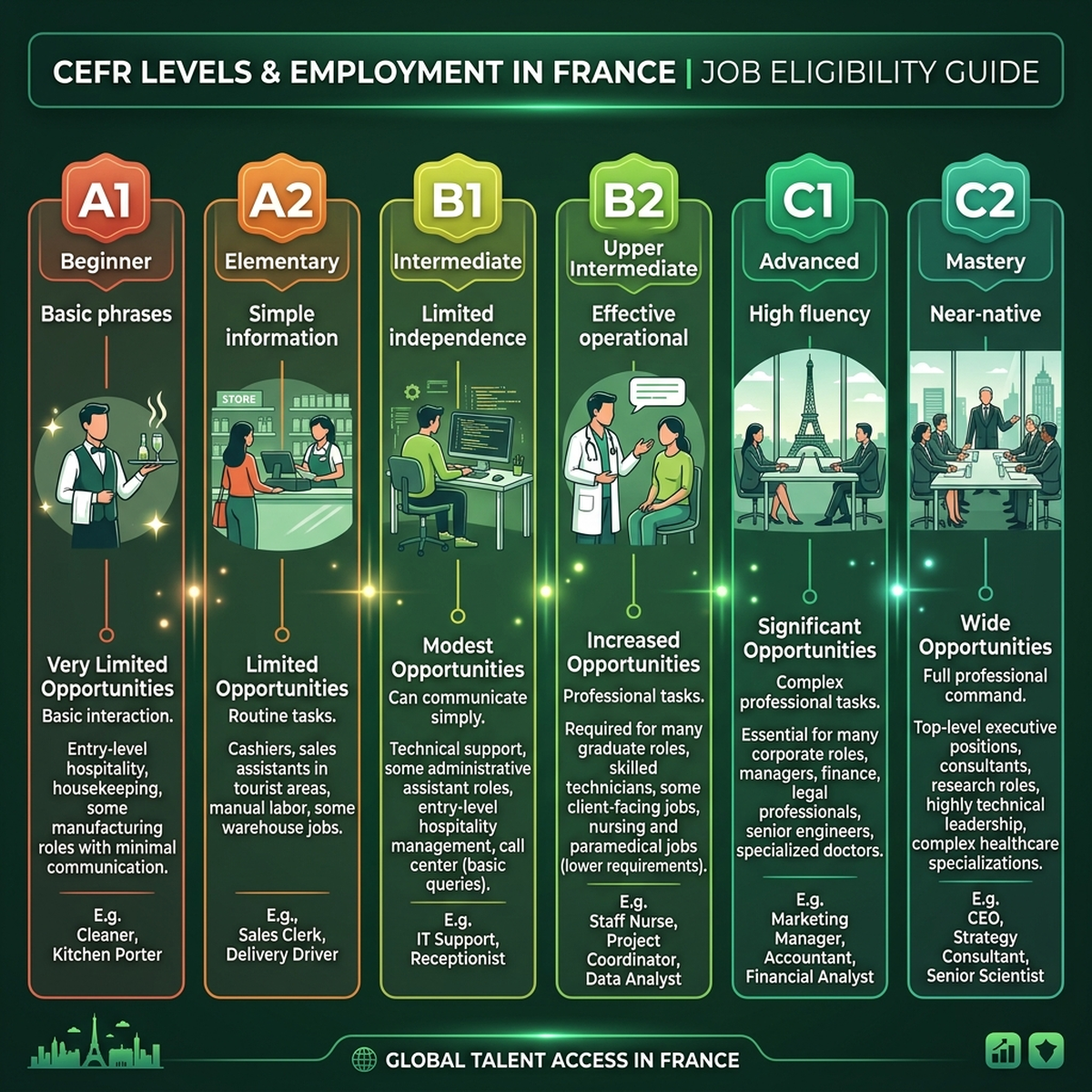 \n
\n | CEFR Level | \nLanguage Capability | \nWorkplace Eligibility | \nTypical Job Roles | \n
|---|---|---|---|
| A1 (Beginner) | \nUnderstands basic greetings, numbers, and isolated workplace phrases. | \nEnglish-first technical environments only. | \nBackend Software Engineer, TAPIF Language Assistant. | \n
| A2 (Elementary) | \nCan handle brief social pleasantries, lunch orders, and simple email acknowledgments. | \nBack-office operations, international logistics. | \nData Engineer, International Logistics Clerk, Hotel Night Auditor. | \n
| B1 (Intermediate) | \nUnderstands standard workplace meetings, writes routine emails, and describes technical issues. | \nTechnical vocational jobs, junior alternance roles. | \nIT Support Specialist, Alternance Student (BTS/CAP), Quality Assurance Tester. | \n
| B2 (Upper-Intermediate) | \nFull professional operational proficiency. Can negotiate, debate, and deliver presentations. | \nStandard requirement for 80% of French corporate positions. | \nProject Manager, Marketing Manager, Financial Analyst, Nurse (Paramedical). | \n
| C1 / C2 (Advanced/Mastery) | \nNuanced comprehension of idioms, legal texts, high-stakes negotiations, and formal rhetoric. | \nRegulated professions, management, legal, and public sector. | \nCorporate Lawyer, Medical Doctor, School Teacher, C-Suite Executive. | \n
Test Your French Level Before Applying
\n\n Wondering whether your French is currently A2, B1, or B2? Take our free, timed 40-question proficiency test to evaluate your grammar, vocabulary, and workplace readiness with a CEFR score breakdown.\n
\n \n3. How Long Does It Take to Learn French Well Enough to Work?
\n\nThe Foreign Service Institute (FSI) of the United States Department of State classifies French as a Category I language (closely related to English). According to FSI empirical data, native English speakers require approximately 600 to 750 classroom hours (supplemented by active practice) to achieve professional working proficiency (equivalent to CEFR B2).
\n\n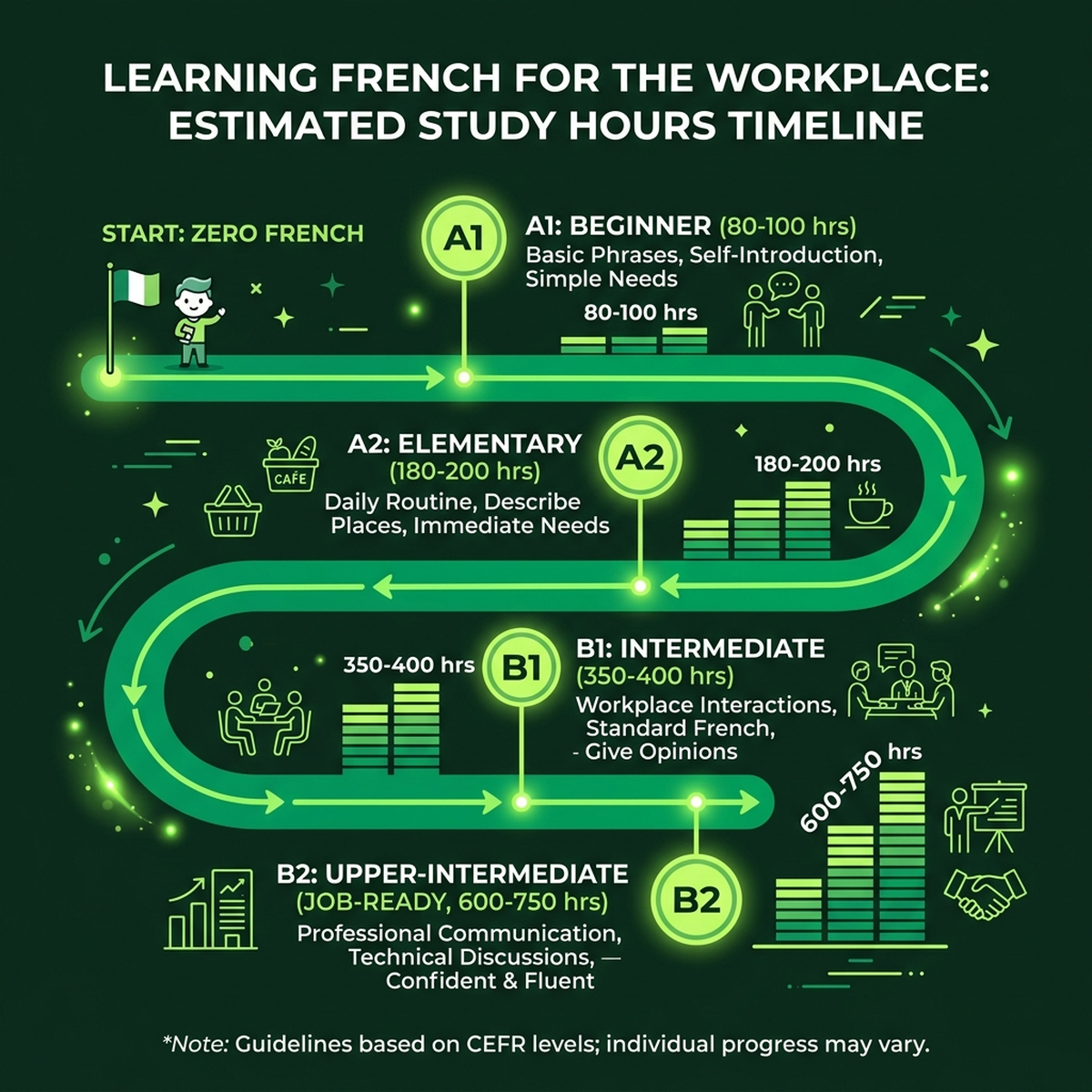 \n
\n Realistic Timelines Based on Weekly Commitment
\n\n5 Hours / Week
\nSelf-study with mobile apps, podcasts, and 1 weekly tutor session.
\n- \n
- A2 Level: 8 to 10 months \n
- B1 Level: 16 to 18 months \n
- B2 Level: 28 to 32 months \n
15 Hours / Week
\nDaily grammar study (1 hr), vocabulary drills (30 min), 3 weekly 1-on-1 speaking classes.
\n- \n
- A2 Level: 3 to 4 months \n
- B1 Level: 6 to 7 months \n
- B2 Level: 10 to 12 months \n
25–30 Hours / Week
\nIntensive language school (Alliance Française or university FLE center) with immersion.
\n- \n
- A2 Level: 6 to 8 weeks \n
- B1 Level: 14 to 16 weeks \n
- B2 Level: 22 to 26 weeks (5–6 months) \n
4-Phase Roadmap: From Zero to Workplace Ready
\n\nTo compress your timeline and focus on vocabulary that appears in French business environments, follow this four-phase sequence:
\n\n\n 1\n Phase 1: Pronunciation & High-Frequency Foundations (Hours 0–100 | A1)\n
\nMaster French vowel phonemes (the difference between u /y/ and ou /u/), nasal vowels (an, on, in), and liaison rules. Memorize the top 500 workplace verbs in present tense (être, avoir, faire, aller, pouvoir, devoir, vouloir) and professional greetings.
\n\n 2\n Phase 2: Narrative Agility & Daily Operations (Hours 100–250 | A2)\n
\nMaster the distinction between passé composé (completed events) and imparfait (ongoing background context). Learn direct and indirect object pronouns (lui, leur, y, en) to avoid repeating nouns in operational emails.
\n\n 3\n Phase 3: Workplace Argumentation & Subjunctive Mood (Hours 250–450 | B1)\n
\nLearn the subjunctive mood (subjonctif présent) to express necessity, doubt, and obligation (Il faut que nous fassions...). Practice participating in meetings, summarizing project blockers, and writing structured client updates.
\n\n 4\n Phase 4: Professional Fluency & Industry Jargon (Hours 450–700 | B2)\n
\nMaster conditional tenses for diplomatic communication (Je souhaiterais proposer...), industry-specific technical vocabulary, and formal French email formulas (Cordialement, Bien à vous). Practice live mock interviews in French.
\nNavigating French Visas and CV Standards for Foreign Job Seekers
\n\nIf you are a non-EU citizen applying for work in France, specific visa categories streamline hiring for skilled international professionals:
\n\n- \n
- Passeport Talent (Talent Passport): A multi-year residence permit designed for highly skilled workers, startup employees (French Tech Visa), researchers, and executives. It exempts employers from the standard labor market test (opposabilité de la situation de l'emploi). \n
- VLS-TS Salarié: The standard long-stay work visa tied to a specific employment contract (CDI or CDD), requiring prior approval from the French labor authority (DREETS). \n
- Alternance & Student Visas: International students holding a valid French student residence permit can work up to 964 hours annually (60% of legal working time) or sign an apprenticeship contract (contrat d'apprentissage). \n
Formatting Your French CV (Curriculum Vitae)
\n\nFrench recruiters expect a concise 1-page format (for candidates with under 10 years of experience). Structure your CV with:
\n\n- \n
- Clear Header: Include full name, professional email, phone number (with country code +33), city, and visa/work authorization status. \n
- Language Section: Explicitly state your CEFR level for each language (e.g., Anglais : Langue maternelle / C2, Français : B2 professionnel). Avoid vague descriptors like "fluent" or "conversational". \n
- Verified Verification Links: Link your Cubbbix French assessment verification or official DELF diploma. \n
Frequently Asked Questions
\n\n\n Can I get a French work visa without speaking French?\n \n
\n\n Yes. The French Talent Passport (Passeport Talent) work visa tracks for qualified employees, researchers, and startup founders do not impose a statutory French language test at the visa application stage. However, long-term multi-year residence cards and naturalization require official language certification (A2 for multi-year cards, B1 for 10-year resident cards, and B2 for citizenship).\n
\n\n Which cities in France offer the most English-speaking jobs?\n \n
\n\n Paris hosts the vast majority of English-speaking corporate and tech jobs. Outside of Paris, Sophia Antipolis (near Nice and Cannes) is a major tech and telecommunications hub with international research teams. Lyon (pharmaceuticals and biotech), Toulouse (aerospace with Airbus headquarters), and Grenoble (semiconductors and scientific research) also offer significant English-language employment.\n
\n\n Is B1 French enough for daily office work in France?\n \n
\n\n B1 is sufficient for understanding standard emails, following project updates, and participating in informal team discussions. However, leading customer presentations, conducting negotiations, or drafting formal corporate proposals typically requires B2 proficiency.\n
\n\n What official French language exam is best for job seekers?\n \n
\n\n The DELF B2 (Diplôme d'Études en Langue Française) is the most widely recognized credential among French universities and employers because it never expires. The TCF (Test de Connaissance du Français) and TEF are also widely accepted but are valid for two years.\n
\n\n Do French tech companies conduct job interviews in English?\n \n
\n\n Yes. Multinational tech firms, scale-ups, and startups at Station F routinely conduct their entire interview loop—including behavioral screens, technical architecture discussions, and coding challenges—exclusively in English.\n
\n\n How does learning French compare to German or Spanish in difficulty?\n \n
\n\n Under FSI ratings, French takes approximately 600–750 class hours (Category I), comparable to Spanish and Italian. German is classified as Category II, requiring approximately 900 class hours due to four grammatical cases and gender declensions.\n
\n\n Can I test my French level online for free before applying?\n \n
\n\n Yes. You can take our free, adaptive Cubbbix French Assessment Test to measure your CEFR band (A1–C2) with 40 calibrated questions covering workplace grammar, tenses, and reading comprehension in 5 to 8 minutes.\n
\n \n
\n Written by Ayesha Hussain
\nEditor and Research Lead · Cubbbix
\n\n Ayesha Hussain researches international workforce mobility, vocational training standards, and language certification benchmarks across the European Union. Her research guides international applicants through visa pathways and workplace integration.\n
\n

Was this article helpful?
Comments
Loading comments...