Does French Proficiency Actually Help You Get a Job? What Recruiters Look For

TL;DR
Listing "Conversational French" on a CV tells a recruiter almost nothing. Here is what B2 actually means, which industries pay extra for it, and the fastest way to get a verifiable CEFR-aligned certificate you can attach to a job application.
Table of Contents
Yes, French proficiency genuinely helps you get a job — but only if you can prove the level. Writing "French: Conversational" on a CV gives a recruiter no usable information. A verifiable CEFR-aligned certificate that states B2 or C1 does.
\n\nFrench is an official working language of the United Nations, the African Union, the European Union, and over 54 countries. According to data from LinkedIn, job postings requiring French language skills grew 18% year-over-year in 2025 across sectors including international finance, tourism, logistics, and NGO work. The candidates who got those interviews were the ones who listed a specific, verifiable proficiency level — not a vague self-assessment.
\n\nWhat CEFR Level Do Employers Actually Want?
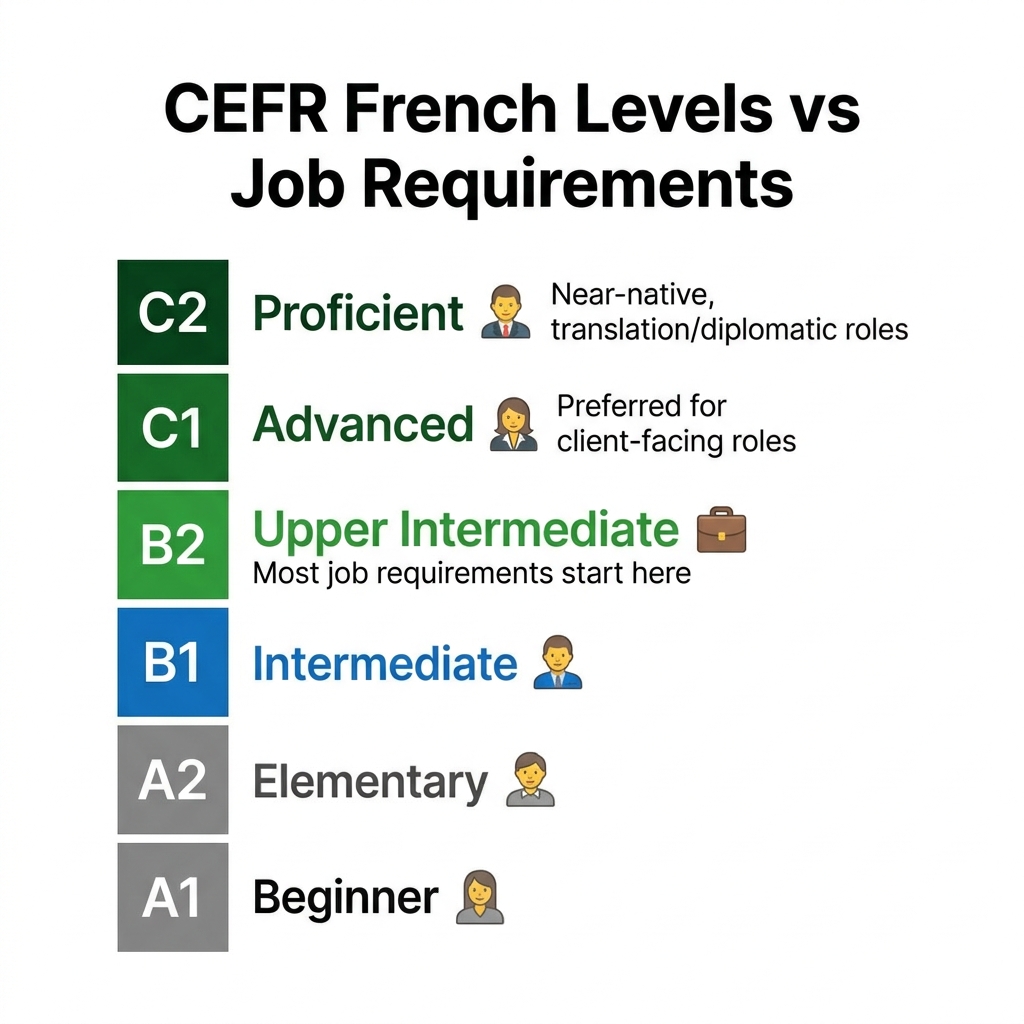
\n\nThe Common European Framework of Reference for Languages (CEFR) runs from A1 (complete beginner) to C2 (near-native). Most job postings that list French as a requirement fall into two categories.
\n\nCustomer-facing roles — concierge, airline cabin crew, patient liaison, hotel front desk — typically require B2. At B2, you can handle routine professional conversations without significant difficulty. Client-facing roles with complex subject matter, such as legal translation, financial advising for French-speaking clients, or senior diplomatic positions, generally require C1 or above.
\n\n\n B1 — the intermediate level — is rarely sufficient for professional employment, though it opens doors in some entry-level teaching assistant or tourism support roles. A1 and A2 are not professionally relevant to employers.
\n\n8 Industries Where French Speakers Earn More
\n\nFrench fluency adds a quantifiable premium in specific sectors. These are the 8 industries where it consistently appears as a differentiator in hiring and compensation decisions.
\n\n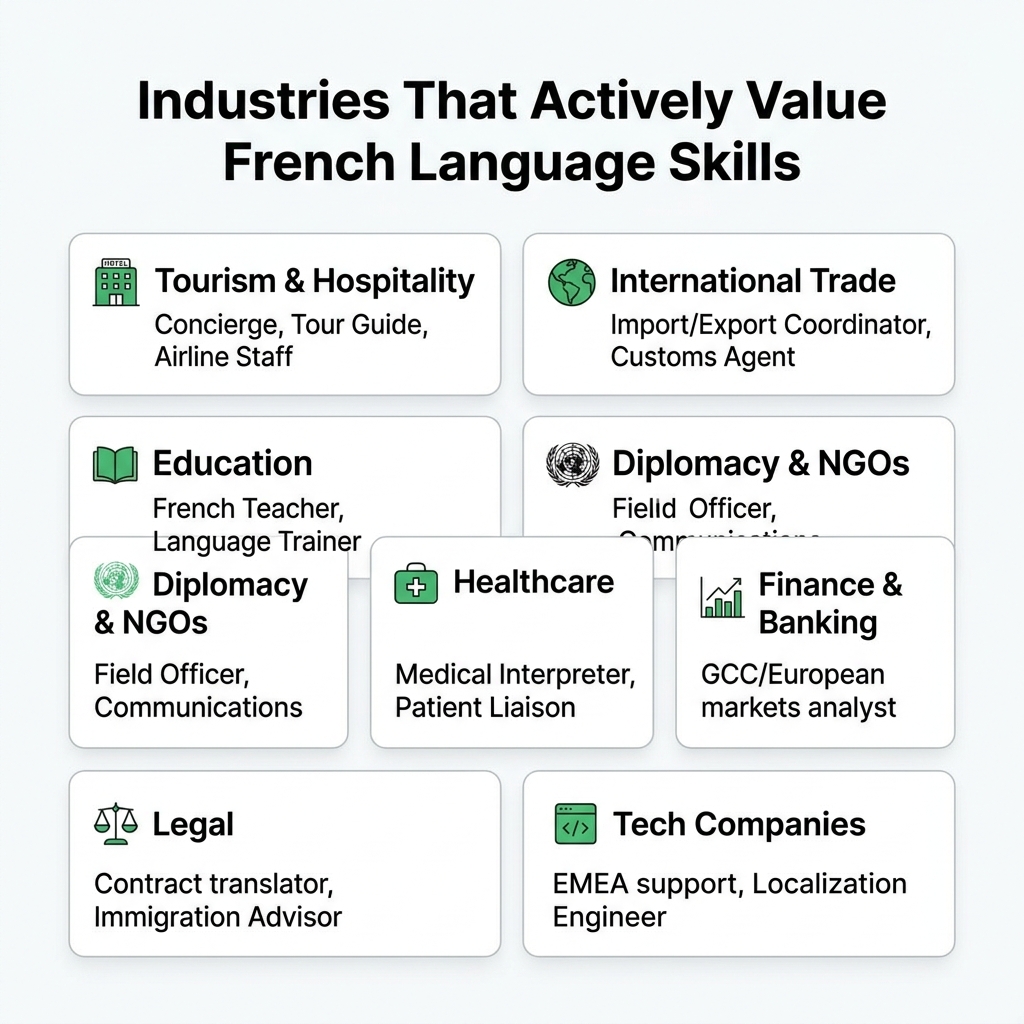 \n
\n 1. Tourism and Hospitality
\n\nFrench tourists are among the highest-spending international travelers. Luxury hotels in Dubai, Qatar, Morocco, and Egypt specifically recruit front desk staff, concierges, and tour coordinators with verified B2+ French. Salary differentials of 10% to 15% above non-French-speaking equivalents are common in five-star properties.
\n\n2. International Trade and Logistics
\n\nWest and Central Africa — francophone economies including Côte d'Ivoire, Senegal, Cameroon, and the Democratic Republic of Congo — represent a combined GDP exceeding $600 billion. Import/export coordinators, customs documentation specialists, and procurement officers with French proficiency command premium positioning in companies trading with these markets.
\n\n3. Education and Language Training
\n\nPrivate language schools, international schools following French or bilingual curricula, and corporate training companies hire French teachers and classroom assistants year-round. Many positions require documented proof of B2 minimum, with preference for C1. Without a certificate, you are competing on a verbal claim against candidates who have one.
\n\n4. Diplomacy, UN, and NGOs
\n\nThe United Nations Secretariat uses French as one of its 6 official languages. Field officer positions for organizations like UNHCR, WHO, and UNICEF that operate across francophone Sub-Saharan Africa or the Maghreb explicitly require professional working proficiency in French. A documented C1 or C2 level is standard for competitive applications.
\n\n5. Healthcare and Medical Interpretation
\n\nHospitals and clinics serving French-speaking expatriate communities hire bilingual patient liaisons and medical interpreters. These roles carry direct patient care responsibility — employers require documented language competence, not self-reported fluency. A CEFR certificate gives a hiring manager a concrete reference point.
\n\nWhy a Certificate Beats "Conversational" on Your CV
\n\nThe problem with language self-ratings on CVs is that they mean different things to different people. One candidate writes "Intermediate French" and means they can hold a 10-minute casual conversation. Another writes the same thing and means they can draft a business proposal. Recruiters have no way to calibrate the difference.
\n\nA certificate from a standardized assessment eliminates that ambiguity. It states a specific level — B1, B2, C1 — against an internationally recognized scale. The recruiter knows exactly what they are reading.
\n\nThe Cubbbix French Assessment gives you a CEFR-aligned score across grammar, vocabulary, and reading comprehension in under 10 minutes. The free result shows your level. The $9.99 certificate gives you a verifiable PDF — with a unique certification ID — that you can attach to a job application, add to your LinkedIn profile under "Licences & Certifications," or include in an email to a recruiter.
\n\nHow to Take the Test and Use the Result
\n\n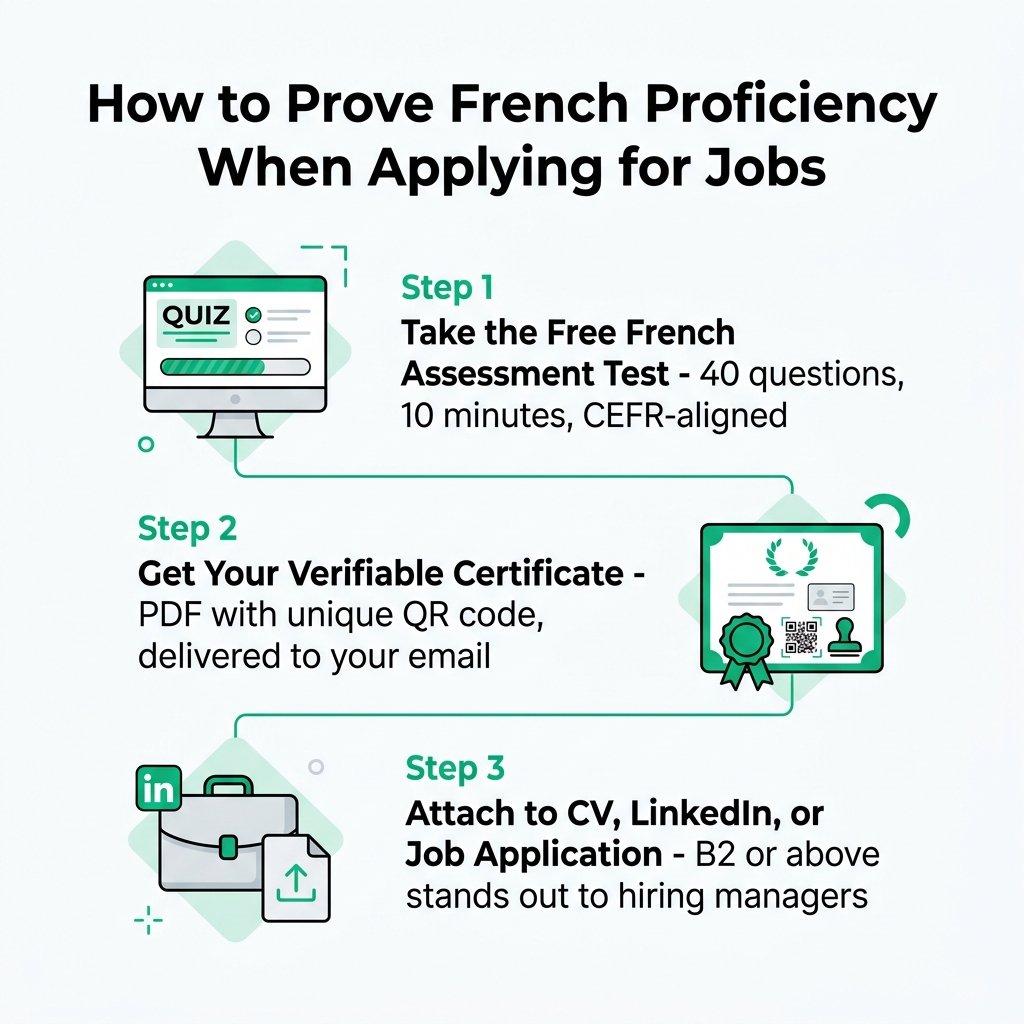 \n
\n Step 1: Take the free assessment
\n\nThe French Assessment Test has 40 questions timed at 12 seconds each. It covers grammar, vocabulary, and reading comprehension across A1 through C1 difficulty bands. You cannot look anything up — the timer enforces natural recall. Complete it in a quiet place, treat it as a real test, and you get an accurate read of your current level.
\n\nStep 2: Get the verifiable certificate
\n\nAfter the assessment, you see your CEFR level and score immediately. If you want something you can submit to a recruiter, the $9.99 certificate option generates a PDF with your name, your exact score, your CEFR level, a unique certification ID, and the assessment date. It gets emailed to you directly. No waiting, no scheduling, no test center.
\n\nStep 3: Attach it the right way
\n\nA PDF certificate gets attached as a supporting document — not embedded in the CV body. In your CV's Languages section, write the specific level: "French — B2 (CEFR-aligned, Cubbbix Assessment, 2026)." In the cover letter or application portal, mention it once: "I have attached a CEFR-aligned French proficiency certificate for reference."
\n\nOn LinkedIn, add it under Licenses & Certifications with the issue date and the certification ID. Recruiters searching for French-speaking candidates can then see a documented credential rather than a freeform text claim.
\n\nShould You Attach a Raw Score Report or CSV?
\n\nIn most cases, no. Raw data files are not standard hiring documents. A recruiter or ATS system receiving a CSV attachment from an unknown source will likely ignore it or flag it. The certificate PDF is designed for professional submission — it is clean, named, formatted, and carries enough identifying information to be credible without requiring the recipient to interpret raw data.
\n\nThe one exception is if the employer specifically requests a detailed language assessment report as part of their application process. In that case, the Cubbbix detailed score report (included in the $9.99 purchase) breaks down performance by grammar, vocabulary, and reading subsections — giving a hiring team or language trainer the full breakdown they need.
\n\nWhat the Cubbbix Certificate Cannot Do
\n\nThe Cubbbix assessment is not a government-accredited exam. If you are applying for Canadian permanent residence under the Express Entry system, French language proficiency must be documented through TEF Canada or TCF Canada — official exams administered at approved test centers under proctored conditions. The same applies to French university admissions requiring DELF or DALF certification.
\n\nFor those official contexts, the Cubbbix assessment is useful as a diagnostic before you book a formal exam. It tells you where you currently stand and where the gaps are, so you can target your preparation rather than booking a $200 exam and discovering your level on the day.
\n\nFind Out Your French Level in 10 Minutes
\n40 questions. 12-second timer. CEFR-aligned results. Free to take. The certificate is $9.99 and delivers instantly to your inbox — ready to attach to your next application.
\n \n Start the Free French Assessment\n \n

Was this article helpful?
Comments
Loading comments...