The Developer's Caveat: Are You an Imposter or Just Overconfident?

TL;DR
Why do junior developers break production while seniors fear they know nothing? We explore the psychology behind the Dunning-Kruger effect and Imposter Syndrome.
Table of Contents
Every developer has felt it. That sinking feeling when you look at a senior engineer's code and think, "I have no idea what I'm doing." Or conversely, that rush of absolute certainty when you push a "quick fix" to production—only to bring the entire site down 5 minutes later.
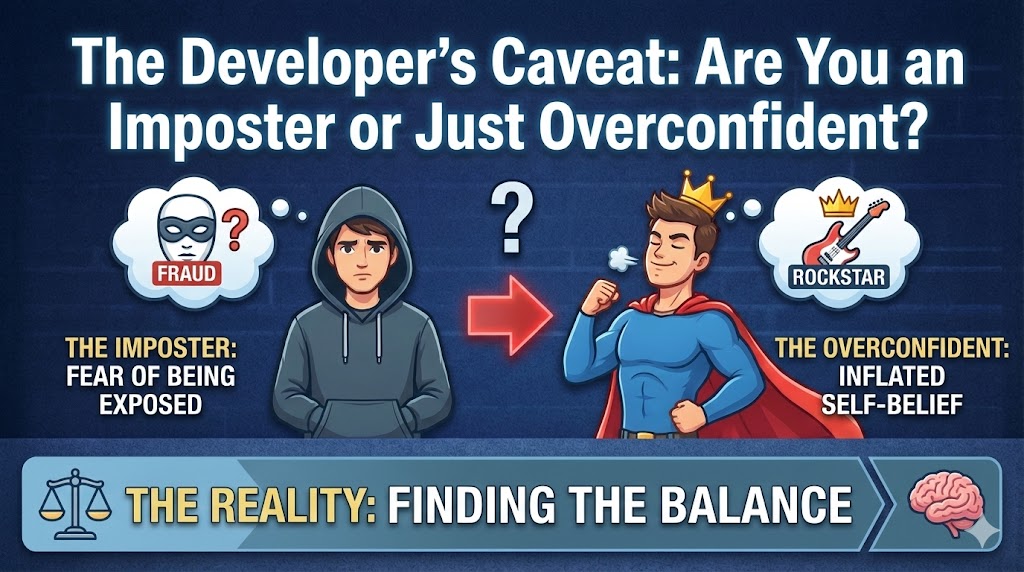
These aren't just mood swings. They are psychological phenomena that define our careers: Imposter Syndrome and the Dunning-Kruger Effect.
But here is the scary part: You probably don't know which one you are suffering from right now. Are you actually incompetent and unaware of it? Or are you highly skilled but paralyzed by doubt? We built the Developer Reality Check to help you find out.
The Peak of "Mount Stupid"
The Dunning-Kruger effect is a cognitive bias where people with low ability at a task overestimate their ability. In coding terms, this is the "Junior Developer Phase."
Symptoms of Dunning-Kruger
- You think "This ticket will only take 1 hour." (It takes 3 days).
- You copy-paste StackOverflow code without reading it.
- You argue about linting rules instead of architecture.
It feels great to be here. Ignorance is bliss. But this is where dangerous bugs are born.
The Valley of Despair (Imposter Syndrome)
As you learn more, you realize how much you don't know. This is the "Mid-Senior Crisis." You know C++, but you don't know Rust. You know React, but you don't know Svelte.
You start to feel like a fraud. You assume everyone else is a genius who reads documentation for fun on weekends.
Symptoms of Imposter Syndrome
- You are afraid to ask questions because you think you "should" know the answer.
- You attribute your success to "luck".
- You over-engineer solutions to prove your worth.
How to Find Your Place
The only way to break out of this cycle is calibration. You need to measure your confidence against your actual competence.
That's why we built a test. It asks you technical questions, but with a twist: you have to rate your confidence before you answer.
- High Confidence + Low Score = Dunning-Kruger. You need to humble yourself and read the docs.
- Low Confidence + High Score = Imposter Syndrome. You are better than you think. Trust your gut.

Was this article helpful?
Comments
Loading comments...