The Ultimate Xbox Console Timeline (2001–2026): Every Generation Explained

TL;DR
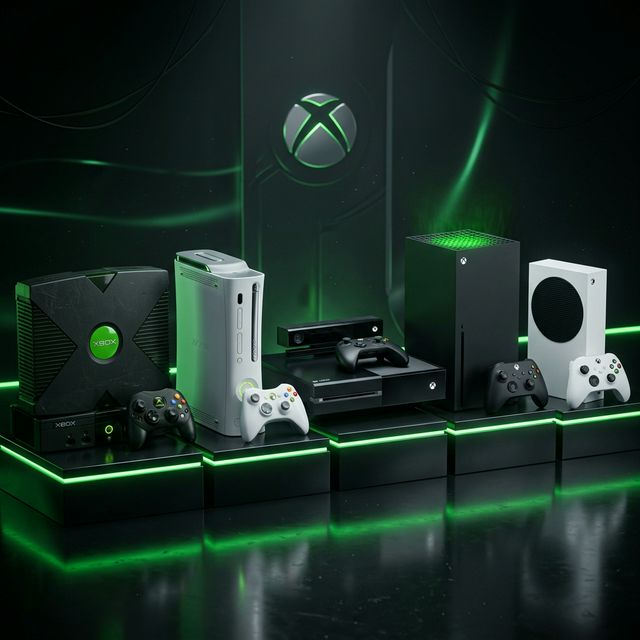
From the bulky original black-and-green "Duke" to the monolithic Series X, we explore the complete 25-year history of Xbox consoles, their cultural impact, and which modern console is right for you today.
Table of Contents
It is hard to imagine a time when Microsoft was not a titan of the living room. Before "Halo" was a household name, before Xbox Live revolutionized online multiplayer, and before Game Pass reshaped how we consume media, Xbox was just a wild, expensive gamble by a PC software company. This is the story of how an underdog project internally code-named "DirectX Box" fought its way into a market dominated by Nintendo and Sony, reshaping the gaming industry forever.
In this comprehensive 25-year retrospective, we will cover every major console release, the defining games of each era, and the technological leaps that brought us from chunky composite cables to stunning 4K 120Hz ray-traced masterpieces.
If you are looking to jump into the modern Xbox ecosystem today or upgrade your existing setup, we have also broken down the latest current-generation offerings at the end of this article, complete with up-to-date buying recommendations.
Generation 1: The Original Xbox (2001)
The year was 2001. Sony's PlayStation 2 was an unstoppable juggernaut, completely dominating the global market. Nintendo had just released the GameCube, securing the family-friendly demographic. Enter Microsoft, walking onto the stage with a massive, heavy, imposing black plastic box adorned with a glowing green jewel.
The "DirectX Box" Gamble
The original Xbox was spearheaded by Microsoft's DirectX team (including Seamus Blackley). They recognized that PCs were advancing faster than traditional, custom-silicon consoles. Their pitch to Bill Gates was audacious: build a console using standard PC parts. It featured a custom 733 MHz Intel Pentium III processor and a 233 MHz Nvidia NV2A GPU—specs that blew both the PS2 and GameCube out of the water.
Unprecedented Hardware Innovations
- Built-in Hard Drive: It was the first console to feature an internal 8GB HDD, eliminating the immediate need for expensive memory cards.
- Broadband Ready: While PS2 relied on dial-up adapters, Xbox included an Ethernet port right out of the box, betting entirely on broadband.
- Dolby Digital: Integrated real-time 5.1 Dolby Digital surround sound.
Halo: The Killer App
Hardware means nothing without software. Bungie's Halo: Combat Evolved launched alongside the system and single-handedly justified its existence. It proved that first-person shooters could work—and thrive—on a console controller, thanks to its brilliant implementation of dual-stick controls and aim assist.
The Birth of Xbox Live (2002)
A year after launch, Microsoft activated the console's Ethernet port with Xbox Live. It was a revelation: a unified friends list, voice chat via headsets, and seamless matchmaking. Games like Halo 2 and MechAssault turned the service into a cultural phenomenon, laying the definitive groundwork for all future online gaming.
Generation 2: Xbox 360 (2005)
If the original Xbox was Microsoft establishing a beachhead, the Xbox 360 was the full-scale invasion. Beating Sony's PS3 to market by a full year, the Xbox 360 capitalized on high-definition gaming and robust online infrastructure to steal the hardcore gaming crown.
High Definition Hits the Mainstream
The Xbox 360 promised "the HD era." Armed with a triple-core IBM PowerPC processor and a unified shader architecture GPU by ATI (now AMD), games like Gears of War, Mass Effect, and BioShock delivered unprecedented visual fidelity. The console normalized 720p and 1080p resolutions just as flat-screen HDTVs were entering living rooms.
Achievements and the Dashboard
Microsoft introduced the "Gamerscore" system. Achievements completely changed player psychology; suddenly, completing arbitrary tasks within a game carried social capital. The dashboard itself evolved multiple times—from the "Blades" interface to the NXE (New Xbox Experience), setting the standard for continuously updated console operating systems.
The Red Ring of Death (RROD)
The 360's legacy was almost destroyed by a catastrophic hardware failure rate caused by thermal stress and lead-free solder cracking. The console would flash three red lights and die. Microsoft's response—a $1.15 billion extended warranty program—saved the brand, eventually leading to reliable hardware revisions.
Notable Hardware Revisions
- Xbox 360 Elite (2007): Brought a sleek black finish, a larger 120GB hard drive, and crucially, an HDMI port.
- Xbox 360 S "Slim" (2010): Fixed the RROD permanently with a massive internal redesign, built-in Wi-Fi, and a dedicated Kinect port.
- Xbox 360 E (2013): A final visual update to align the console’s looks with the upcoming Xbox One.
Generation 3: Xbox One (2013)
The story of the Xbox One is a tale of hubris, pivot, and eventual course-correction. Riding the massive success of the 360, Microsoft initially positioned the Xbox One not just as a gaming console, but as the ultimate "all-in-one" media hub for the living room (hence the name).
A Rocky Launch and "TV, TV, TV"
The 2013 reveal focused heavily on cable box integration, sports, and the bundled Kinect 2.0 camera. Gamers were alienated by higher pricing ($499 vs PS4's $399) and restrictive mixed messaging regarding always-online requirements and DRM policies. Sony's PlayStation 4 capitalized on these missteps immediately.
The Phil Spencer Era & Game Pass
After a leadership change assigned Phil Spencer as head of Xbox, the company radically shifted philosophy. They unbundled the Kinect, lowered the price, and shifted total focus back to games. This era gave birth to two of the most important innovations in modern gaming:
- Backwards Compatibility: A dedicated software team engineered brilliant emulators allowing hundreds of original Xbox and 360 games to play on the One natively.
- Xbox Game Pass (2017): Often called the "Netflix of Games," this subscription service offered a massive library of downloadable games for a flat fee, completely disrupting the retail software industry.
The Console Revisions That Saved the Gen
Xbox One S (2016)
A beautiful, compact redesign that shrank the original bulky "VCR" form factor by 40%. It abandoned the external power brick, added a 4K Ultra HD Blu-ray drive, and supported HDR gaming.
Xbox One X (2017)
Billed as "the world's most powerful console," the One X packed a staggering 6 Teraflops of GPU power. It allowed existing games to run at native 4K resolution, effectively bridging the gap to the next tier of computing and regaining hardware supremacy.
Generation 4: Xbox Series X and Series S (2020)
Learning from past mistakes, Microsoft approached the ninth console generation with a two-pronged strategy. Released during the height of the 2020 global pandemic, the "Series" machines prioritized raw performance, solid-state speeds, and the ultimate Game Pass ecosystem.
The SSD Revolution
The defining characteristic of this generation wasn't just graphical fidelity; it was speed. Switching from mechanical hard drives to custom NVMe SSDs functionally eliminated loading screens. The Quick Resume feature allowed players to suspend multiple games in memory and swap between them in seconds.
These machines utilize custom Zen 2 CPUs and RDNA 2 GPUs from AMD, supporting hardware-accelerated ray tracing, 120 FPS frame rates, and Variable Refresh Rate (VRR).
The Current Lineup: Which Should You Buy?
If you are looking to upgrade today, Microsoft offers distinct tiers depending on your budget and display setup. Here are our top recommendations for the current generation.
1. Xbox Series X (1TB)
The Ultimate 4K Powerhouse flagship
The Series X is designed for uncompromising performance. Boasting 12 Teraflops of graphical muscle, it is built to play games at true 4K resolution up to 120 frames per second. It includes a physical disc drive (crucial for physical media collectors or backwards compatibility). If you own a high-end 4K OLED TV, this is the machine you need.
Check Price on Amazon2. Xbox Series S (1TB Carbon Black)
The Sweet Spot for Digital Gamers
The Series S is the smallest Xbox ever made. It targets 1080p and 1440p resolutions instead of 4K, making it incredibly cost-effective. It lacks a disc drive completely. The newer "Carbon Black" edition doubles the internal storage to 1TB, solving the biggest problem of the original white model. It is the perfect entry point for Game Pass.
Check Price on Amazon3. Xbox Elite Wireless Controller Series 2
The Premium Accessory Upgrade
If you already own a console, the best upgrade you can make isn't another box—it's your controller. The Elite Series 2 features adjustable-tension thumbsticks, wrap-around rubberized grips, and shorter hair trigger locks. It brings an unparalleled level of precision to competitive shooters and racers.
Check Price on AmazonThe Ecosystem Future: Beyond the Box (2026 and Beyond)
As we look toward the future, the definition of an "Xbox" is changing. Microsoft's strategy has pivoted from selling pure hardware boxes to bringing the Xbox ecosystem to every screen available.
With Xbox Cloud Gaming natively integrated into modern Samsung TVs, Amazon Fire Sticks, and mobile devices, the barrier to entry has never been lower. Microsoft’s recent massive studio acquisitions (including Bethesda and Activision Blizzard) ensure that the software pipeline will remain flush with industry-defining titles for decades to come.
Whether you are playing "Halo 6" natively on a 12-teraflop monolith or streaming the newest "Call of Duty" over 5G to your tablet, the spirit of that original, bulky black-and-green box from 2001 lives on. The hardware may evolve, but the directive remains the same: play everywhere.

Was this article helpful?
Comments
Loading comments...