AI Regulation News October 2026: The August Reckoning, US Preemption Battle, and 15 Countries Update


TL;DR
Comprehensive October 2026 analysis of global AI regulation: the EU AI Act August 2 compliance reckoning, the high-stakes US federal preemption battle, technical auditing mandates, and regulatory updates across 15 nations.
Table of Contents
Executive Briefing: Global AI Regulation Landscape (October 2026)
October 2026 marks a defining inflection point in international artificial intelligence governance. Following the immediate enforcement of General Purpose AI (GPAI) provisions under the European Union AI Act on August 2, 2026, corporate legal teams encountered simultaneous regulatory updates across North America, Europe, Asia-Pacific, Latin America, and the Middle East in October 2026. Meanwhile, Washington DC has become the epicenter of a high-stakes legislative battle over federal preemption of state-level AI safety statutes.
Governments transitioned from drafting voluntary ethical guidelines to enforcing hard statutory penalties in late 2026. This policy evolution creates distinct legal requirements for frontier foundation model developers and downstream enterprise integrators. Companies operating internationally must now navigate divergent requirements for algorithmic auditing, synthetic media watermarking, model weight security, and sovereign compute localization.
The August 2, 2026 EU AI Act Reckoning
The European Union AI Act (Regulation EU 2024/1689) reached its most significant enforcement milestone on August 2, 2026. While prohibited AI practices were banned in February 2025, August 2 marks the official binding deadline for Chapter V rules governing General Purpose AI (GPAI) models. Foundation model providers placing models on the European market must demonstrate full compliance with transparency, copyright, and risk management mandates.
Figure 1: European AI Office compliance monitors tracking General Purpose AI (GPAI) model audits in Brussels following the August 2, 2026 enforcement deadline.
Under the August 2 rules, all GPAI model providers must maintain detailed technical documentation describing model architecture, training data composition, and energy consumption metrics. Crucially, model creators must publish comprehensive summaries of the data used to train their models and demonstrate compliance with EU copyright law under Article 53, including opt-out mechanisms reserved by rights holders under Directive (EU) 2019/790.
For models evaluated as presenting systemic risks—defined under Article 51 by a cumulative compute threshold exceeding 10^25 floating-point operations (FLOPs)—the requirements expand significantly. Systemic risk model developers must perform mandatory adversarial testing (red-teaming), document and report serious incidents to the European AI Office, ensure advanced cybersecurity protections for model weights, and submit regular risk assessment evaluations.
The European AI Office in Brussels, established under the European Commission, leads enforcement alongside national competent authorities. Technical audit teams inspect model documentation, review training logs, and evaluate red-teaming reports. Failure to comply exposes providers to severe financial sanctions scaled to global corporate revenues.
EU AI Act Penalties taking effect in 2026
- Non-compliance with GPAI obligations (Article 53 & 55): Fines up to €15 million or 3% of total worldwide annual turnover, whichever is higher.
- Supply of incorrect or misleading information to regulators: Fines up to €7.5 million or 1.5% of total worldwide annual turnover.
- Violations of prohibited AI practices (Article 5): Fines up to €35 million or 7% of total worldwide annual turnover.
The US Preemption Battle: Washington DC vs. State Lawmakers
In the United States, October 2026 is defined by intense debate over federal preemption. As state legislatures in California, Colorado, Utah, and Washington enacted distinct AI safety, discrimination, and transparency statutes, technology industry coalitions pushed Congress to establish a single, preemptive federal framework.
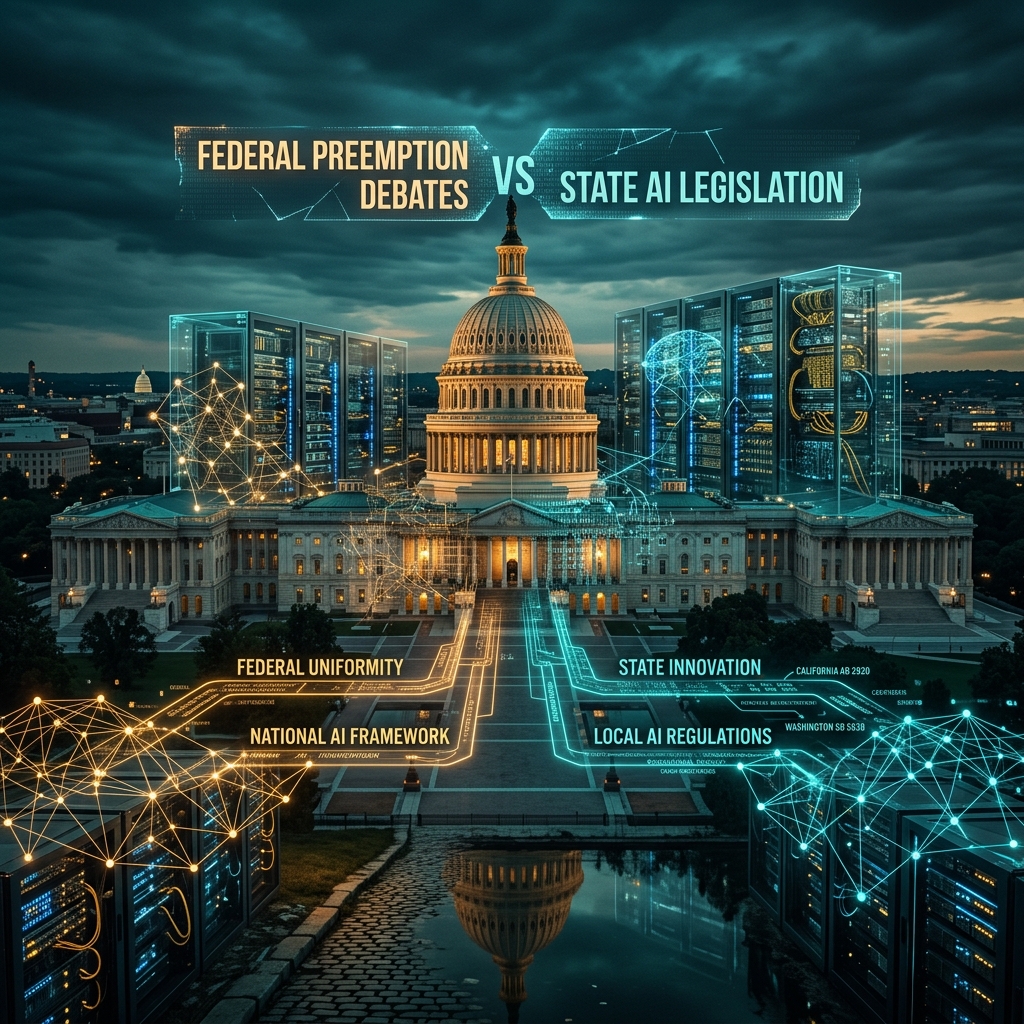
Figure 2: Conceptual representation of the legislative struggle between federal uniformity proposals on Capitol Hill and state-level AI safety mandates.
The central battle lines in Washington center on proposed preemption clauses within federal AI safety legislation. Proponents argue that a patchwork of 50 different state laws creates unsustainable compliance burdens for startups and enterprises alike. Opponents, including state attorneys general and consumer advocacy groups, counter that federal preemption would dilute critical consumer protections established by states.
California remains the epicenter of state-level regulation. Following refined iterations of California SB 1047 and companion bills AB 2013 and AB 2655, California law requires foundation model developers spending over $100 million on model training to implement documented safety protocols, conduct independent cybersecurity evaluations, and provide clear reporting pathways for internal whistleblowers. Meanwhile, Colorado's SB 205 (enacted with 2026 enforcement provisions) imposes mandatory algorithmic discrimination assessments on developers and deployers of high-risk AI systems used in employment, housing, healthcare, and financial services.
The legal clash centers on Commerce Clause authority versus state police powers. If federal preemption provisions pass Congress, state statutes requiring state-specific safety audits and civil liability mechanisms would be nullified. Conversely, if preemption fails, multi-state enterprises must build localized compliance layers tailored to individual state thresholds.
Global AI Regulation Tracker: 15 Key Countries Update
Beyond the European Union and the United States, national regulatory frameworks across 15 key countries accelerated in October 2026. The following global update outlines the legal status, primary enforcement bodies, and technical obligations currently active across major economies:

Figure 3: Global AI regulation tracking network monitoring compliance status across 15 national jurisdictions in late 2026.
1 European Union
Chapter V GPAI model rules active as of August 2, 2026. The European AI Office in Brussels has expanded its technical audit staff to 140 specialists, focusing initial enforcement reviews on foundation models exceeding 10^25 FLOPs and AI systems deployed in critical infrastructure and public administration.
2 United States
Federal preemption bill introduced in Congress to override state AI statutes. Simultaneously, the FTC and DOJ maintain active antitrust and consumer protection investigations regarding exclusive model licensing, compute bundling, and deceptive synthetic content generation.
3 United Kingdom
The UK Government updated its statutory footing for the AI Safety Institute under the 2026 Digital Security and AI Bill. Moving beyond voluntary testing agreements, the law mandates pre-deployment safety evaluations for frontier models trained within UK data centers.
4 Japan
Japan's Ministry of Economy, Trade and Industry (METI) published revised AI Governance Guidelines. Tokyo District Court rulings clarified AI copyright boundaries, requiring explicit license verification when commercial models train on protected Japanese media catalogs.
5 China
The Cyberspace Administration of China (CAC) expanded its mandatory Generative AI Algorithm Filing registry. October 2026 directives mandate real-time cryptographic watermarking for all public-facing text, image, and voice synthesis algorithms operating in China.
6 India
The Ministry of Electronics and Information Technology (MeitY) issued updated advisories under the IT Rules and Digital India Act framework. Platforms deploying AI models must label synthetic media and ensure algorithms do not violate constitutional bias prohibitions.
7 Brazil
Brazil's Senate passed pivotal amendments to Bill 2338/2023. The law establishes strict civil liability for developers of high-risk automated decision systems and creates a centralized Brazilian AI Supervisory Authority with statutory fine powers.
8 United Arab Emirates
The UAE Council for Artificial Intelligence expanded the Dubai AI & Web3 Campus regulatory sandbox. New guidelines govern autonomous agent execution in financial transactions and mandate localized data residency for public sector AI deployments.
9 Singapore
The Infocomm Media Development Authority (IMDA) launched AI Verify 2.0. The updated open-source testing toolkit incorporates specialized evaluation suites for large language model hallucination rates, jailbreak vulnerability, and red-teaming compliance.
10 Canada
Innovation, Science and Economic Development Canada (ISED) finalized technical compliance standards under the Artificial Intelligence and Data Act (AIDA). High-impact systems must complete independent bias and safety audits before public commercial release.
11 Australia
The Department of Industry, Science and Resources announced mandatory AI Guardrails for high-risk applications in healthcare, banking, and recruitment, supported by updated Australian Privacy Principle enforcement.
12 South Korea
South Korea's National Assembly enacted the Basic Act on AI Promotion and Safety. The law mandates technical reliability checks for generative AI services and mandates clear labels on synthetic content to prevent deepfake manipulation.
13 Saudi Arabia
The Saudi Data and AI Authority (SDAIA) published comprehensive sovereign AI cloud standards. International vendors supplying AI cloud infrastructure must maintain domestic data processing centers within the Kingdom.
14 Switzerland
The Swiss Federal Council issued its position paper on AI regulation, aligning national standards with the Council of Europe Framework Convention on Artificial Intelligence while maintaining Swiss business neutrality.
15 Nigeria
The National Information Technology Development Agency (NITDA) released Nigeria's National AI Strategy regulatory sandbox, establishing operational guidelines for automated credit scoring and health diagnostic models.
Summary Comparison of Global AI Legal Frameworks
| Country / Region | Primary Legislation / Instrument | Key Regulatory Body | Maximum Non-Compliance Fine | Enforcement Date |
|---|---|---|---|---|
| European Union | EU AI Act (Regulation 2024/1689) | European AI Office / National DPAs | €35M or 7% global annual turnover | August 2, 2026 (GPAI rules) |
| United States (State level) | California SB 1047 / Colorado SB 205 | State Attorneys General / Civil Courts | Up to $10,000 per violation / Civil remedies | Enacted / 2026 Phased Enforcement |
| United Kingdom | Digital Security and AI Bill 2026 | UK AI Safety Institute / Ofcom | Up to £18M or 10% global turnover | October 2026 Statutory Mandate |
| China | Generative AI Measures & Filing Rules | Cyberspace Administration of China (CAC) | RMB 100,000 + Operational Suspension | Active (Updated October 2026) |
| Brazil | Bill 2338/2023 (AI Legal Framework) | Brazilian AI Supervisory Authority | R$ 50M per violation or 2% turnover | Passed Senate / 2026 Rollout |
| Singapore | AI Verify Framework & Governance Code | Infocomm Media Development Authority (IMDA) | Sandbox Compliance / PDPC Fines | Active (Version 2.0 October 2026) |
Technical Auditing and Algorithmic Red-Teaming Mandates
A notable change in late-2026 regulations is the shift toward mandatory technical auditing. Regulatory frameworks no longer accept self-written corporate policy statements as sufficient proof of compliance. Instead, engineering teams must provide verifiable empirical proof of model behavior, safety guardrails, and data lineage.

Figure 4: Automated technical auditing pipeline verifying model robustness, synthetic data provenance watermarks, and bias mitigation metrics.
Compliance across major jurisdictions now requires four standardized technical auditing pillars:
- C2PA Provenance and Watermarking: Regulators in the EU, China, South Korea, and California require synthetic audio, video, and image content to embed invisible, cryptographically verifiable Coalition for Content Provenance and Authenticity (C2PA) metadata headers. Software pipelines must validate these manifests before serving generated assets to consumers.
- Independent Red-Teaming Protocols: Foundation model developers must submit third-party adversarial attack logs detailing model resistance against prompt injection, dangerous chemical/biological knowledge extraction, and automated cyber-offense capabilities.
- Algorithmic Discrimination Testing: Enterprise deployments in employment and financial scoring must run continuous statistical parity audits, documenting disparate impact ratios across protected demographic groups using the standard four-fifths (80%) rule threshold.
- Model Weight Security Standards: Organizations handling frontier model weights must demonstrate physical and digital air-gapping, hardware security module (HSM) key storage, and strict role-based access controls to prevent weight exfiltration by unauthorized entities.
Third-party auditing firms must certify model compliance before enterprise commercial launch. These auditors assess training dataset licensing agreements, evaluate automated content filters under high-concurrency stress tests, and verify that alignment guardrails remain stable under complex adversarial prompt injections.
Enterprise Governance Strategy and Boardroom Action Items
For Chief Legal Officers, Chief Information Officers, and AI Engineering leads, the regulatory updates of October 2026 require structural adjustments to enterprise AI deployment pipelines. Legal liability no longer rests solely with base model providers. Downstream companies that fine-tune, prompt-engineer, or integrate foundation models into commercial workflows share statutory responsibilities.

Figure 5: Enterprise AI governance committee conducting real-time risk classification and model audit reviews in an executive board setting.
Leading organizations have adopted five immediate operational action items to establish compliance posture:
- Maintain a Centralized AI Inventory: Document every internal and customer-facing AI model, API endpoint, third-party vendor tool, and automated decision system currently operating across the enterprise.
- Implement Automated Risk Tiering: Classify every AI system into regulatory risk tiers (Prohibited, High-Risk, GPAI, Minimal Risk) based on the EU AI Act and local national legislation.
- Update Vendor Licensing Contracts: Ensure vendor service level agreements (SLAs) contain explicit indemnification clauses, technical audit rights, and data training opt-out confirmations from model providers.
- Establish Human-in-the-Loop Safeguards: Incorporate mandatory human review checkpoints for high-risk automated decisions in hiring, credit approval, medical diagnostics, and legal evaluation.
- Conduct Regular Data Provenance Scans: Verify that internal training sets and fine-tuning corpora do not contain unauthorized copyrighted material or personal data processed without valid legal bases under GDPR or statutory privacy laws.
Enterprise software engineering teams must build continuous integration and continuous deployment (CI/CD) pipelines that incorporate automated compliance testing steps. Every model update or fine-tuning run must pass automated bias, hallucination, and safety checks prior to production deployment, logging execution metadata for future regulatory inspection.
Sovereign AI Infrastructure and Data Localization Shifts
The final key trend highlighted in October 2026 is the rapid rise of sovereign AI policies. Countries increasingly view compute infrastructure and foundation model independence as critical components of national security and economic autonomy.

Figure 6: National sovereign compute cluster facility configured to comply with data localization mandates and regional security frameworks.
Governments in Saudi Arabia, the UAE, Japan, France, and Singapore have allocated billions in public-private capital toward domestic GPU clusters and sovereign foundation models trained exclusively on local languages and culturally aligned datasets. Consequently, data localization mandates have tightened. Enterprise cross-border transfers of sensitive industrial or personal data for off-site AI model training now face strict approval requirements across multiple continents.
Multinational enterprises must design hybrid multi-region cloud architectures to meet sovereign compute mandates. Storing and processing training data within national geographic boundaries ensures compliance with local data localization laws while shielding enterprises from geopolitical trade disruptions.
Frequently Asked Questions (FAQ)
What is the August 2, 2026 enforcement deadline under the EU AI Act?
August 2, 2026 is the official statutory deadline when Chapter V of the EU AI Act takes effect. This chapter imposes binding compliance obligations on providers of General Purpose AI (GPAI) models, requiring technical documentation, copyright law compliance summaries, and specialized systemic risk evaluations for models trained with compute exceeding 10^25 FLOPs.
How does US federal preemption affect state AI laws like California SB 1047?
Federal preemption proposals in Washington DC aim to establish a single national AI regulatory standard that overrides individual state statutes. If enacted with strong preemption clauses, federal law would replace state-specific mandates in California, Colorado, and Utah, creating uniform nationwide rules for foundation model safety and liability.
What are the penalties for non-compliance with global AI regulations in 2026?
Penalties have become severe across major jurisdictions. The EU AI Act enforces fines up to €35 million or 7% of global annual turnover for prohibited AI practices, and up to €15 million or 3% for GPAI model violations. In the UK, Brazil, and individual US states, fines range from 2% to 10% of global turnover or substantial civil damages per violation.
Do downstream companies integrating third-party AI APIs need to comply with AI regulations?
Yes. Downstream enterprise deployers that integrate foundation models via APIs or fine-tune third-party models must comply with deployer obligations. This includes conducting risk assessments, ensuring human oversight for high-risk applications, avoiding discriminatory outcomes in employment or finance, and verifying synthetic content labeling.
What technical standards are required for synthetic content watermarking in 2026?
Most major regulatory authorities, including the EU, China, South Korea, and US state bodies, recognize the Coalition for Content Provenance and Authenticity (C2PA) open standard. Compliant generative AI systems must embed cryptographic metadata and invisible watermarks into generated media to ensure origin traceability and prevent deepfake deception.


Was this article helpful?
Comments
Loading comments...