Business Setup in Dubai: Real Costs, Mainland vs Free Zone, and Step-by-Step Formation

TL;DR
A detailed breakdown of business setup costs in Dubai across Mainland and Free Zones. Compare trade license fees, office space requirements, 9% corporate tax regulations, visa quotas, and bank account approval timelines.
Table of Contents
Executive Cost & Timeline Summary (2026 Baseline)
Starting a business in Dubai centers on one primary architectural choice: selecting between a Free Zone and a Mainland entity under the Dubai Department of Economy and Tourism (DED). Foreign investors own 100% of both company structures under federal commercial law. The right choice depends on where your clients are physically located, whether you trade physical goods within the local UAE market, and your physical office requirements.
Setting up a company in Dubai has shifted from a broker-dominated paper process to an automated digital registration framework. Entrepreneurs can secure a trade license, complete residency visa medical checks, and obtain an establishment card within ten working days.
However, marketing quotes from registration agents routinely omit recurring operational overhead. First-time founders frequently encounter unexpected fees for immigration cards, Ejari tenancy attestations, annual license renewal charges, and corporate tax compliance filings. Knowing the exact cost components before filing paperwork prevents costly restructuring later.
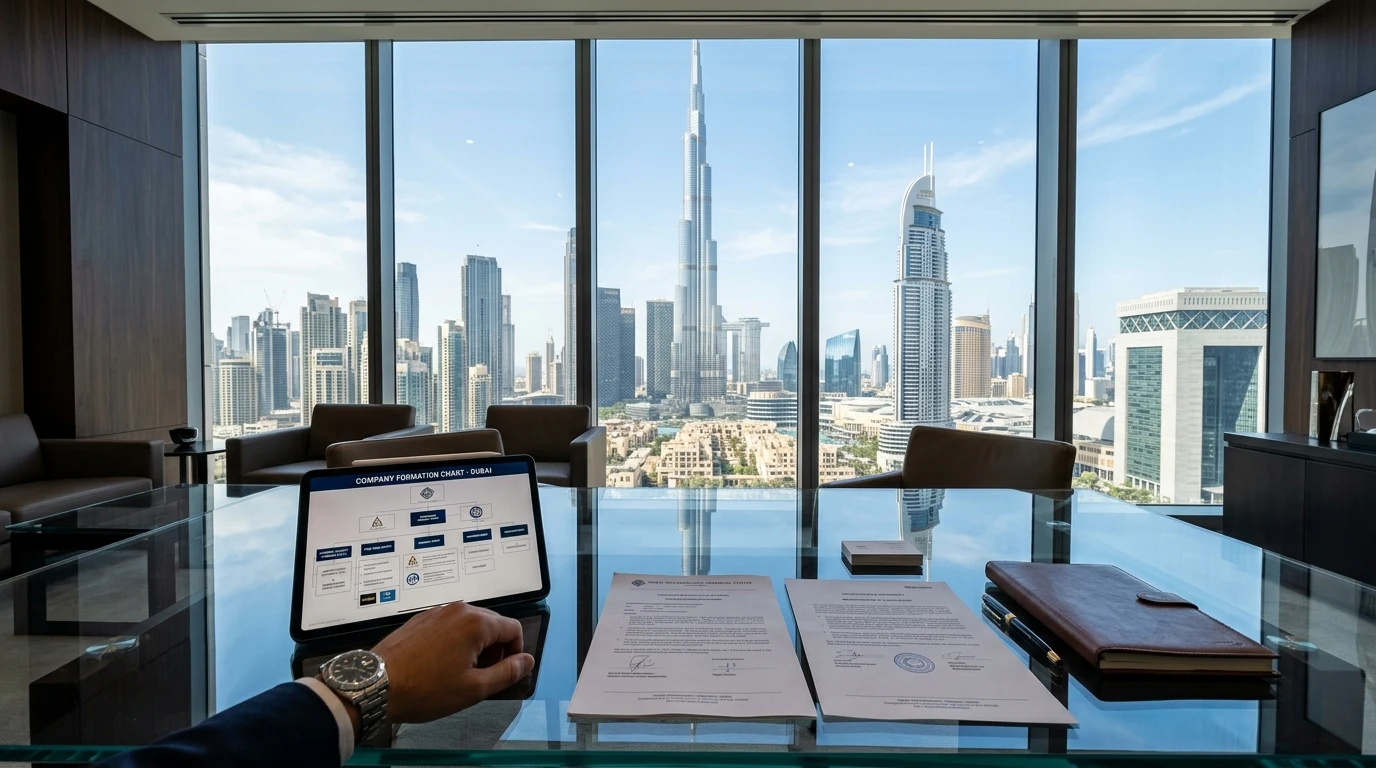
Modern corporate setup in Dubai: choosing the right jurisdiction between Dubai Mainland and Free Zones dictates legal scope, tax treatment, and office space commitments.
Mainland (DED) vs Free Zone: The Core Legal Distinction
Every commercial enterprise registered in Dubai operates under one of two jurisdictions. While marketing agencies advertise both as equivalent, their legal rights and operational boundaries differ significantly under UAE federal commercial law.
| Operational Feature | Dubai Mainland (DED) | Dubai Free Zone (e.g. DMCC, IFZA) |
|---|---|---|
| 100% Foreign Ownership | Yes, for commercial and professional activities under Federal Decree-Law No. 26 of 2020. | Yes, 100% foreign equity ownership standard across all Free Zones. |
| Trading Scope | Unrestricted. Can contract directly with private consumers, UAE government entities, and international clients. | International markets, business-to-business within Free Zones, or via a local commercial distributor on the mainland. |
| Physical Office Requirement | Mandatory physical lease registered with Ejari (minimum 100–140 sq ft for basic visa allocations). | Flexible. Flexi-desk, smart desk, or virtual office solutions allowed for 0–3 visas. |
| Visa Quota Allocation | Determined directly by office square footage (typically 1 visa per 80–100 sq ft of leased space). | Determined by purchased license package tier (e.g., 1-visa, 2-visa, or 5-visa flexi-desk packages). |
| Customs Duties on Goods | Standard 5% customs duty paid at port of entry upon initial import. | 0% customs duty on goods imported, stored, or re-exported through the Free Zone customs boundary. |
| Average Starting Cost | AED 18,500 – AED 35,000+ (license fee + commercial lease + municipal market fee). | AED 12,500 – AED 25,000 (inclusive of registration, shared desk, and initial quota). |
The 100% Foreign Ownership Rule on the Mainland
Prior to June 2021, foreign founders opening a mainland LLC were legally required to assign 51% of company shares to an Emirati local sponsor. The UAE abolished this requirement through amendments to the Federal Commercial Companies Law.
Over 1,000 commercial, professional, and industrial activities now qualify for full 100% foreign equity ownership on the Dubai Mainland. Only activities classified under strategic impact—including defense manufacturing, oil and gas exploration, and specialized security operations—retain local shareholding requirements.
Itemized Cost Breakdown: Trade Licenses, Visas, and Spaces
To calculate your true startup capital requirement, separate your setup budget into three distinct cost buckets: licensing, immigration, and premises.
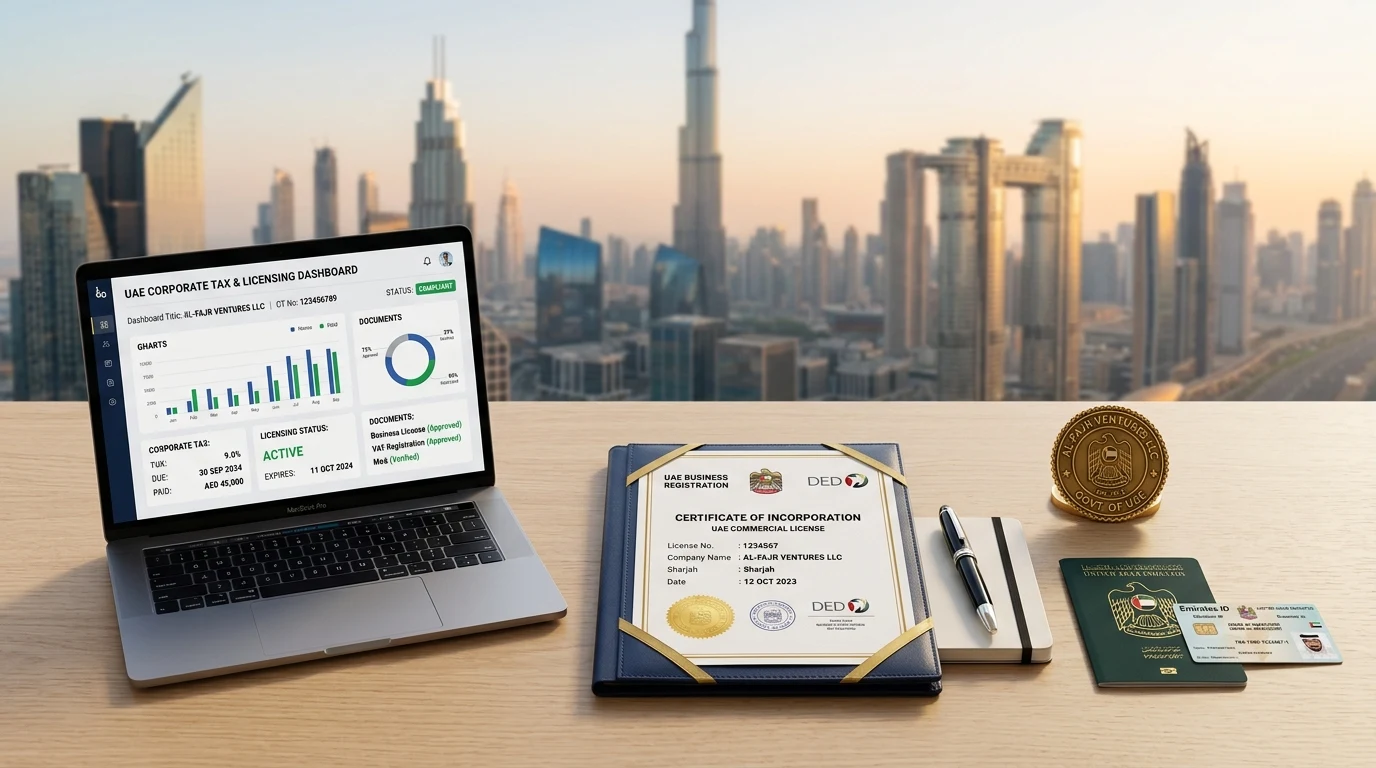
Documentation requirements for Dubai trade license issuance: initial name reservation, memorandum of association, and corporate tax compliance registration.
1 Trade License & Government Fees
- Trade Name Reservation (DED baseline): AED 620
- Initial Approval Certificate: AED 120
- DED Commercial License Issuance: AED 10,000 – AED 15,000
- Free Zone All-in License Package: AED 12,500 – AED 22,000
- Dubai Chamber of Commerce Membership: AED 1,200 – AED 2,200
2 Residency Visa & Emirates ID Costs
- Establishment Card (Immigration): AED 2,000 – AED 2,500
- Entry Permit (Inside country status change): AED 1,100 – AED 1,800
- VIP Medical Fitness Test (Blood & X-ray): AED 750 – AED 850
- Emirates ID Typing & Card (2 Years): AED 370 – AED 450
- Mandatory Health Insurance (Basic essential): AED 950 – AED 1,200
Top Free Zones in Dubai for 2026
Dubai features more than 30 specialized free economic zones. Each jurisdiction focuses on specific industries, pricing tiers, and customs infrastructures.
1. DMCC (Dubai Multi Commodities Centre)
Located in Jumeirah Lakes Towers (JLT). Recognized globally for commodities trading, tech hubs, energy trading, and corporate advisory firms. Setup packages start higher at approximately AED 25,000 to AED 38,000, but the zone offers strong banking credibility and established physical commercial space.
Best for: Financial firms, crypto ventures, commodities brokers, high-end consultancies2. IFZA (International Free Zone Authority)
Based in Dubai Silicon Oasis. IFZA provides accessible, competitive packages for digital marketing, IT services, management consulting, and e-commerce. License packages begin around AED 12,900 for a zero-visa tier, with remote incorporation supported through digital signatures.
Best for: Tech freelancers, digital agencies, remote founders, solopreneurs3. Meydan Free Zone
Situated near Downtown Dubai at the Meydan Grandstand. Meydan offers digital marketplace licenses, allowing founders to combine service, trading, and light commercial activities under a single license framework. Setup packages range between AED 12,500 and AED 20,000.
Best for: E-commerce businesses, cross-border marketing, digital media creators4. DAFZA (Dubai Airport Freezone)
Directly adjacent to Dubai International Airport. Features bonded air cargo facilities, fast customs clearance lanes, and heavy warehousing infrastructure. Setup costs range from AED 30,000 to AED 60,000+.
Best for: International aviation, logistics hubs, pharmaceutical distributionStep-by-Step Dubai Company Formation Guide
Follow this sequential protocol to move from concept to an active trading entity with an active bank account.
1 Activity Selection & NER Activity Matching
Identify the precise commercial activities from the UAE National Economic Register (NER). You can combine up to 10 aligned activities under a single license in most Free Zones. Ensure chosen activities match your intended banking operations.
2 Trade Name Reservation
Submit three trade name options. Rules: no religious terms, no country or city names unless approved, no offensive language, and no abbreviations. Foreign names incur an additional government fee of approximately AED 1,000 on mainland registrations.
3 Initial Approval & Security Screening
The licensing authority submits shareholder passport copies and background records for initial security clearance. Approval takes 24 to 48 hours for standard international passports.
4 MOA Drafting & Digital Notarization
Sign the Memorandum of Association (MOA) and Articles of Association. For Mainland DED entities, signing occurs through Dubai Courts digital notarization system. Free Zones utilize secure internal digital signature portals.
5 Office Lease & Ejari Registration
Mainland companies must finalize an office lease and secure an Ejari certificate registered with the Dubai Land Department. Free Zone entities receive a flexi-desk agreement or lease certificate issued directly by the zone authority.
6 Trade License Issuance & Establishment Card
Pay the final license voucher. Upon issuance, apply immediately for your company Establishment Card through the Federal Authority for Identity, Citizenship, Customs and Port Security (ICP) or GDRFA Dubai to begin visa processing.
7 Residency Visa Processing & Emirates ID
Enter the UAE on an entry permit or perform an in-country status change. Complete the mandatory medical fitness test (blood screening and chest X-ray) and submit biometric data at an ICP center. Physical Emirates ID cards arrive via Emirates Post within 3 to 5 days.
Corporate Tax (9%) and VAT Rules Explained
Under Federal Decree-Law No. 47 of 2022, the UAE enforces a federal corporate tax framework. The policy balances international OECD compliance while keeping the UAE one of the lowest corporate tax regimes globally.
Corporate Tax Rates
- 0% Tax Bracket: Applies to taxable net profit up to AED 375,000 (approx. $102,000 USD) per fiscal year.
- 9% Standard Tax Rate: Applies exclusively to the portion of net taxable profit exceeding AED 375,000.
- Small Business Relief: Entities with annual gross revenue below AED 3,000,000 can elect for Small Business Relief, treating taxable income as zero through tax periods ending on or before December 31, 2026.
VAT & Compliance Filing
- 5% Standard VAT: Value Added Tax applies to taxable supplies of goods and services within the UAE.
- Mandatory VAT Registration: Required when taxable turnover exceeds AED 375,000 over a 12-month period.
- Voluntary VAT Registration: Permitted once taxable turnover exceeds AED 187,500.
- EmaraTax Registration: Every business entity must register for Corporate Tax on the Federal Tax Authority (FTA) portal, even if zero tax is owed. Failure to register incurs a fixed AED 10,000 penalty.
The 0% Free Zone Corporate Tax Condition
Free Zone companies do not automatically receive 0% corporate tax. To maintain Qualifying Free Zone Person (QFZP) status under Cabinet Decision No. 55 of 2023, the entity must: (1) derive income exclusively from Qualifying Activities or transactions with other Free Zone entities, (2) maintain adequate economic substance and physical operating assets in the UAE, (3) prepare annual audited financial statements, and (4) comply with arm length transfer pricing rules. Generating non-qualifying mainland revenue exceeding 5% of total turnover or AED 5,000,000 revokes the 0% benefit for five consecutive years.
Opening a Corporate Bank Account in the UAE
Corporate bank account opening represents the most rigorous step in Dubai company formation. Central Bank compliance guidelines enforce anti-money laundering (AML) and know-your-customer (KYC) documentation for all foreign-owned entities.
Traditional Tier-1 Banks (Emirates NBD, Mashreq, ADCB, FAB)
These institutions provide comprehensive multi-currency corporate banking, trade finance facilities, and dedicated relationship managers. However, account approvals require 4 to 8 weeks. Founders must show verified corporate bank statements from previous businesses, supplier invoices, proof of client contracts, and maintain average monthly balances of AED 50,000 to AED 250,000.
Digital Business Banks (Wio Bank Business, Zand)
Digital corporate platforms licensed by the UAE Central Bank have reduced approval wait times to 48 to 72 hours. Verification takes place through UAE Pass and digital document upload. Wio Bank Business offers accounts with low or zero monthly balance requirements, charging a modest monthly platform fee (AED 99 to AED 249), making it a practical choice for early-stage startups and consultants.
Frequently Asked Questions
Can a foreign national own 100% of a company in Dubai?
Yes. Foreign nationals can own 100% of shares in both Free Zone entities and Dubai Mainland (DED) companies. Under Federal Decree-Law No. 26 of 2020, the historic 51% Emirati local sponsor rule was eliminated for commercial and professional trading licenses.
What is the minimum cost to start a business in Dubai?
The lowest all-inclusive starting cost for an active trade license in Dubai is between AED 12,500 and AED 14,500 (~$3,400 to $3,950 USD). This pricing is available through competitive Free Zones such as IFZA or Meydan for a zero-visa service license with a flexi-desk package. If you require one investor residency visa, the total cost rises to AED 18,500–AED 22,000.
Do I need a physical office space to obtain a trade license?
Mainland DED companies must present an attested Ejari tenancy contract for physical office space or certified business center space. Free Zone companies can use shared coworking desks (flexi-desks) or virtual office agreements provided directly by the zone authority for 0 to 3 visa quotas.
How does corporate tax apply to Dubai startups?
The UAE charges 0% corporate tax on annual net profits up to AED 375,000 (~$102,000 USD). Any taxable net profit above AED 375,000 is taxed at a flat 9%. Businesses with annual gross revenue under AED 3,000,000 can apply for Small Business Relief to maintain zero tax liability through 2026.
How long does the entire business setup and visa process take?
Trade license issuance takes 3 to 7 working days. Following license delivery, completing the Establishment Card, medical screening, biometric Emirates ID registration, and visa stamping takes an additional 5 to 7 working days. Corporate bank account opening takes between 3 days (digital banks) and 4 weeks (traditional commercial banks).


Was this article helpful?
Comments
Loading comments...