Halal Trade AI: How Saudi Arabia, Singapore, and Türkiye Are Rewriting the Rules of Islamic Commerce

TL;DR
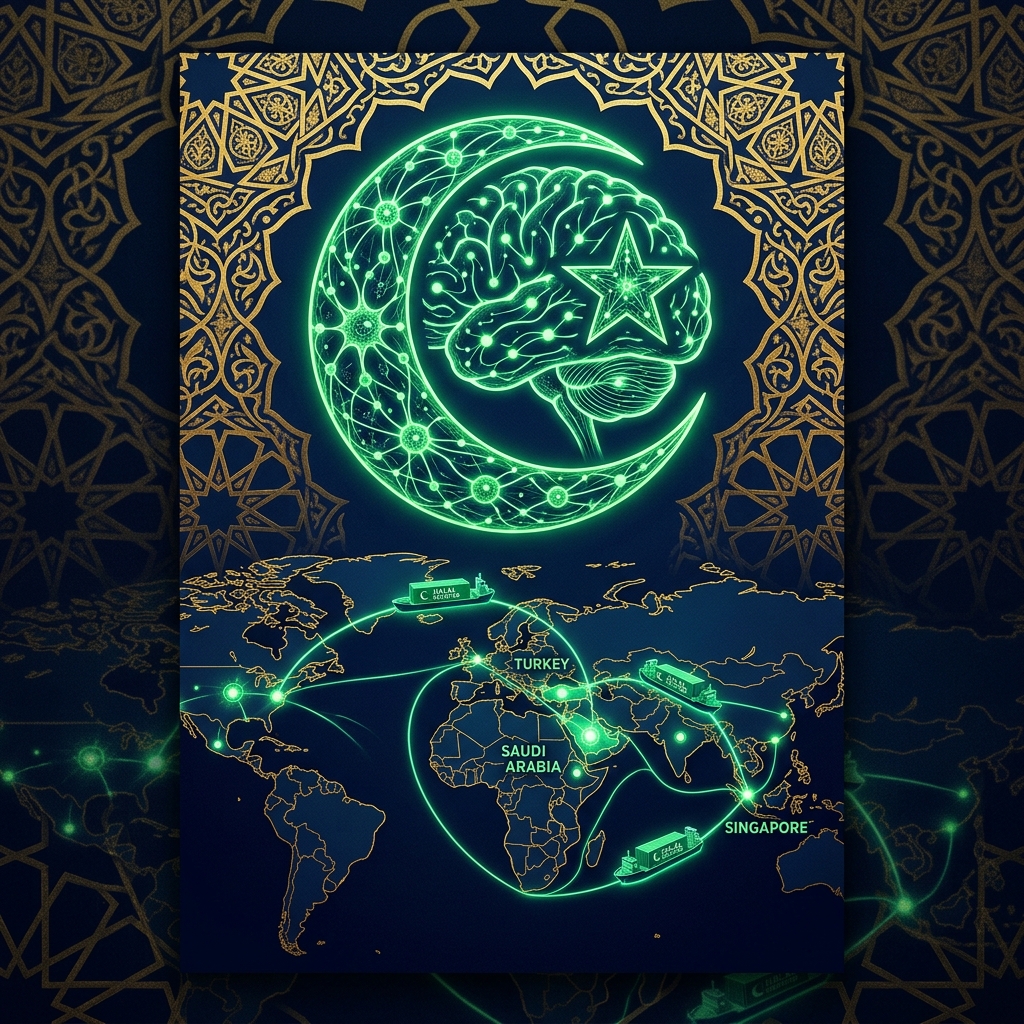
The global halal economy is a $7.7 trillion market — and artificial intelligence is becoming its most powerful accelerator. From Saudi Arabia's Vision 2030 to Singapore's MUIS certification system and Türkiye's halal export ambitions, here's how AI is transforming halal trade for the Islamic world.
Table of Contents
The global halal economy is valued at $7.7 trillion and growing at roughly 9.5% annually. It spans food and beverages, pharmaceuticals, cosmetics, fashion, finance, and travel. For decades, its central challenge was not market size — demand has always been there — but verification: how do you reliably confirm that a product is genuinely halal across a supply chain that may span a dozen countries, hundreds of suppliers, and millions of individual transactions? In 2026, the answer is increasingly: artificial intelligence.
Three countries sit at the intersection of Islamic commerce and technological ambition in ways that are reshaping how the halal economy operates: Saudi Arabia, Singapore, and Türkiye. Each approaches the opportunity differently, from different starting positions, with different regulatory architectures. Together, they illustrate what an AI-powered halal trade system could look like at scale — and what is still missing.
Why halal verification has always been a data problem
Halal compliance is fundamentally an information problem. It is not enough for a product to be halal at the point of sale. It must be halal at every stage: the source ingredients, the processing facility, the packaging materials, the logistics chain, and the storage conditions. A single haram element — even an indirect contaminant in processing — can invalidate certification. Tracing this across global supply chains, with multiple intermediaries and language barriers, using paper-based systems and manual inspection, has been expensive, slow, and prone to fraud.
The scale of documented halal fraud is significant. In 2013, the European horse meat scandal revealed widespread food labeling fraud that extended into halal-certified products. In 2023, Malaysian authorities uncovered a network of fraudulent halal certificates being sold to exporters targeting Middle Eastern markets. The common thread: a verification system that relied on periodic physical audits and paper trails that could be falsified.
This is precisely the problem AI is well suited to solve. Machine learning systems can continuously monitor supply chain data rather than conducting periodic spot checks. Computer vision can inspect production lines in real time for prohibited materials. Blockchain-anchored audit trails can make halal certification records immutable and publicly verifiable. Natural language processing can screen ingredient lists across multiple languages simultaneously. The tools exist. The question is which countries are actually deploying them and how.
Saudi Arabia: the world's largest halal importer goes digital
Saudi Arabia is the world's single largest importer of halal-certified products, driven by a population of 36 million, 2 million Hajj pilgrims annually requiring halal-compliant food services, and one of the highest per-capita food import rates in the world. The Kingdom imports roughly 80% of its food supply — a strategic vulnerability that Vision 2030 is directly addressing by building domestic production capacity and digitizing the entire import and certification infrastructure.

The Saudi Food and Drug Authority (SFDA) has been rolling out a digital halal certification platform that connects importers, manufacturers, and inspection bodies on a unified system. The platform uses AI to cross-reference ingredient declarations against a continuously updated database of halal-permissible and haram substances, flagging potential compliance issues automatically rather than relying entirely on human reviewers to catch them. Shipments that pass automated screening move to expedited clearance; those flagged require enhanced inspection. This has measurably reduced dwell times at Jeddah Islamic Port for compliant shipments.
Under the National Industrial Development and Logistics Program (NIDLP) — a Vision 2030 initiative — Saudi Arabia is building integrated logistics corridors where halal status is tracked digitally from origin to final retail point. The Jeddah Economic City and NEOM's logistics zones are designed with embedded digital certification infrastructure rather than retrofitting paper systems. For halal exporters worldwide, meeting Saudi Arabia's evolving digital standards is no longer optional: it is the price of market access to the world's wealthiest halal consumer base.
Saudi Arabia is also emerging as a halal pharmaceutical hub under Vision 2030, specifically targeting the development of AI-verified halal-compliant medicines — a segment historically underserved because gelatin-based capsules (typically derived from pork) dominate global pharmaceutical packaging. AI systems that can identify substitutable halal-compliant excipients and flag non-compliant formulations during drug development review are attracting investment from both Saudi sovereign funds and international pharmaceutical companies seeking market access.
Singapore: the non-Muslim nation leading halal AI infrastructure
Singapore is a country where Muslims constitute approximately 15% of the population — and yet it is arguably the most sophisticated halal certification ecosystem in the world. The Majlis Ugama Islam Singapura (MUIS), Singapore's Islamic religious authority, operates a halal certification system that has become a global benchmark. Its reputation is so strong that MUIS certification is accepted as a mark of quality not just in Singapore but across much of Southeast Asia, the Gulf, and Oceania.
Singapore's advantage is institutional trust built over decades, combined with the country's broader infrastructure of excellence in trade logistics, regulatory precision, and technology adoption. MUIS has been systematically integrating AI into its certification workflows since the early 2020s. Its HalalHub digital platform connects certified businesses, streamlines renewal applications, and uses data analytics to monitor compliance patterns across the certified ecosystem — identifying establishments whose supply chain data suggests elevated risk before a physical audit is triggered.

Singapore is also positioning itself as the primary halal trade gateway between Southeast Asian producers and Gulf markets. Its free trade agreement network — the most extensive in Asia — combined with its MUIS certification credibility and world-class port infrastructure makes it a natural transshipment and value-adding hub for halal goods. AI-powered provenance tracking systems are being piloted in Singapore's cold chain logistics infrastructure, specifically for halal meat and seafood products moving between Australian, New Zealand, and Brazilian producers and GCC consumers.
The Economic Development Board of Singapore has identified the halal economy as a specific growth sector, with targeted grants for companies developing AI tools for halal compliance, ingredient screening, and supply chain traceability. The result is a cluster of startups working on problems like automated halal-status ingredient parsing from product labels in multiple languages, DNA-based species verification for meat products (to detect undeclared species substitution), and real-time monitoring systems for halal-certified food manufacturing facilities.
Türkiye: the sleeping giant of halal exports awakens
Türkiye is the world's sixth-largest food exporter and one of the largest agricultural producers in Europe and the Middle East combined. It has a Muslim-majority population, a deep tradition of halal food production, and geographic positioning that makes it a natural supplier for both European Muslim consumers and GCC markets. Yet for years, Türkiye punched below its weight in halal trade because its certification infrastructure was fragmented, inconsistent, and not recognized in key Gulf markets.
That is changing rapidly. The Turkish Standards Institution (TSE) and GIMDES (an independent halal certification body) are both investing in digital certification infrastructure. The Turkish government, as part of its broader export diversification strategy, has identified halal certification as a strategic trade enabler — particularly for accessing the $2.3 trillion OIC (Organisation of Islamic Cooperation) member countries' food import market, which Türkiye is geographically positioned to serve more efficiently than competitors from South America or Oceania.
Turkish food technology companies are developing AI tools specifically for halal compliance in processed food manufacturing — scanning ingredient lists for substances whose halal status requires case-by-case determination (enzymes, emulsifiers, and flavor compounds derived from ambiguous sources are particularly complex), and cross-referencing them against multiple certification body databases simultaneously. This automation addresses a real bottleneck: halal compliance review for complex processed foods can require months of manual expert review. AI-assisted review can reduce this to days, with human scholars reviewing AI-flagged edge cases rather than screening every input from scratch.
Türkiye's ambition is to become the leading halal food exporter to the Arab world, displacing competitors who lack its combination of production scale, proximity, and Muslim-majority cultural alignment. In 2025, Türkiye's halal-certified food exports exceeded $8 billion, with Saudi Arabia, the UAE, Iraq, and Egypt as primary destinations. With AI-accelerated certification and digital traceability, the target is to double this within five years.
Halal trade AI — key market figures
- $7.7 trillion — estimated size of the global halal economy in 2025 (DinarStandard / IsDB)
- $2.3 trillion — annual halal food and beverage market globally
- 9.5% — projected annual growth rate of the halal economy through 2030
- 80% — share of Saudi Arabia's food supply that is imported, requiring halal certification
- $8 billion+ — Türkiye's halal-certified food exports in 2025
- 57 countries — OIC members representing a combined halal consumer market of 1.9 billion people
- 2 million+ — Hajj pilgrims annually requiring verified halal food supply chains in Saudi Arabia
- 4,000+ — MUIS-certified establishments in Singapore's halal certification ecosystem
The AI-powered halal supply chain: from farm to table
Across all three countries, the most consequential AI application in halal trade is not certification paperwork — it is supply chain integrity. The promise of an AI-powered halal supply chain is continuous, automated verification rather than periodic snapshot audits. This requires integrating data from multiple points across the chain into a unified system that can detect anomalies in real time.

The architecture being piloted in Singapore and discussed in Saudi Arabia's National Digital Transformation Strategy works in stages. At source — farms, slaughterhouses, processing facilities — IoT sensors and camera systems generate continuous data about conditions, processes, and inputs. AI systems analyze this data stream for compliance signals. Each verified event is written to a blockchain ledger, creating a tamper-resistant audit trail. As goods move through customs — whether in Jeddah, Singapore's Tanjong Pagar, or Istanbul — smart systems can query the blockchain record and make clearance decisions in minutes rather than days.
For the end consumer, this infrastructure makes halal verification genuinely meaningful. Scanning a QR code on a package could retrieve the full blockchain-anchored provenance: the specific farm, the slaughter date, the processing facility's last AI audit report, the cold chain temperature record, and the certifying body's digital signature. This is not a theoretical capability. Pilot systems along these lines are operating in Singapore for certain product categories. Scaling them across the full trade volume between OIC countries is the work of the next decade.
The standardization problem that AI cannot solve alone
The most significant limitation of AI in halal trade is not technical — it is jurisdictional. There is no single global halal standard. The differences between Malaysian JAKIM standards, Saudi SFDA requirements, UAE ESMA certification, Singapore's MUIS framework, and the various Turkish certification bodies are not trivial. They reflect genuine scholarly differences in Islamic jurisprudence about edge cases: the permissibility of certain processing agents, the requirements for slaughter supervision, the acceptable distance between halal and non-halal processing in a shared facility.
An AI system can automate compliance checking — but only against a defined standard. When the standard itself varies by jurisdiction, a product certified halal in Malaysia may not automatically satisfy Saudi requirements. Singapore's MUIS works to maintain mutual recognition agreements with key trading partners, but these are bilateral negotiations, not a unified global framework. Until OIC member states achieve greater harmonization of halal standards — a process the Islamic Development Bank has been supporting through its Halal Industry Development work — AI can improve the efficiency of existing certification systems without resolving their fundamental fragmentation.
This is the frontier where halal trade AI meets governance: not just Islamic jurisprudence, but the international trade architecture that determines which certifications markets accept, and under what conditions. Saudi Arabia's growing digital certification requirements effectively set de facto standards for any country that wants access to the Kingdom's $50+ billion annual food import market. Singapore's MUIS standards carry weight because Singapore is a trusted neutral certification body with no domestic halal-economy interest to protect. Türkiye's certification ambitions require Gulf recognition agreements before they translate into export growth. AI accelerates each of these dynamics — but the diplomatic and standards work is still done by humans.
What this means for businesses in the Islamic world
For food manufacturers, pharmaceutical companies, cosmetics producers, and logistics operators serving OIC markets, the trajectory is clear: halal compliance is moving from periodic paper-based certification to continuous digital verification, and the pace of that transition is being set by the world's largest halal markets — led by Saudi Arabia.
Organizations that invest now in digital halal compliance infrastructure — ingredient traceability systems, blockchain-anchored supplier records, AI-assisted certification workflows — will have a structural advantage as Saudi Arabia, Singapore, and Türkiye's digital requirements become the market access standard. Those that wait for paper-based systems to become obsolete before adapting will face abrupt compliance costs and market access delays.
The halal economy is not a niche. It is a $7.7 trillion market growing faster than the global average, served by consumers who make purchasing decisions based on religious and ethical compliance that AI can now verify more reliably than any paper audit. The countries building the infrastructure to deliver that verification — Saudi Arabia with its market scale, Singapore with its institutional credibility, Türkiye with its production capacity — are positioning themselves at the center of a restructured global Islamic trade system. The race is underway.
References
- DinarStandard / IsDB — "State of the Global Islamic Economy Report 2024–25." Annual benchmark report on the halal economy.
dinarstandard.com - Islamic Development Bank (IsDB) — Halal Industry Development Program documentation and market sizing data.
isdb.org - Saudi Food and Drug Authority (SFDA) — Digital halal certification platform documentation and import requirements.
sfda.gov.sa - MUIS Singapore — HalalHub platform overview and MUIS halal certification framework documentation.
muis.gov.sg/halal - Singapore Economic Development Board (EDB) — Halal economy development initiative and grant programs.
edb.gov.sg - Turkish Standards Institution (TSE) — Halal certification standards documentation for Turkish export products.
tse.org.tr - Organisation of Islamic Cooperation (OIC) — Trade statistics for OIC member countries and halal economy framework.
oic-oci.org - Reuters — Coverage of the 2013 European horsemeat scandal and its impact on halal food certification systems.
reuters.com - Malaysia JAKIM — Halal certification framework and international recognition agreements.
halal.gov.my

Was this article helpful?
Comments
Loading comments...