How Many Miles Have You Scrolled on Instagram? The Hidden Distance We Travel Without Moving


TL;DR
A tech-and-wellbeing look at the invisible mileage of modern life — and what it's quietly costing us. We explore the massive scale of infinite scroll.
Table of Contents
Somewhere between your morning alarm and your last glance at the ceiling before sleep, your thumb performed a small, repetitive miracle: it moved. Up, up, up. A photo of a wedding. A recipe you'll never make. A stranger's opinion on a topic you didn't ask about. A dog in a raincoat. Up, up, up.
You never left your chair. Your body stayed in one place from breakfast to bedtime. And yet, by the most conservative estimates, you traveled. Not in miles walked or steps counted, but in miles scrolled — a distance covered entirely by the tip of one finger, dragging a glowing rectangle of glass past your eyes thousands of times a day.
It sounds like a gimmick, the kind of trivia fact that gets a laugh and then gets forgotten. But sit with it for a moment, because the number is not trivial at all. It's a mirror. And most of us have never looked into it.
The Numbers: Small Motions, Enormous Distances
Here is what researchers have actually measured, not guessed at.
A widely cited estimate — first floated by a Facebook regional executive and later repeated across behavioral studies — puts the average person's daily scroll distance at roughly 300 feet, or about 90 meters, of content every single day. That's the approximate height of the Statue of Liberty, scrolled past your eyes before you've even finished your coffee.
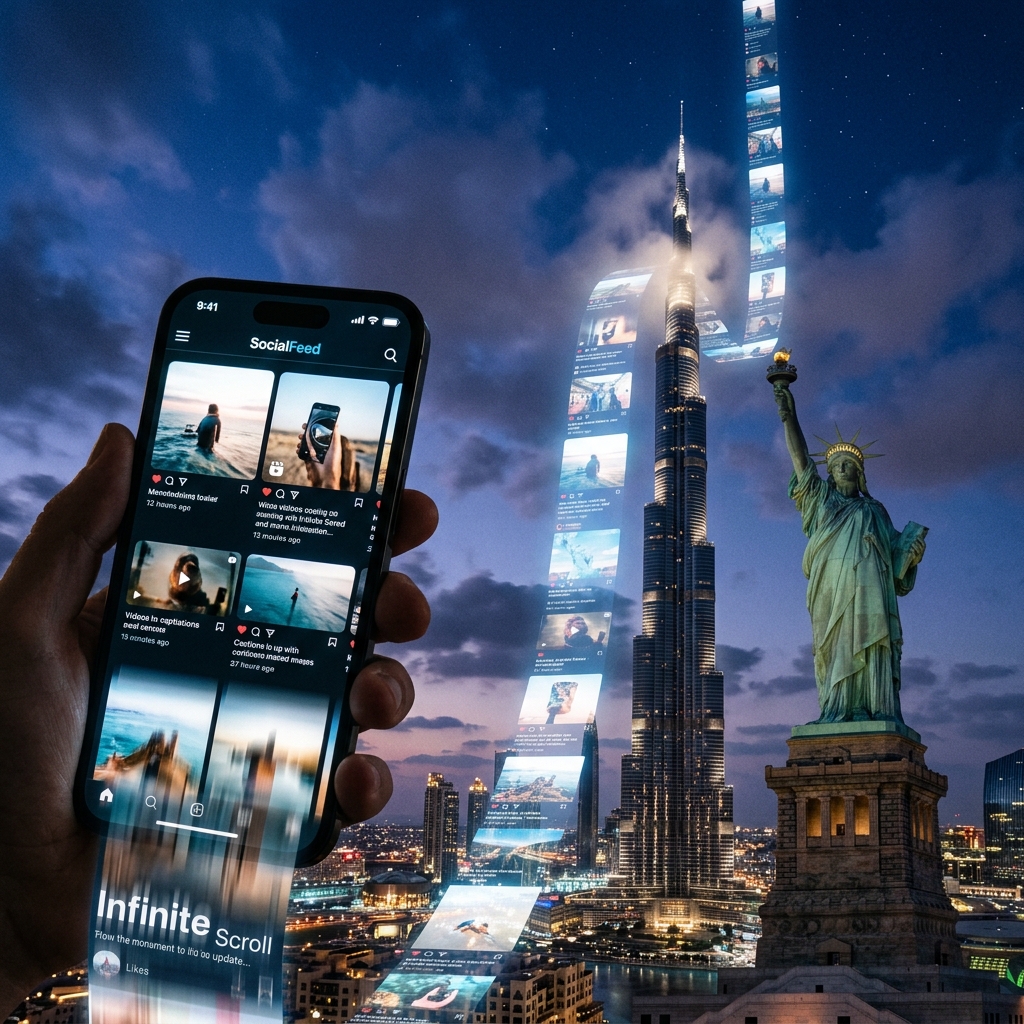
Zoom out to a full year, and the picture becomes almost unbelievable. Data journalists and researchers who've tried to model scroll depth over longer periods have suggested that an average smartphone user might cover the equivalent height of the Burj Khalifa in a single week and Mount Everest within a year of ordinary scrolling. Separately, a 2023 survey of 2,000 people found the average person scrolls roughly 43 feet — about 13 metres — every single day, which adds up to the height of London's Elizabeth Tower each week. Independent data-science estimates have landed in a similar range, suggesting the average person's thumb travels somewhere around five miles a year just from scrolling text and images on a six-inch screen.
The exact figure depends on your phone, your habits, your platform of choice — there's no single universal number, and researchers are candid about that uncertainty. But the direction is unmistakable: this is a lot of motion for a habit most of us think of as sitting still.
And the time behind that motion is just as staggering. Recent industry data puts the global social media population above 5.8 billion users, with the average person now spending around two hours and twenty-one minutes on social platforms every day. Multiply that across a planet of scrollers, and the world collectively spends more than 15 billion hours a day on social media — a genuinely civilizational amount of human attention, spent in fractions of a second, over and over again.
Why This Number Matters More Than It Seems
It's tempting to treat "miles scrolled" as a novelty stat, like counting how many times you blink. But there's a reason this framing has stuck around in psychology writing for nearly a decade: it converts something abstract — time spent online — into something physical and almost embarrassing. A mile is a distance you can picture. Walking it takes effort, intention, a destination. Scrolling it takes none of that. You end up somewhere without ever choosing to go there.
That's the quiet unsettling part. A mile walked usually means you arrived somewhere — a park, a friend's house, the end of a good thought. A mile scrolled usually means you arrived nowhere. You're not more informed, not more connected, not more rested. You're just further down a feed that has no bottom, because it was never built to have one.
The Tech Perspective: Why the Feed Never Ends
This isn't an accident of design. It's the design.
Infinite scroll — the interface pattern that lets you keep swiping up forever without ever hitting a "next page" button — was engineered specifically to remove the natural stopping points that older websites had. No page numbers. No "you've reached the end." Just an endless, frictionless supply of content, refreshed by algorithms trained on one goal: keep your thumb moving.
Behind that feed sits a recommendation system that studies your pauses, your likes, your rewatches, and your scroll-back-ups the way a fisherman studies currents. It isn't guessing what you want; it's calculating what keeps you there three seconds longer than the last thing did. Psychologists who study this describe it as an engineered feedback loop that leans on novelty and reward to keep people engaged, the same basic wiring that makes slot machines effective.
There's also a darker undercurrent to what keeps that thumb moving. Behavioral researchers point out that human attention has an old evolutionary bias toward threat and negativity — the same instinct that once helped an ancestor tell a stick from a snake at a glance. That instinct to flinch first and think later is baked into how our attention works, and social platforms, whether deliberately or not, have learned to feed it. Outrage, fear, and conflict travel further and faster than calm, ordinary content — which is part of why doomscrolling feels less like a choice and more like a current pulling you along.
None of this makes you weak-willed for scrolling as much as you do. It means you're a normal human being interacting with a system built by thousands of very smart people whose job, quite literally, is to make stopping harder than continuing.
A Story: Aina's Mile
Aina, a 24-year-old graphic designer, didn't think of herself as someone with a "phone problem." She worked hard, slept enough, saw her friends. But one evening, half-heartedly curious, she downloaded a screen-time tracker that estimated scroll distance instead of just time.
The first night, it told her she'd scrolled the height of a ten-story building before dinner.
She laughed at first — it felt abstract, almost funny. But by the end of the week, the number had climbed past a mile. Not a mile she'd walked to clear her head, or a mile she'd run to feel strong. A mile she'd swiped through half-consciously, mostly in the fifteen-minute gaps between tasks, the ones she used to fill by staring out a window or talking to whoever was nearby.
What struck her wasn't guilt. It was grief, small and specific — for the daydreams she hadn't had, the conversations that had gone quiet because a phone was easier than a pause. She didn't quit social media. She didn't need to swear off her favorite app or perform some dramatic digital detox for an audience online. She just started noticing the mile. And noticing, it turned out, was enough to change the shape of her evenings — not eliminate the scroll, but shrink it back down to something she'd actually chosen, instead of something that had simply happened to her.
Aina's story isn't unique, and it isn't meant to be a cautionary tale with a villain in it. It's just what it looks like when a person quietly measures a habit they'd never thought to measure — and finds out it was bigger than they assumed.
The Human Message: This Isn't About Shame
Here's the part worth saying plainly: none of this is an argument that social media is evil, or that you've failed by using it. Connection matters. So does entertainment, learning, laughter, and the specific comfort of seeing a friend's face pop up when you're far from home. Social platforms have made genuine good possible — community for the isolated, information for the curious, a stage for creators who'd never have had one otherwise.
The point of the mileage isn't to shame anyone into guilt. It's to offer a moment of honest awareness — the same kind you'd want from a pedometer, not a lecture. A pedometer doesn't tell you walking is bad. It just tells you the truth about your day, so you can decide, with open eyes, whether that truth matches what you actually want for yourself.
Psychologists who study digital wellbeing describe a useful middle path: engaging with intention rather than either total abstinence or unconscious autopilot. That can mean asking, before you open an app, what you're actually hoping to get from it — connection, information, distraction, comfort — and noticing honestly whether the next twenty minutes delivered that, or just delivered more scrolling. It can mean setting soft edges around your day: specific windows for checking in, rather than a phone that's always half-open in your hand. It can mean simply putting the phone in another room during dinner, not as punishment, but as an act of care toward the people sitting across from you.

What Miles Scrolled Can Teach Us About Miles Lived
There's a certain poetry in measuring scroll distance the same way we measure a run or a hike. A mile walked in the woods leaves you with muddy shoes and a clearer head. A mile scrolled leaves you with sore eyes and a faint, hard-to-name tiredness — what some researchers and writers have started calling "digital fatigue," the mental exhaustion of processing far more information than any brain evolved to sort through in a day.
The comparison isn't meant to guilt anyone out of their phone. It's meant to restore a bit of proportion. We plan our physical miles — a morning walk, a weekend hike, a run before work. Almost nobody plans their scroll miles. They simply accumulate, in the cracks of the day, while we're waiting for a kettle to boil or a friend to text back.
Reclaiming even a fraction of that distance doesn't require rejecting technology. It requires the same kind of attention we already give to a walking route: choosing where the mile goes, instead of letting the current decide.
A Gentle Way Forward
If any of this resonates, there's no need for a dramatic reset. A few small, achievable shifts tend to do more good than an all-or-nothing detox that rarely survives past day three:
- Notice one scroll session a day. Not to judge it, just to see it — how it started, how long it lasted, how you felt afterward.
- Give scrolling a destination. Open the app for something — a specific person's update, a specific topic — rather than opening it to see what happens.
- Protect one unscrolled hour. A meal, a walk, the twenty minutes before sleep. Not because the phone is dangerous, but because that hour deserves to be fully yours.
- Swap comparison for connection. If a feed leaves you feeling worse about your own life, that's useful information, not a personal failing — and it's worth following up with an actual message to an actual person instead of another scroll.
The Last Scroll
So — how many miles have you scrolled today? This week? This year? You may never know the exact number, and that's fine; no tracker will ever capture it perfectly. But the act of asking is its own small return to awareness, a way of stepping back into a life that's been quietly, constantly in motion without you.
The feed will always be there, endless and patient, engineered to outlast your attention span. The question worth asking isn't how to beat it. It's simply: of all the miles you'll travel today, how many do you want to remember?


Was this article helpful?
Comments
Loading comments...