Liechtenstein Explained: Top 10 Questions on Language, Business, Monarchy, and Daily Life

TL;DR
Everything you need to know about Liechtenstein: Discover how this 160 sq km Alpine nation balances a powerful monarchy with direct democracy, high-tech manufacturing, Swiss Franc currency, and strict residency quotas.
Table of Contents
Liechtenstein is far more than an Alpine enclave—it is a concentrated powerhouse of advanced industrial engineering, digital asset regulation, and deep-tech manufacturing. Spanning just 160 square kilometers with a population of ~40,000, this Principality holds global industrial weight, zero national debt, and one of the highest R&D investments per capita worldwide. Below are direct insights into how Liechtenstein quietly powers modern global infrastructure, fintech, and precision technology.
Liechtenstein Tech at a Glance
High density of R&D facilities and global tech HQs.
World’s first comprehensive legally binding token economy architecture.
Driven by robotics, nanotech, precision optics, and MedTech.
Consistently ranks at the top in patent filings per capita in Europe.
1. How can a microstate become a high-tech manufacturing giant?
While often stereotyped as purely a financial center, over 40% of Liechtenstein’s economic value comes directly from high-tech manufacturing and advanced engineering. The microstate maintains no natural resources, forcing its industrial sector to compete purely on high-margin innovation, software-hardware integration, and precision quality.
Liechtenstein’s technology footprint relies on hyper-specialization. Rather than mass consumer electronics, local firms supply critical, zero-tolerance components used globally in semiconductor fabrication, aerospace systems, automated automotive assembly, and smart construction devices.
Its physical geography—nestled between the tech corridors of Eastern Switzerland and Western Austria—allows immediate integration into the Rhine Valley’s high-tech industrial cluster, supported by direct technology transfers with institutes like ETH Zurich.
2. What major global technologies are engineered in Liechtenstein?
Engineers and tech pioneers in Liechtenstein hold thousands of patents. Several global market leaders operate their primary R&D headquarters within its borders:
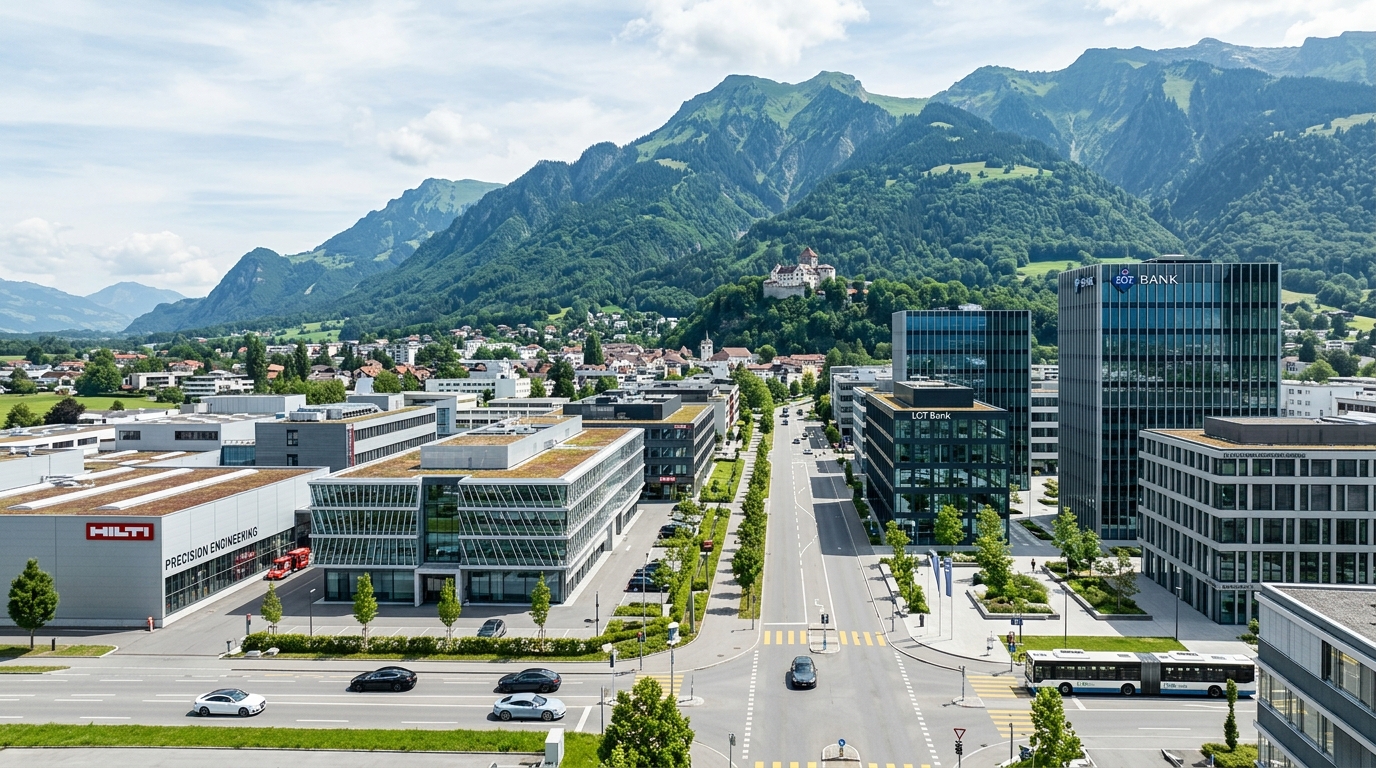
- Hilti AG (Schaan): Pioneers smart IoT construction tools, laser measurement systems, wearable exoskeletons for job sites, and cloud-managed asset tracking hardware.
- Ivoclar (Schaan): A global titan in MedTech and digital dentistry, pioneering CAD/CAM restorative materials, 3D printing resins, intraoral scanning algorithms, and AR-guided cosmetic dental apps.
- Oerlikon Balzers (Balzers): Architects ultra-thin PVD/CVD surface coatings essential for microchips, high-stress automotive engine components, and aviation turbine blades.
- Kaiser AG (Nendeln): Engineers autonomous and tele-operated mobile walking excavators and advanced environmental tech for high-altitude micro-trenching and heavy robotics.
3. Why is Liechtenstein considered a global leader in Blockchain and Web3 architecture?
In January 2020, Liechtenstein became the first nation on Earth to enact a comprehensive, legally binding civil framework for the token economy: the Token and Trusted Technology Service Provider Act (TVTG), commonly known as the Blockchain Act.
Instead of attempting to force decentralized technology into legacy financial codes, the government designed the structural Token Container Model. Under this architecture, a token is legally defined as a digital container capable of holding any rights—whether physical property, equity, IP rights, or software access.
This legal infrastructure provides complete regulatory clarity for tokenized real-world assets (RWA), decentralized physical infrastructure networks (DePIN), and institutional digital asset custodians overseen directly by the Financial Market Authority (FMA).
4. How is AI and automation altering Liechtenstein's industrial ecosystem?
Industrial firms in Liechtenstein rely heavily on high-level automation, predictive maintenance AI, and computer vision systems to maintain global competitiveness despite operating in a high-cost labor environment.
Smart Robotics & Digital Twins
Manufacturing plants utilize digital twin simulation environments to stress-test high-precision anchor manufacturing and micro-coating processes before deployment to worldwide assembly lines.
AI-Assisted MedTech Workflows
Dental tech systems integrate neural networks to automatically reconstruct 3D models of human teeth, optimize CAD milling trajectories, and simulate optical shade matching.
5. What role does the country play in semiconductor & optics supply chains?
Though consumers rarely see the "Made in Liechtenstein" label on finished electronics, global semiconductor foundries depend on equipment built in the Principality. Advanced vacuum technologies and thin-film optical coatings developed locally enable the lithography tools and cleanroom environments used to manufacture modern microprocessors.
Firms specialized in extreme surface treatment provide protective nanocoatings for precision optics, laser cutting components, and sensor arrays operating in outer space and deep-sea exploration hardware.
6. How does Liechtenstein's tax & corporate structure attract tech startups?
Liechtenstein’s tax code is designed for IP-heavy companies and tech enterprise R&D. Corporate tax is set at a flat 12.5% with an IP box regime that provides favorable treatment for revenue generated from patented technologies and software rights.
- Fast-Track Sandbox Licensing: The FMA maintains a dedicated "Regulatory Lab" specifically for Fintech, Web3, and Insurtech startups seeking to test business models under official supervision.
- Full EEA Integration: Tech companies incorporated in Liechtenstein can passport their digital financial services, software solutions, and regulated operations seamlessly across all 27 EU member states plus Iceland and Norway.
7. How does the country train and recruit top-tier tech talent?
Because the domestic talent pool is naturally constrained by population size, Liechtenstein relies on a dual-track strategy: high-yield vocational tech training combined with cross-border talent integration.
The University of Liechtenstein in Vaduz operates dedicated R&D centers for Information Systems, Business Process Management, and Distributed Ledger Technologies, working directly alongside enterprise partners.
Additionally, over 55% of the daily workforce commutes into Liechtenstein every morning from technical universities in Switzerland (including ETH Zurich and NTB Buchs) and Austria (FH Vorarlberg), driving specialized expertise directly into local labs.
8. What digital infrastructure powers Liechtenstein’s smart state?
Liechtenstein operates one of the highest gigabit fiber-to-the-home (FTTH) and 5G density coverages in Europe. Its compact size makes it an ideal real-world testbed for urban smart grid infrastructure, automated power monitoring, and digital e-government initiatives.
Through its centralized eGovernment platform, citizens and corporate entities execute tax filings, business incorporations, and civil registration securely via e-ID authentication, drastically cutting bureaucratic overhead for fast-moving technology ventures.
9. What role does Liechtenstein play in European space tech & satellite R&D?
Despite its lack of a spaceport, Liechtenstein contributes critical components to global aerospace systems and satellite infrastructure. Micro-coatings developed by local nanotech firms are used to protect optical sensors and solar panels on European Space Agency (ESA) satellites from extreme orbital radiation and thermal degradation.
Furthermore, precision structural engineering firms in the Rhine Valley supply high-tolerance metal alloys and custom structural fasteners used in rocket payload fairings and commercial satellite positioning arrays, embedding Liechtenstein technology directly into outer-space communications.
10. How is Liechtenstein building a strategic cybersecurity & data privacy hub?
Leveraging its long-standing reputation for institutional trust and data protection, Liechtenstein has emerged as a key European hub for cybersecurity enterprise infrastructure. The country's strict privacy laws—combined with full compliance with European Economic Area (EEA) cybersecurity standards—attract data protection firms, secure cloud providers, and cryptographic key management facilities.
Local tech initiatives focus heavily on zero-trust architectures, AI-driven threat intelligence, and post-quantum cryptographic security for enterprise SaaS platforms and cross-border financial networks.
This briefing is part of our Global Microstate Deep-Tech Series. Empirical data and legal references reflect official publications from the Government of the Principality of Liechtenstein (Regierung des Fürstentums Liechtenstein), the TVTG Token Act registry, the University of Liechtenstein DLT research unit, and corporate IP filings.

Was this article helpful?
Comments
Loading comments...