AI Regulation News September 2026: Global Enforcement Waves, State-Level Fractures, and Statutory Compliance Deadlines

TL;DR
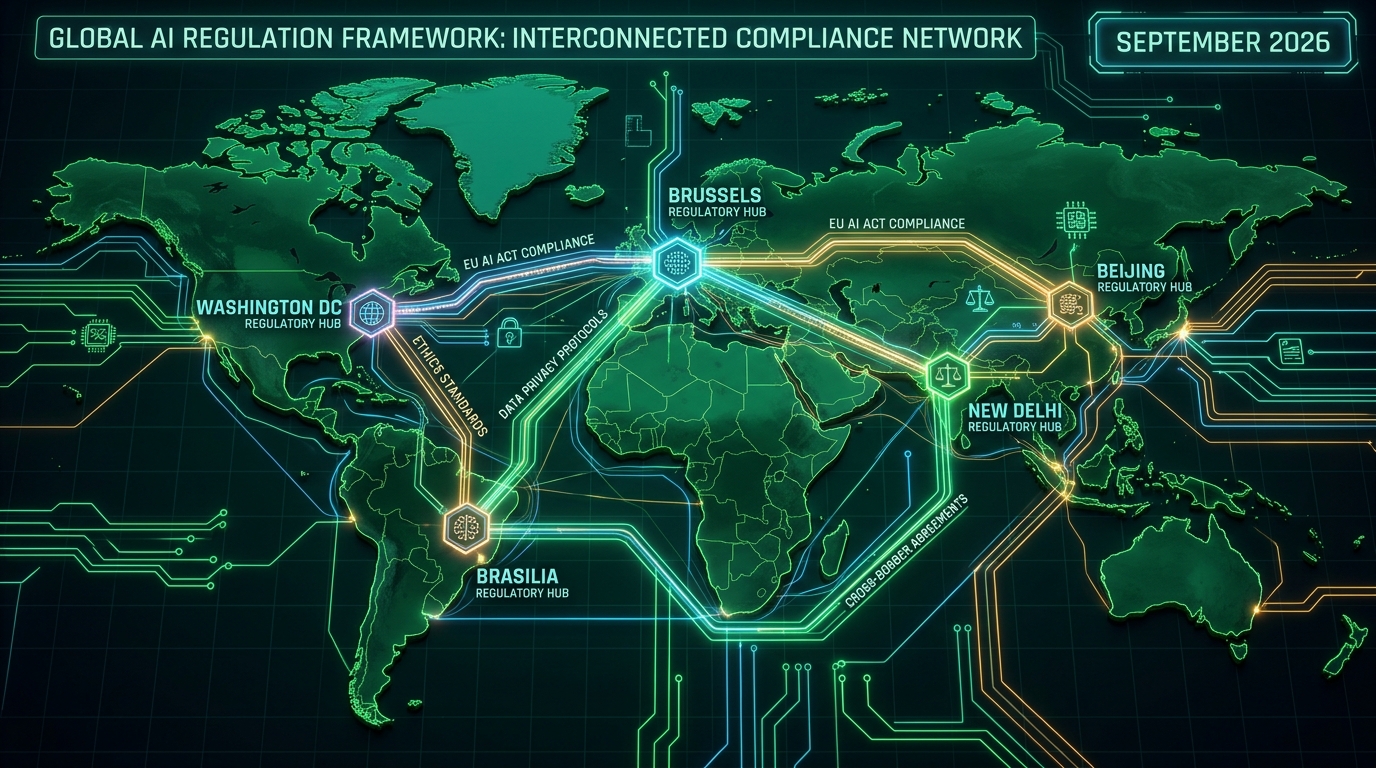
September 2026 brings direct statutory milestones for AI developers globally. The EU AI Office begins high-risk audits, California faces the SB 1047 signature deadline, Brazil votes on Bill 2338, and India presents its AI liability framework.
Table of Contents
In September 2026, global AI regulation will shift from preliminary administrative preparation to active statutory enforcement. Regulatory agencies across the European Union, the United States, China, India, and Brazil will execute audit mandates, vote on landmark bills, and issue formal technical guidance. If your team builds, fine-tunes, or deploys AI systems in multiple countries, September will require immediate adjustments to your data governance pipelines and legal documentation.
September 2026 Regulatory Takeaways
The European AI Office and national data protection authorities will initiate technical audits on Article 11 technical files for high-risk systems deployed after August 2.
Governor Gavin Newsom faces a September 30 deadline to sign or veto the Frontier AI Safety Act. Colorado releases formal audit rules for SB24-205.
Brazil's Senate will vote on Bill 2338/2023 on September 16. India's parliament will review the Digital India Act strict liability framework for generative AI.
1. European Union: First Wave of High-Risk On-Site Audits
The transition period for general high-risk systems under the EU AI Act concluded on August 2, 2026. Throughout September, the European AI Office in Brussels, working alongside 24 national market surveillance authorities, will begin its first scheduled wave of compliance inspections.
French regulator CNIL, German BfDI, and Spanish AESIA will focus their initial requests on three regulated sectors: automated resume screening tools in human resources, algorithmic credit assessment systems in retail banking, and AI triaging tools in private healthcare clinics.
Mandatory Technical Files Under Article 11
Under Article 11 and Annex IV of the AI Act, providers of high-risk systems must present an up-to-date Technical Documentation dossier before placing a system on the market or putting it into service. Regulators will audit the following specific technical assets during September inspections:
- System Architecture Diagrams: Complete hardware and software topology, including data pre-processing scripts, model weights versioning, and inference APIs.
- Training Data Governance Logs (Article 10): Verifiable records of dataset origin, data cleaning procedures, mitigation of demographic biases, and data gap analyses.
- Human Oversight Architecture (Article 14): Technical mechanisms enabling human operators to understand system outputs, override automated choices, or halt execution via a hardware or software kill-switch.
- Risk Management System (Article 9): Continuous identification and evaluation of known and foreseeable risks throughout the system lifecycle.
- Cybersecurity and Accuracy Benchmarks (Article 15): Documented resilience against data poisoning, adversarial inputs, and model extraction attacks.
| EU AI Act Category | Targeted Industry | September Audit Focus | Maximum Statutory Penalty |
|---|---|---|---|
| High-Risk (Annex III, Point 4) | Employment & HR Tech | Bias testing across protected groups, candidate notification notices | €35M or 7% global turnover |
| High-Risk (Annex III, Point 5) | Banking & Credit Scoring | Explainability of credit denial decisions, training data provenance | €35M or 7% global turnover |
| General-Purpose AI (GPAI) | Foundation Model Labs | Copyright transparency summaries (Article 53), systemic risk reporting | €15M or 3% global turnover |
| Limited-Risk (Article 50) | Customer Chatbots & Deepfakes | Machine-readable watermarking, visible synthetic content labels | €15M or 3% global turnover |
General-Purpose AI Model Reporting Window
By September 15, providers of GPAI foundation models that exceed the 10^25 FLOPs training threshold will submit their first formal systemic risk evaluations to the European AI Office. The AI Office will review red-teaming methodologies, energy consumption disclosures, and compliance with the standardized copyright training summary template published in July.
2. United States: California SB 1047 Deadline and State-Level Expansion
The United States regulatory environment will experience substantial divergence during September 2026. Without a unified federal AI statute, state governments will enforce localized compliance standards that require multi-state compliance tracking.

California: Governor Newsom's September 30 Deadline
California Senate Bill 1047 (the Safe and Secure Innovation for Frontier Artificial Intelligence Models Act) cleared both chambers of the state legislature in late August. Governor Gavin Newsom must sign or veto the legislation by midnight on September 30, 2026.
If enacted into law, SB 1047 will impose strict obligations on developers training AI models that require more than 10^26 integer or floating-point operations and cost over $100 million to train:
- Mandatory Pre-Training Safety Protocols: Developers must implement administrative, technical, and physical safeguards to prevent catastrophic harms (such as automated cyberattacks on critical infrastructure or creation of chemical and biological weapons).
- Full Shutdown Capability: Developers must maintain the technical ability to execute a prompt, complete shutdown of all model instances under their control.
- Annual Independent Third-Party Audits: Starting in 2027, covered developers will submit yearly third-party safety audits to the newly established California Frontier Model Division.
- Statutory Whistleblower Protections: Employees who report safety protocol violations or hazardous capabilities directly to the California Attorney General will receive civil protections against retaliation.
Colorado SB24-205 and Illinois Automated Hiring Rules
In Colorado, the Attorney General's office will conduct public rulemaking hearings during September to finalize reporting forms for Senate Bill 24-205 (Consumer Protections for Artificial Intelligence). The law mandates that both deployers and developers of high-risk AI systems implement risk management programs to prevent algorithmic discrimination in employment, education, housing, and financial services.
In Illinois, updates to the Illinois Human Rights Act (HB 3773) take direct effect. Employers using AI to evaluate, recruit, promote, or discipline workers must provide written notice to applicants and verify that algorithms do not rely on zip codes or proxy attributes to discriminate against protected classes.
Congressional Preemption Standoff in Washington DC
The US House Judiciary Committee will reconvene hearings on the "Great American AI Act" on September 17. The primary conflict centers on federal preemption. Tech industry representatives advocate for a uniform national standard that overrides state-level rules. A coalition of 19 state attorneys general opposes preemption, arguing that federal drafts establish weaker consumer protections than existing state legislation.
3. Asia-Pacific: China CAC Audits and India's Digital India Act
Regulatory authorities in Asia will advance distinct regulatory models during September, balancing technological deployment with national security and consumer protection.
China: Cyberspace Administration Algorithm Reviews
The Cyberspace Administration of China (CAC) will publish its September algorithm registry, containing newly approved domestic foundation models and generative services. Following the entry into force of companion AI rules, CAC provincial inspection units in Beijing, Shanghai, and Shenzhen will audit commercial conversational applications for:
- Mandatory Watermarking Adherence: Verifying that all generated text, images, and audio contain explicit visual watermarks and machine-readable cryptographic metadata.
- Emotional Dependence Safeguards: Ensuring companion chatbots limit continuous interaction times for users under 18 and refrain from simulating real-world medical or financial authority.
- Core Socialist Values Adherence: Conducting automated prompt testing to confirm responses adhere to national information security requirements.
India: Strict Liability Framework in Parliament
India's Ministry of Electronics and Information Technology (MeitY) will introduce the revised draft of the Digital India Act during the parliamentary session beginning September 21. The revised bill introduces a statutory liability framework that removes intermediary safe harbor protections for generative AI outputs that cause documented economic harm or disseminate deepfakes of public figures.
Japan and Singapore: Technical Safety Frameworks
Japan's Ministry of Economy, Trade and Industry (METI) will release an updated version of its AI Guidelines for Business on September 10, introducing watermarking recommendations for media companies. Singapore's Infocomm Media Development Authority (IMDA) will publish automated red-teaming test suites under its Model AI Governance Framework, providing developers with open-source benchmarking scripts for prompt injection and model extraction vulnerabilities.
4. Latin America and Global Developments: Brazil, UK, and Canada
Outside North America, Europe, and Asia, several key jurisdictions will reach legislative decision points during September.
Brazil: Senate Plenary Floor Vote on Bill 2338/2023
The Brazilian Federal Senate scheduled the final plenary floor vote on Bill 2338/2023 for September 16, 2026. The legislation establishes a comprehensive legal framework for artificial intelligence in Brazil, heavily influenced by the EU AI Act structure:
- Risk Classification: Designates biometric identification, judicial decision support, critical infrastructure control, and credit evaluation as high-risk.
- Algorithmic Impact Assessments (AIA): High-risk deployers must conduct and publish independent assessments evaluating human rights risks prior to commercial launch.
- Civil Liability Rules: Introduces strict liability for operators of high-risk AI and fault-based liability with a reversed burden of proof for other commercial systems.
United Kingdom: AI Regulation and Safety Bill Progression
The United Kingdom's AI Regulation and Safety Bill will advance to the House of Lords committee stage on September 22. The bill will codify the statutory powers of the UK AI Safety Institute, establishing legally binding safety evaluation requirements for frontier foundation models before public deployment.
Canada: Artificial Intelligence and Data Act (AIDA) Review
Canada's federal parliament will resume committee consideration of Bill C-27 (including AIDA) in late September. With federal elections approaching in 2027, Canadian enterprise teams continue to match internal controls with provincial privacy laws in Quebec (Law 25) and voluntary federal codes of conduct.
5. Technical Architecture: Engineering Changes for September Compliance
Complying with the international regulatory wave requires practical updates to engineering architecture, data pipelines, and deployment monitoring.

1. Immutable Audit Logging (EU Article 12 & Colorado SB24-205)
Under EU AI Act Article 12, high-risk systems must automatically record events (logs) throughout their lifecycle. Engineering teams must ensure production inference pipelines store immutable records with the following attributes:
Logs must be retained for at least 6 months under standard EU provisions or up to 2 years for credit and insurance systems under sectoral regulations.
2. Training Data Provenance and Copyright Opt-Outs
Under EU Article 53, developers training models on web data must prove compliance with machine-readable copyright opt-outs (such as robots.txt directives or HTTP headers matching the TDM reservation standard). Teams must maintain web crawl logs documenting URL timestamps, HTTP status codes, and robots exclusion evaluations.
3. Automated Red-Teaming and Bias Testing
Engineering teams must run scheduled automated evaluations prior to production releases. Tests must quantify demographic parity, disparate impact ratios, and prompt injection resistance, saving output distributions into permanent verification stores.
6. Four-Week September Compliance Action Plan
Product leaders, engineering managers, and legal teams can follow this structured 4-week execution roadmap during September to address regulatory exposures.
| Week | Core Focus Area | Key Engineering & Legal Tasks | Deliverable |
|---|---|---|---|
| Week 1 (Sep 1–7) | System Inventory & Classification | Catalog all live AI models, APIs, and automated tools across company departments. Map use cases against EU Annex III and Colorado SB24-205 definitions. | Consolidated AI Risk Registry |
| Week 2 (Sep 8–14) | Article 11 Technical Dossiers | Assemble training data logs, architectural diagrams, model cards, and human oversight manuals for high-risk systems. | Article 11 Technical Files |
| Week 3 (Sep 15–21) | US State Geo-Fencing & Bias Checks | Evaluate HR tools against Illinois HB 3773 and Colorado rules. Implement user notification modals and bias audit reporting scripts. | Bias Disparity Report & UI Notices |
| Week 4 (Sep 22–30) | Logging & Whistleblower Procedures | Verify immutable inference logging pipelines. Establish internal reporting channels compliant with California SB 1047 requirements. | Production Audit Log Verification |
7. 2026–2027 Global Compliance Milestones Calendar
Track these scheduled statutory deadlines across international jurisdictions over the next 12 months:
- September 16, 2026: Brazilian Senate plenary floor vote on Bill 2338/2023.
- September 21, 2026: Indian Parliament begins review of Digital India Act generative AI liability clauses.
- September 30, 2026: California Governor deadline to sign or veto SB 1047.
- October 15, 2026: UK AI Regulation and Safety Bill expected to receive Royal Assent.
- January 1, 2027: California Frontier AI Safety Act initial provisions take effect (if signed).
- February 1, 2027: Colorado SB24-205 algorithmic discrimination compliance mandatory for consumer-facing systems.
- August 2, 2027: EU AI Act obligations apply to high-risk AI embedded in regulated products (medical devices, motor vehicles, aviation).
- August 2, 2028: Final EU AI Act deadline for public administration systems and existing high-risk tools.
Frequently Asked Questions
What happens if my company deploys an uncertified high-risk AI system in the EU in September 2026?
Deploying a high-risk AI system without completing the conformity assessment, registering the tool in the EU database, and maintaining Article 11 technical documentation violates the EU AI Act. National competent authorities can order immediate market withdrawal, issue mandatory corrective orders, and impose fines up to €35 million or 7% of total worldwide annual turnover for the preceding financial year.
Does California SB 1047 apply to startups and open-source models?
SB 1047 applies to models that cost over $100 million to train and use more than 10^26 FLOPs. Most early-stage startups and small models fall below this compute and cost threshold. However, developers fine-tuning covered models with more than $10 million in compute or 10^25 FLOPs become subject to derivative compliance obligations.
How does China verify AI content labeling compliance?
The Cyberspace Administration of China conducts algorithmic verification using automated crawlers and scheduled laboratory inspections. Regulators test whether public generative AI tools embed both conspicuous visual watermarks and hidden cryptographic metadata containing the provider identification and content generation timestamp.
What are the key requirements for Colorado SB24-205 compliance?
Colorado SB24-205 requires deployers of high-risk AI systems to implement a formal risk management policy, complete annual algorithmic impact assessments, provide clear consumer disclosure notices before using AI in consequential decisions, and maintain a public website statement describing all active high-risk systems.
Will US federal AI legislation override state AI laws in 2026?
Federal preemption remains stalled in the House Judiciary Committee due to opposition from state attorneys general. Companies should not expect a preemption bill to pass before the November 2026 congressional elections, making multi-state compliance tracking essential for products operating across the United States.
How can engineering teams verify that web scrapers obey EU copyright opt-outs?
Engineering teams must configure web crawlers to parse robots.txt files, HTML meta tags with name="robots", and HTTP headers containing TDM reservation flags (Article 4(3) of Directive 2019/790). Automated scraper logs must record whether a target domain permitted or restricted automated extraction, creating a timestamped verification trail for Article 53 technical documentation.


Was this article helpful?
Comments
Loading comments...