Metaverse: The Internet's Dumbest Idea

TL;DR
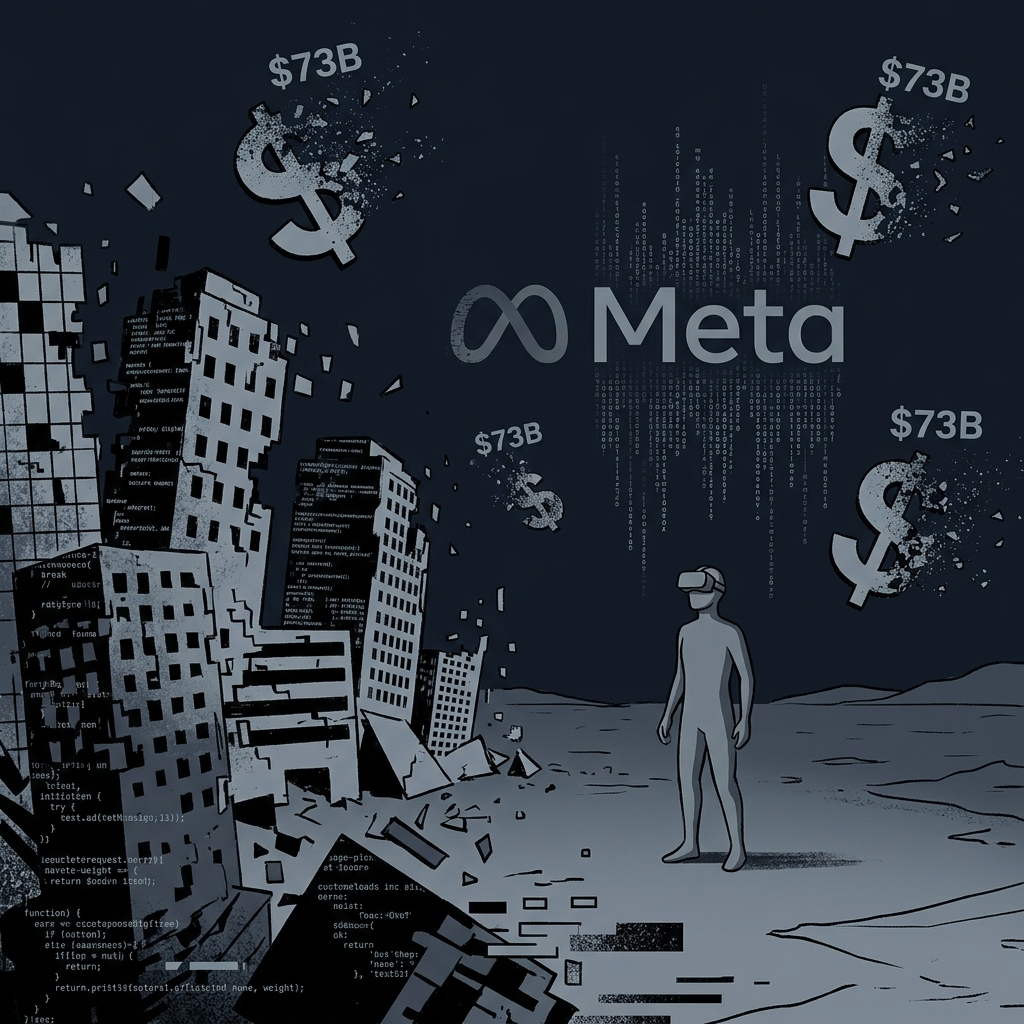
Facebook renamed itself Meta, spent $80+ billion building a virtual world where nobody showed up, then quietly pivoted to AI. Here is the full story of how the metaverse went from a 1992 sci-fi novel to the most expensive failed rebrand in tech history.
Table of Contents
Facebook renamed itself Meta in 2021, spent over $80 billion building a virtual world, and watched almost nobody show up. By 2023, Zuckerberg announced a pivot to AI. By early 2026, Reality Labs had laid off roughly 1,500 employees and frozen development on Horizon Worlds for VR. The metaverse was, by every practical measure, over.
Where the word actually came from
The term "metaverse" did not start with Facebook. It came from Neal Stephenson's 1992 science fiction novel Snow Crash, a mix of the words "meta" and "universe." In the book, the Metaverse is a persistent, immersive virtual world experienced through VR headsets, where users appear as avatars and conduct social and economic life alongside the physical world.
That concept sat in the sci-fi canon for over a decade before anyone tried to build it commercially. In 2003, Linden Lab launched Second Life, a 3D user-generated world with its own economy, virtual land ownership, and a currency (the Linden Dollar) exchangeable for real money. It is still often cited as the first genuine metaverse platform. Then in 2014, VRChat launched on early Oculus Rift hardware, a social VR platform with user-created avatars and worlds that quietly accumulated a deeply committed community over years.
Neither of these companies renamed themselves after the concept. That distinction belongs to Zuckerberg.
What Meta actually built
In 2019, Facebook launched Facebook Horizon, later rebranded as Horizon Worlds: a social VR platform where users could build spaces, play games, and hang out as legless avatars. In October 2021, Facebook renamed the entire parent company to Meta Platforms, a public declaration that the metaverse was the company's direction for the next decade.
The pitch was ambitious. Zuckerberg described a future where people would work, learn, shop, and socialize inside a persistent virtual space, a replacement for the physical office and the physical store and, in some tellings, significant portions of everyday life. The problem was that nobody asked for this.
VR had an established, willing audience: gamers. Nobody outside that group was interested in strapping a headset to their face to attend a meeting or browse products. The use cases Meta kept demonstrating, virtual offices, virtual shopping malls, virtual real estate, made sense on a whiteboard and nowhere else.
The virtual real estate era
The hype peaked in 2021. Property sales across major metaverse platforms topped $500 million that year. Republic Realm, a virtual real estate investment firm, spent $4.3 million on a single digital property inside The Sandbox. An NFT collector paid $450,000 for a virtual plot next to Snoop Dogg's digital mansion in the same platform.
Decentraland sold a single parcel for $2.43 million in late 2021. By early 2023, analytics firm DappRadar reported that Decentraland had as few as 38 daily active users on some days, tracked by unique wallet interactions. Decentraland disputed the methodology and cited approximately 8,000 daily users by their own counting. Either number was a disaster relative to the valuations.
Mark Cuban called virtual real estate dumb. He was not wrong.
Reality Labs financial losses, by year
- 2019: Net loss of $4.5 billion on $501 million in revenue
- 2020: Net loss of $6.62 billion on $1.14 billion in revenue
- 2021: Net loss of over $10 billion
- 2022–2025: Continued losses each year
- Q1 2026 alone: Operating loss of approximately $4 billion
- Cumulative total (2020–early 2026): Over $80 billion
Why it didn't work
The technology wasn't ready. In 2022, a New York Times piece by Lauren Jackson laid out the infrastructure gap: the metaverse needed hardware and software that didn't exist at the required scale, a monopolistic approach to platform development, and no clear governance standards. Intel's senior vice president said publicly that achieving Zuckerberg's vision would require a 1,000-times increase in computational efficiency from the state of the art at the time.
Nobody wanted to wear a headset to work. The consumer VR market in 2021 and 2022 was still built on gaming and enthusiast use. Quest headsets sold reasonably well as gaming devices. They did not sell as productivity tools. The Office in VR had no constituency.
Privacy concerns were serious. Facebook had an existing reputation for aggressive data collection. The metaverse would have added biometric data, including gaze tracking, hand movement, and physical behavior patterns, to what the company could collect. David Reed of Liverpool Hope University noted in 2021 that the data collection potential of a metaverse environment would dwarf anything possible on the current web.
Safety inside the platform was bad. Horizon Worlds faced documented reports of sexual harassment within months of launch. In 2022, BBC News and the Washington Post both found that minors were accessing adult content on VRChat and Horizon Worlds despite age requirements of 13 and older. Roblox's chief scientist compared moderating 3D social spaces to shutting down speakeasies.
Nobody solved the identity problem. Companies pushed to trademark their brands in the metaverse while regulators had no framework for virtual crimes, virtual property rights, or virtual contracts. The legal infrastructure for the metaverse did not exist, and no one was in a hurry to build it.
What VRChat did differently
VRChat launched in 2014. It didn't have a corporate parent betting the company on it. It launched on the original Oculus Rift developer kit and built its user base slowly, from people who genuinely wanted to be there. That community, developers building custom worlds and avatars, VTubers, social regulars, was passionate and self-sustaining. VRChat grew organically. By the time Meta was collapsing, VRChat had a stable audience that nobody had manufactured.
The contrast is direct: one platform was built from real users who chose it, the other was a $80 billion corporate bet on users who never showed up.
The pivot, and the exit
In 2023, Zuckerberg announced that Meta would shift focus toward AI. In January 2026, Reality Labs laid off approximately 1,500 employees, around 10% to 15% of the division, and shut down three internal VR game studios. Meta announced it would remove Horizon Worlds from the Quest Store and end VR development by June 15, 2026, pivoting the platform to mobile only. User backlash caused a partial reversal: existing VR worlds would remain live for current users, but no new content would be added.
The company that renamed itself after a virtual world it couldn't build had, by the middle of 2026, moved on to the next thing. Meta's 2026 capital expenditure on AI infrastructure is projected at between $125 billion and $145 billion.
The name Meta remains. The metaverse does not.
References
- Neal Stephenson — Snow Crash (1992). First use of the word "metaverse."
- The New York Times — Lauren Jackson, "The Metaverse Is Stalled," 2022.
nytimes.com - The New York Times — Ryan Mac, coverage of Meta's metaverse struggles, 2022.
nytimes.com - The Verge — Decentraland daily user report, 2023.
theverge.com - CNBC — Republic Realm $4.3 million Sandbox purchase, 2021.
cnbc.com - BBC News — Investigation into minors accessing adult VR content, 2022.
bbc.com - Washington Post — Child safety in virtual reality platforms, 2022.
washingtonpost.com - Meta Platforms / Reality Labs — Quarterly earnings reports, 2019–2026.
investor.fb.com - Liverpool Hope University — David Reed, commentary on metaverse data collection, 2021.


Was this article helpful?
Comments
Loading comments...