Top 10 French Learning Resources in 2026: The Definitive Guide for Every Level


TL;DR
From beginner apps to advanced immersion platforms, we researched and ranked the 10 best French learning resources available in 2026. Whether you want gamified daily practice, AI-powered conversation, or university-backed courses, this guide covers the tools that actually work — and tells you which ones to skip.
Table of Contents
French is the fifth most spoken language in the world, with over 321 million speakers across 29 countries. Whether you are learning French for work, immigration to Canada or France, academic requirements, or personal enrichment, the quality of your learning resources determines how fast you progress. The problem is that there are now hundreds of apps, courses, and platforms competing for your attention, and most of them are mediocre.
We spent weeks researching, testing, and comparing the most recommended French learning tools available in 2026. This guide ranks the top 10 based on what actually matters: pedagogical quality, real-world effectiveness, price, and how well each tool addresses specific learning goals. No sponsorships influenced this list.
Before you start: Know your current level
The single most important step before choosing any resource is knowing where you stand. Are you an absolute beginner (A1), comfortable with basic conversation (B1), or already reading French novels (C1)? Every tool on this list works best within a specific proficiency band.
If you are unsure of your level, take our free Cubbbix French Assessment Test. It is a 40-question adaptive quiz aligned to the Common European Framework of Reference (CEFR) that gives you a reliable A1–C2 placement in under 10 minutes. Knowing your CEFR level before you start means you pick the right tool from day one instead of wasting weeks on material that is too easy or too hard.
Quick summary: The top 10 at a glance
- Duolingo — Best for building a daily habit (A0–A2)
- Babbel — Best for structured grammar (A1–B1)
- Pimsleur — Best audio-first method for commuters (A1–B2)
- TV5MONDE Langue Française — Best free immersion platform (A2–C2)
- italki — Best for live conversation with native tutors (A2–C2)
- Language Transfer — Best free audio course for beginners (A0–A2)
- Lawless French — Best grammar reference website (A1–C1)
- Anki — Best spaced-repetition flashcard system (All levels)
- Busuu — Best for native speaker feedback (A1–B2)
- Cubbbix French Assessment Test — Best free CEFR placement test (All levels)
1. Duolingo — Best for building a daily habit
Best for: Absolute beginners (A0–A2) | Price: Free (Super: $12.99/month)
Duolingo remains the world's most popular language learning app, and for good reason. Its gamified interface — streaks, XP points, leaderboards, and bite-sized lessons — is specifically designed to get you to open the app every single day. For someone who has never studied French before, Duolingo provides a gentle, low-pressure introduction to basic vocabulary, sentence structure, and pronunciation.
What it does well: Duolingo excels at building the daily habit. Its push notifications, streak system, and competitive leaderboards exploit behavioral psychology to keep you coming back. The French course covers approximately 2,000 vocabulary words and basic grammar through A2 level. The recent addition of AI-powered roleplay conversations (available on Super) adds a useful speaking component.
Where it falls short: Duolingo's weakness is depth. Grammar explanations are minimal, and the app rarely teaches you why a sentence is structured a certain way. Users who rely solely on Duolingo often plateau at A2 and struggle with real-world conversation. It is a starting tool, not a finishing tool.
2. Babbel — Best for structured grammar
Best for: Grammar-focused learners (A1–B1) | Price: $14.95/month
If Duolingo is the fun friend who gets you started, Babbel is the serious tutor who makes sure you understand the rules. Babbel's French course is built around structured grammar lessons developed by linguists. Each lesson explicitly teaches a grammar concept — verb conjugations, gendered nouns, pronoun placement — and then reinforces it through contextual exercises.
What it does well: Babbel provides clear, concise grammar explanations that Duolingo deliberately avoids. The review system spaces out vocabulary repetition to aid long-term retention. Lessons are built around practical dialogue scenarios (ordering food, booking a hotel, introducing yourself), which means you learn grammar within useful, real-world contexts.
Where it falls short: Babbel's content currently caps around B1 level. Advanced learners will exhaust the material. It also lacks a significant speaking practice component — you can record yourself, but there is no AI or human feedback loop to correct your pronunciation in real time.
3. Pimsleur — Best audio-first method for commuters
Best for: Learners on the go (A1–B2) | Price: $21.99/month
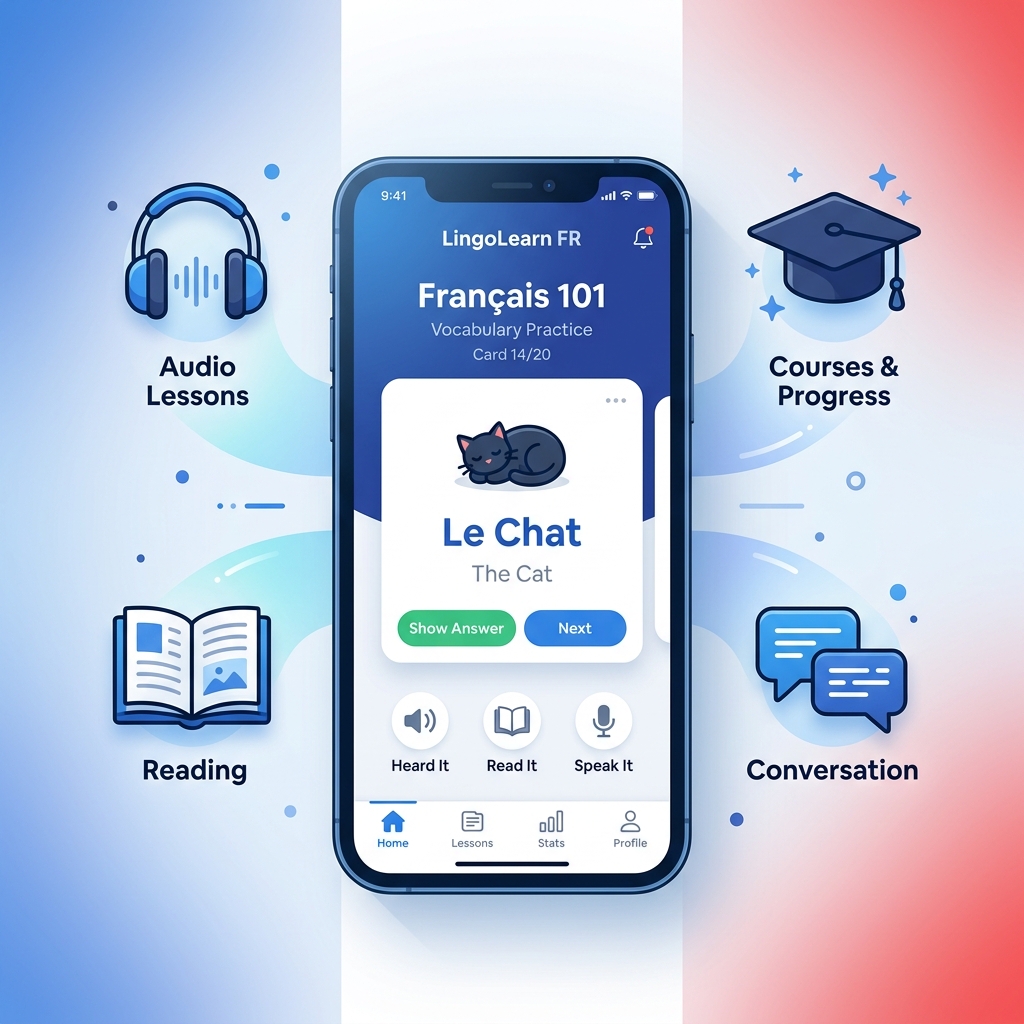
Pimsleur has been teaching languages through audio since 1963, and its core method has barely changed because it works. Each 30-minute lesson follows a graduated interval recall pattern: you hear a French phrase, translate it, and repeat it at increasingly spaced intervals. The method forces active production rather than passive recognition.
What it does well: Pimsleur is the gold standard for developing pronunciation and conversational reflexes without looking at a screen. If you commute 30–60 minutes daily, Pimsleur transforms dead time into productive study. The French course covers 150 lessons across 5 levels, taking most learners from zero to solid B1–B2 conversational ability.
Where it falls short: Pimsleur teaches you to speak but not to read or write. There is no visual component. You will develop strong oral skills but may struggle to spell the words you can say fluently. It also moves slowly by design — impatient learners may find the pacing frustrating.
4. TV5MONDE Langue Française — Best free immersion platform
Best for: Intermediate to advanced immersion (A2–C2) | Price: Free
TV5MONDE is the most underrated French learning resource on the internet. Operated by the international French-language television network, it provides hundreds of hours of authentic video content — news reports, documentaries, cultural segments, interviews — with accompanying exercises tailored to specific CEFR levels.
What it does well: TV5MONDE gives you real French as spoken by real French speakers. This is not simplified textbook audio. You hear natural speed, regional accents, idiomatic expressions, and current cultural references. Each video comes with comprehension questions, vocabulary lists, and grammar exercises designed by professional language teachers. It is the closest you can get to living in France without buying a plane ticket.
Where it falls short: The interface is functional but not polished. Navigation can feel clunky compared to modern app design. It also requires at least A2-level reading ability to use the exercises effectively, which means absolute beginners should start elsewhere and return to TV5MONDE once they have basic comprehension.
5. italki — Best for live conversation with native tutors
Best for: Speaking practice at any level (A2–C2) | Price: $10–40/hour
No app can replace a real human conversation. italki connects you with thousands of native French tutors for one-on-one video lessons. You can choose between professional teachers (typically $25–40/hour) and community tutors ($10–20/hour) based on your budget and goals.
What it does well: italki solves the single biggest problem in language learning: the speaking barrier. You can study grammar, memorize vocabulary, and complete app exercises for months, but if you never practice speaking with a real person, you will freeze the first time someone addresses you in French. italki removes that barrier entirely. A good tutor will correct your mistakes in real time, explain nuances that no app covers, and adapt the lesson to your specific weaknesses.
Where it falls short: Quality varies significantly between tutors. You may need to trial 3–5 teachers before finding one whose style matches your learning needs. It also requires scheduling and commitment — it is not a "pick up and play" resource like an app.
6. Language Transfer — Best free audio course for beginners
Best for: Absolute beginners who want to understand structure (A0–A2) | Price: Free
Language Transfer is a free audio course created by Mihalis Eleftheriou. The French course, called "Introduction to French," consists of approximately 40 lessons available on YouTube, Spotify, and the Language Transfer app. The method — called the "Thinking Method" — teaches you to derive French from English using systematic rules and patterns rather than rote memorization.
What it does well: Language Transfer teaches you how French works rather than asking you to memorize phrases. You learn that English words ending in "-tion" are almost always the same in French ("nation," "conversation"), that "-ous" becomes "-eux" ("curious" → "curieux"), and that "-ty" becomes "-té" ("liberty" → "liberté"). These transfer rules give you access to thousands of words immediately. The course is entirely free, with no ads and no upsells.
Where it falls short: The course is audio-only and covers approximately A1–A2 material. It provides no reading, writing, or cultural content. Think of it as a powerful conceptual foundation that you must supplement with other tools.
7. Lawless French — Best grammar reference website
Best for: Grammar clarification at any level (A1–C1) | Price: Free
Lawless French, created by French teacher Laura K. Lawless, is the most comprehensive free grammar reference on the web. It covers every French grammar topic in exhaustive detail: verb tenses, subjunctive usage, pronoun placement, articles, prepositions, partitives, and hundreds of idiomatic expressions.
What it does well: When you encounter a grammar rule you do not understand, Lawless French provides the clearest explanation available. Each lesson includes example sentences, common mistakes, and links to related topics. The site also offers vocabulary lists organized by theme, verb conjugation tables, and short quizzes. It is the reference manual that every French learner should have bookmarked.
Where it falls short: Lawless French is a reference, not a course. It does not teach in a structured sequence. You need to know what you are looking for. Pair it with a structured course (like Babbel or Language Transfer) and use Lawless French to clarify questions as they arise.
8. Anki — Best spaced-repetition flashcard system
Best for: Vocabulary retention at all levels | Price: Free (desktop), $24.99 (iOS one-time)
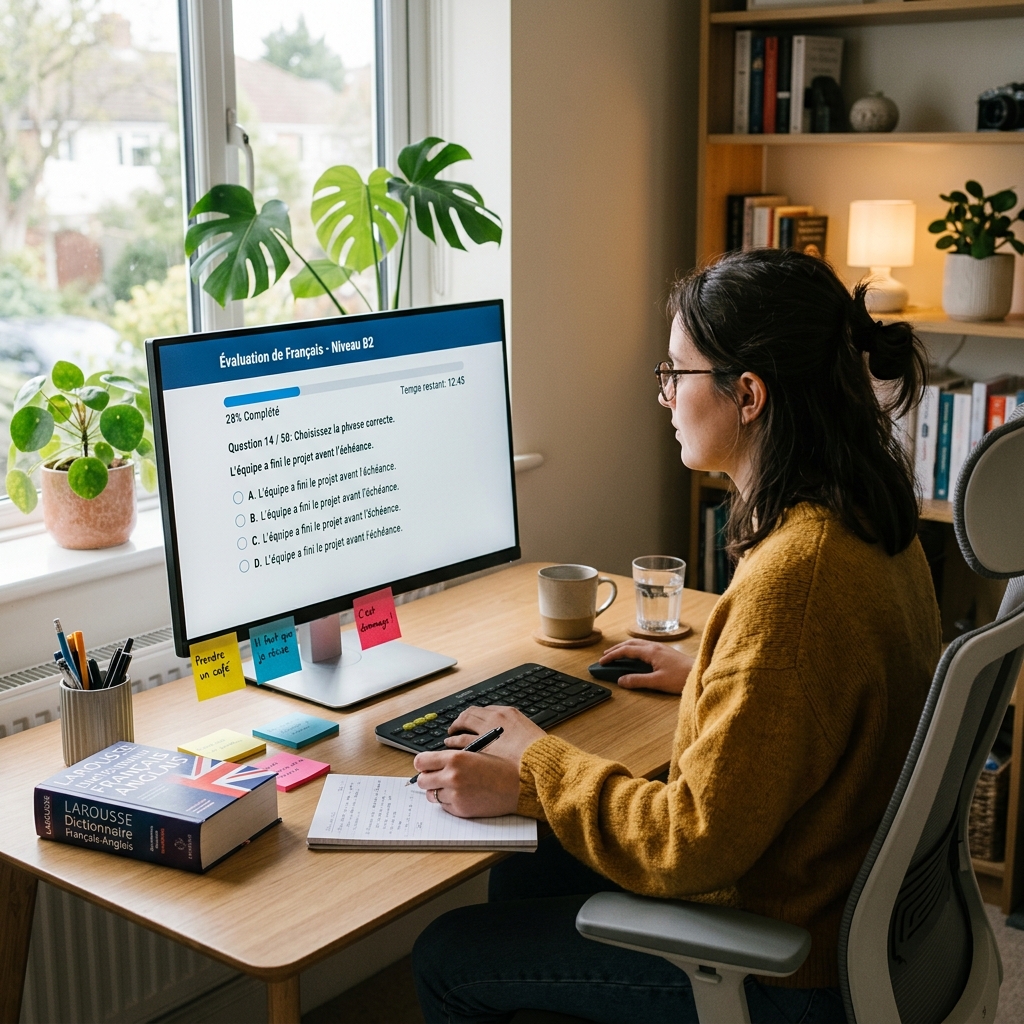
Anki is the most powerful vocabulary memorization tool available. It uses a spaced repetition system (SRS) algorithm that schedules flashcard reviews at mathematically optimal intervals — showing you a card right before you would forget it. This maximizes long-term retention with minimal daily study time.
What it does well: Anki's algorithm is scientifically validated for long-term memory. You can download pre-made French decks (many contain 5,000+ words with audio pronunciation) or create custom cards for vocabulary you encounter in your other studies. The desktop app is free, and the community has produced excellent shared decks organized by CEFR level, topic, and frequency.
Where it falls short: Anki has a steep learning curve. The interface is utilitarian and can feel overwhelming to new users. Creating high-quality custom cards is time-consuming. It also teaches vocabulary in isolation — you learn individual words but not how to use them in sentences. Always supplement Anki with reading and conversation practice.
9. Busuu — Best for native speaker feedback
Best for: Learners who want peer correction (A1–B2) | Price: Free (Premium: $13.99/month)
Busuu combines structured lessons with a unique community feature: native French speakers review your written and spoken exercises and provide corrections. This creates a feedback loop that most apps lack entirely.
What it does well: The community correction feature is Busuu's killer advantage. When you complete a writing exercise, it is sent to native speakers who mark errors and suggest improvements. This is free, human-quality feedback on your actual output. The course structure follows CEFR levels clearly, and Busuu offers official McGraw-Hill certificates upon course completion.
Where it falls short: The quality of community corrections varies. Some reviewers provide detailed, helpful feedback; others simply click "looks good" without reading carefully. The free tier is limited, and the Premium subscription is necessary to access the full course and offline mode.
10. Cubbbix French Assessment Test — Best free CEFR placement test
Best for: All levels, placement and progress tracking | Price: Free
Disclosure: this is our own tool. We include it because it fills a specific gap that none of the resources above address: accurate, free level assessment.
The Cubbbix French Assessment Test is a 40-question adaptive quiz that evaluates your grammar, vocabulary, and reading comprehension and maps your score to CEFR bands from A1 to C2. It uses adaptive logic, meaning the difficulty adjusts based on your answers, so the final result accurately reflects your current level.
What it does well: It gives you a clear, unambiguous CEFR level in under 10 minutes. No sign-up is required. You can retake it monthly to track progress. For learners preparing for official exams like the DELF, DALF, or TCF Canada, it provides a useful benchmark to see if you are ready. An optional paid certificate ($9.99) includes a detailed performance report breaking down your grammar and vocabulary gaps, which you can add to your CV or LinkedIn.
Where it falls short: It is an assessment, not a course. It tells you where you are but does not teach you anything. Use it at the beginning and end of your study cycle, not during daily practice.
How to combine these tools: A practical study plan
No single app or website will make you fluent. The most effective approach combines tools based on the four core language skills: listening, speaking, reading, and writing. Here is a practical weekly framework based on the resources in this guide:
- Daily (10–15 min): Duolingo or Babbel for structured practice + Anki for vocabulary review
- Commute/exercise (30 min): Pimsleur or Language Transfer audio lessons
- 3x per week (20 min): TV5MONDE video exercises for immersion and listening comprehension
- 1–2x per week (30–60 min): italki conversation lesson with a native tutor
- As needed: Lawless French for grammar reference when questions arise
- Monthly: Cubbbix French Assessment Test to track CEFR progress
This combination covers all four skills systematically. The key is consistency: 20 minutes daily beats a 3-hour session once a week. Language acquisition is a function of sustained exposure over time, not intensity in a single sitting.
What about AI-powered tools like ChatGPT?
Large language models like ChatGPT, Claude, and Gemini can serve as surprisingly effective French practice partners. You can ask them to correct your French writing, explain grammar rules, generate example sentences, simulate conversations, or translate text with detailed explanations of why each word was chosen.
However, LLMs are not language teachers. They can generate incorrect French, miss subtle grammatical errors, or provide explanations that sound authoritative but are wrong. Use them as a supplement — a tireless practice partner available at 2 AM — but do not treat their output as authoritative. For grammar questions, trust Lawless French. For pronunciation, trust Pimsleur or a human tutor. For assessment, trust a structured test like the CEFR French Assessment.
Frequently asked questions
How long does it take to learn French?
The U.S. Foreign Service Institute (FSI) estimates that English speakers need approximately 600 class hours to reach professional working proficiency (B2–C1) in French. At 1 hour per day, that is roughly 2 years. At 30 minutes per day, 3–4 years. These estimates assume structured study with qualified instruction, not casual app use.
Is Duolingo enough to learn French?
No. Duolingo is an excellent starting tool, but it caps at approximately A2 level. To reach conversational fluency (B1+), you need grammar instruction, immersion content, and speaking practice with humans — none of which Duolingo provides adequately on its own.
What is the CEFR and why does it matter?
The Common European Framework of Reference for Languages (CEFR) is an international standard that defines language proficiency on a six-level scale from A1 (beginner) to C2 (mastery). It matters because employers, universities, and immigration authorities use CEFR levels to define language requirements. Knowing your CEFR level lets you set concrete goals and choose resources matched to your ability.
What is the best French resource for TCF Canada preparation?
For TCF Canada, you need strong listening and reading comprehension plus written and oral expression. Combine TV5MONDE (listening/reading), italki (oral expression), and Babbel (grammar foundation). Use the Cubbbix French Assessment monthly to track your CEFR level against the CLB requirements for your immigration program.
Ethics and disclosure
This article was not sponsored by any of the platforms listed. We include our own tool (Cubbbix French Assessment Test) with clear disclosure. All pricing information is accurate as of July 2026 and may change. The featured images in this article were generated using artificial intelligence. FSI class hour estimates are sourced from publicly available U.S. Department of State data.
References
- U.S. Foreign Service Institute (FSI) — Language difficulty rankings and class hour estimates for English speakers.
state.gov/foreign-language-training - Council of Europe — Common European Framework of Reference for Languages (CEFR).
coe.int/cefr - Organisation Internationale de la Francophonie — French language global statistics (321 million speakers, 29 countries).
francophonie.org - TV5MONDE — Free French learning platform with authentic video content and exercises.
langue-francaise.tv5monde.com - Lawless French — Comprehensive French grammar reference by Laura K. Lawless.
lawlessfrench.com - Cubbbix — Free CEFR-aligned French Assessment Test.
cubbbix.com/french-quiz


Was this article helpful?
Comments
Loading comments...