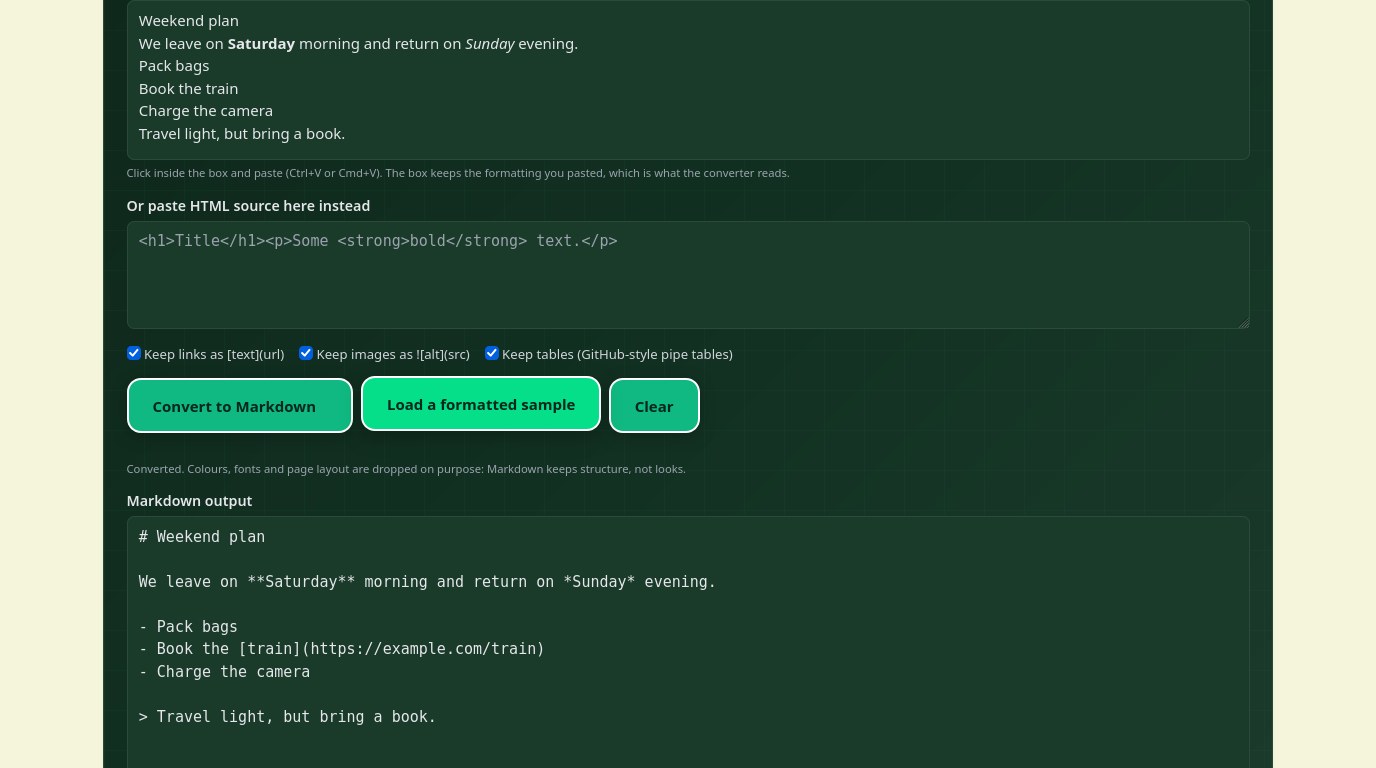
Paste Markdown: convert Word or web text to clean Markdown
Paste formatted text from Word, Google Docs or a web page and get clean Markdown: headings, bold, italic, lists, links, quotes, code blocks and tables, all in your browser.
"Practical guides, productivity hacks, and deep dives into modern development, AI, and design tools."
Paste formatted text from Word, Google Docs or a web page and get clean Markdown: headings, bold, italic, lists, links, quotes, code blocks and tables, all in your browser.
Identify the language and script of any snippet of text: script detection from Unicode blocks plus common-word scoring for Latin, Cyrillic and Arabic scripts, with a confidence label.
Score your text with Flesch Reading Ease, Flesch-Kincaid Grade, Gunning Fog and SMOG, plus word, sentence and syllable counts and your longest sentences.
Find hidden characters in pasted text: zero-width spaces, joiners, BOM, non-breaking spaces, soft hyphens and direction controls, with a cleaned copy.
Find a character by name or code point, copy it with its HTML entity, and inspect pasted characters to see their exact code points.
Make fast checklists that stay private on your device: multiple lists, priorities, due dates, filters, and JSON export and import.
Make, study and flip digital flashcard decks in your browser: add cards, shuffle, mark known or still learning, and export or import decks as JSON.
Conjugate a Form I Arabic verb in past, present and command from any three-letter root, plus ready-made hollow (قال) and defective (دعا) tables, with the present vowel you pick yourself.
The 16 classical Arabic poetry metres (buhur) with their feet, from al-Tawil to al-Mutadarik, the five circles of al-Khalil, the licensed variations, and a verse formatter.
Printable Arabic handwriting tracing sheets: pick letters, sizes and rows, trace the faint letters, and learn all four forms of each letter with a starter word.
Arabic text uses three digit systems: Western (0-9), Eastern Arabic (٠-٩, U+0660) and Persian (۰-۹, U+06F0). Convert any text between them, with separators, so searches and imports stop missing.
Arabic search breaks on أ vs ا, ى vs ي, ة vs ه, tashkeel and tatweel. The five Lucene normalization rules collapse every variant to one form, with a switch for each rule.