AI Regulation News: June 2026 Global Update — 11 Countries, New Laws, and the August Deadline

TL;DR
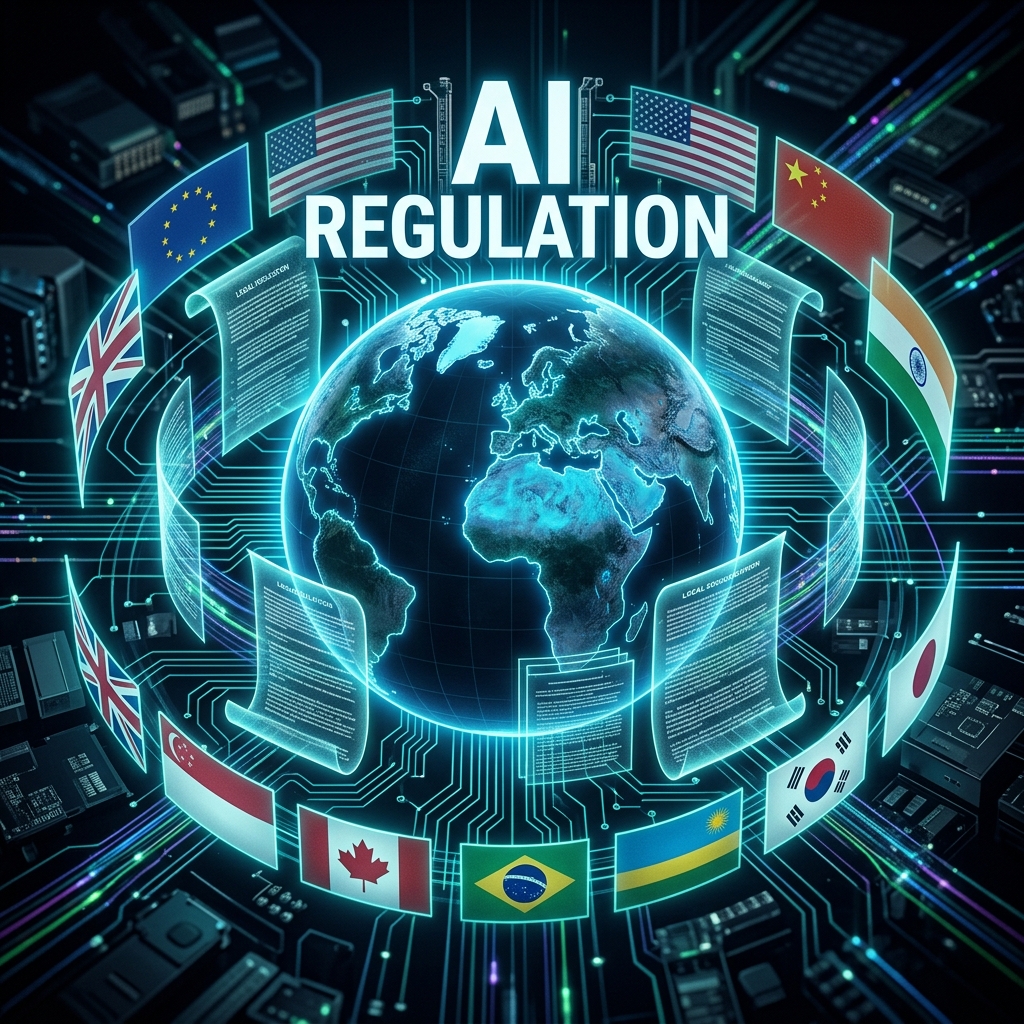
AI regulation news June 2026: 11 countries covered, including the EU's August 2 deadline, China's July 15 companion AI rules, South Korea's live AI Basic Act, India's Supreme Court AI regulations, and first-ever African AI agency in Rwanda.
Table of Contents
Six months ago, teams could still debate whether global AI regulation was a distant concern. June 2026 closes that debate. The EU's biggest enforcement deadline is 48 days away. South Korea's AI Basic Act is already in force. China is enforcing new rules on virtual companions and algorithmic trade secrets. India's Supreme Court is writing its own AI rulebook. Rwanda just became the first African country to stand up a dedicated AI agency.
This is not the future of AI governance. This is the present. And if your product touches users in more than one country, you are already operating inside multiple regulatory frameworks whether you know it or not.
The 60-day deadline nobody should miss: EU AI Act, August 2, 2026
The EU AI Act has been rolling out in stages. The next stage is the biggest one, and it lands in 48 days.
August 2, 2026 is when the bulk of the remaining obligations kick in — transparency duties, high-risk system rules, and provider obligations touching everything from hiring tools to medical devices to credit scoring.
- Feb 2, 2025: General provisions and prohibited practices applied.
- Aug 2, 2025: GPAI model obligations began.
- Aug 2, 2026: Most remaining rules apply. This is the one coming fast.
- Aug 2, 2027: High-risk AI in regulated products (medical, vehicles) gets final rules.
What is new as of June 2026
On May 19, 2026, the European Commission published draft non-binding guidelines on high-risk classification for complex and agentic AI systems. The guidance requires holistic assessment of the entire chain, not individual components.
On June 10, 2026, the Commission released a Code of Practice specifically on AI-generated content labeling, bridging GPAI obligations with the broader transparency duties coming in August.
Member States must also stand up national AI regulatory sandboxes by August 2. France, Germany, and Spain are actively enrolling early participants now. Source: EU AI Act implementation timeline
What teams with EU exposure should do now
- Run your AI inventory against the May 19 high-risk classification update, especially for agentic pipelines.
- Audit AI-generated content outputs against the June 10 Code of Practice.
- Check GPAI deployer documentation requirements for third-party model usage.
- Build your evidence log now — missing records are the most common enforcement trigger.
China: from rules to enforcement, fast
China already had more AI-specific regulations than any other country before June 2026. This month it added more and started enforcing harder.
In force now
- AI trade secrets (June 1, 2026): Algorithms, training datasets, and source code now explicitly classified as trade secrets. Fines up to 5 million yuan for violations.
- Technology transfer controls (June 11, 2026): New restrictions on overseas transfer of Chinese-developed AI algorithms and software.
Coming July 15, 2026: companion AI rules
Interim measures for anthropomorphic AI interaction services take effect in four weeks. Requirements include: disclosure that users interact with AI (not humans), features to prevent addictive usage, and an explicit ban on virtual companion services for minors. If you operate any AI companion, emotional support bot, or roleplay AI with Chinese users, this is your next deadline.
United States: fragmented, fast, and increasingly federal
The US still lacks a single national AI law. But June 2026 produced the clearest federal signals yet — and states are not waiting.
Federal signals
A new presidential executive order in early June emphasizes an "America First" AI strategy — innovation promotion plus hardened security against foreign AI threats. Congress is also considering the "Great American Artificial Intelligence Act of 2026," which proposes to preempt certain state-level AI regulations. If it passes, state compliance maps change overnight.
State activity in June 2026
- New York: Seven AI-related bills sent to the Governor, covering chatbot disclosure and algorithmic discrimination in employment.
- Colorado: Governor vetoed HB 1210 (algorithmic pricing ban), but SB24-205 high-risk AI obligations remain active.
- Rhode Island: Both chambers approved a ban on therapy chatbots for vulnerable users.
United Kingdom: dual-track compliance is now the default
The UK maintains its sector-specific, pro-innovation approach with no single AI act. But many UK businesses are subject to the EU AI Act anyway, due to its extraterritorial reach. The MHRA published healthcare AI guidance on June 11, 2026. UK companies with EU customers are on both tracks simultaneously — UK sector rules and EU AI Act.
India: two fronts, one clear direction
India moved on two fronts in June 2026:
- Supreme Court AI Regulations (June 12, 2026): Draft rules for AI use in courts. AI is assistive only — standalone algorithmic judicial decisions are prohibited. Comment period closed June 20.
- IT Rules amendment (Feb 2026, in force): Social media platforms must label AI-generated and synthetic content. Deepfake labeling is now a legal obligation, not a guideline.
India's broader approach is "techno-legal" — using existing law plus the non-binding India AI Governance Guidelines (released November 2025) rather than a single heavy-handed AI act.
South Korea: the first major AI act in Asia is live
South Korea's AI Basic Act — the Framework Act on the Development of AI and the Creation of a Foundation for Trust — came into force on January 22, 2026. It is the first comprehensive, risk-based AI framework in Asia.
- Transparency disclosures required for AI systems that interact with users
- Impact assessments required for high-impact systems
- National AI Committee established for cross-agency enforcement
If you have users or operations in South Korea, the AI Basic Act is a current legal obligation, not a future concern.
Japan: innovation-first, but privacy rules are tightening
Japan's AI Promotion Act (enacted 2025) provides the framework. The June 2026 compliance update: the government is advancing an amendment to the Act on the Protection of Personal Information (APPI) that includes a consent exception for AI training data. Japan's voluntary governance model means light enforcement — but METI guidance carries real weight in procurement and partner relationships.
Canada: starting over, more carefully
After AIDA (Bill C-27) failed in 2025, Canada launched its "AI for All" national strategy in June 2026 — coordinating existing rules rather than attempting another omnibus act. Bill C-34 (Safe Social Media Act, introduced June 10, 2026) also includes specific provisions requiring AI chatbot transparency, with a focus on child safety.
Brazil: building the foundation
Brazil lacks a dedicated AI law. Governance runs through the General Data Protection Law (LGPD) and Consumer Defense Code. Bill No. 2338/2023 — a risk-based AI regime modeled on the EU — remains in legislative progress. If you serve Brazilian users with AI products, you need LGPD compliance now and should track Bill 2338 closely.
Singapore: the trusted hub strategy
Singapore relies on its Model AI Governance Frameworks rather than a single law. In June 2026, IMDA and Microsoft signed an MOU on AI safety research, agentic AI governance, and multilingual safety benchmarks. Singapore's voluntary framework is likely to harden into binding rules as agentic AI becomes mainstream — watch for this transition in the next 12–18 months.
Africa: Rwanda leads, a continent watches
Rwanda approved the establishment of a National Artificial Intelligence Agency in June 2026 — the first African country with an institution entirely dedicated to AI governance. Continental debate continues about whether to adopt the EU model or develop original African AI frameworks suited to local infrastructure, context, and risk profiles.
The global map: where each country stands right now
| Country / Region | Status | Key Date | Approach |
|---|---|---|---|
| European Union | Enforcement rolling | Aug 2, 2026 | Comprehensive, risk-based |
| China | Active enforcement | July 15, 2026 | Sector-specific, intensifying |
| South Korea | In force | Jan 22, 2026 | Comprehensive national act |
| United States | Fragmented | State-by-state | Federal draft, state action |
| India | Partial rules in force | Feb 2026 (labeling) | Techno-legal, guidelines-first |
| United Kingdom | Sector-specific | Ongoing | Pro-innovation, dual-track |
| Japan | Voluntary framework | APPI amendment pending | Innovation-first |
| Canada | Strategy reset | June 2026 | Coordinated existing law |
| Brazil | Bill pending | 2026 (TBD) | LGPD + Consumer law |
| Singapore | Principles-based | Ongoing | Hub strategy, voluntary |
| Rwanda | Agency established | June 2026 | First dedicated African agency |
The convergence problem nobody talks about
Every major jurisdiction now uses risk-based language. Every major jurisdiction now requires transparency for high-risk AI. Every major jurisdiction now talks about accountability. But the definitions of "high-risk," the documentation requirements, the enforcement bodies, and the penalty structures are all different.
For a product team shipping to global markets, you cannot write one policy and call it done. You need a living compliance architecture — one that maps each product and each user population to the specific obligations that apply, and updates as those obligations change.
A June 2026 action plan: 4 weeks, 4 priorities
Week 1: EU audit and August readiness
Run your full AI inventory against the May 19 high-risk classification guidance. Flag agentic pipelines. Assign documentation owners. Start your evidence log today.
Week 2: China July 15 deadline check
If you have any AI companion, emotional, or roleplay features: audit against the July 15 rules immediately. Check whether any model weights or training pipelines cross Chinese borders under the new technology transfer controls.
Week 3: Content labeling audit
Map every AI-generated output (text, images, audio, video) against active labeling rules: EU Code of Practice (June 10), China (Sep 2025, in force), India IT Rules (Feb 2026, in force). If you serve South Korean users, confirm transparency disclosures under the AI Basic Act.
Week 4: Documentation and monitoring setup
Create or update your AI system register with owner, use case, risk classification, jurisdictions, and evidence log location. Set up a monthly regulatory monitoring cadence. Assign someone to track the US federal AI bill — if it passes with preemption language, state compliance maps change overnight.
Final take
The opening question in AI regulation used to be: will governments actually do anything? That question has its answer. They are doing things. Simultaneously. In multiple languages. With different definitions of the same words.
The teams that will win the next 18 months of AI regulation are not the ones with the most lawyers. They are the ones who built lightweight, auditable, jurisdiction-aware compliance systems early — so that each new rule update is a data entry, not a crisis. June 2026 is a good month to start building that.



Was this article helpful?
Comments
Loading comments...