Is AI Taking Over Gulf Jobs?


TL;DR
AI will displace an estimated 9 million jobs across the GCC by 2030, according to McKinsey. But the picture is more specific than that headline suggests. Here is what is actually happening, which roles are genuinely at risk, and what Gulf workers can do right now.
Table of Contents
AI will displace an estimated 9 million jobs across the GCC by 2030, according to McKinsey Global Institute. That is roughly 14% of the current regional workforce. And no, it is not evenly distributed.
Which jobs are actually at risk
The roles most exposed are the ones built around high-volume, rule-based tasks. Data entry clerks, bank tellers, insurance adjusters processing standard claims, customer service agents handling scripted queries. These are not abstract projections. Emirates NBD deployed an AI triage system in 2023 that reduced its customer service headcount by 30% in two years. Abu Dhabi National Insurance rolled out AI underwriting tools that cut processing time from 3 days to 4 hours.
Government administration is another pressure point. The UAE's Smart Government initiative has automated more than 1,100 public services since 2021. Saudi Arabia's NEOM project is planning to use AI operations centers that require a fraction of the administrative staff a traditional city government would need.
Construction supervision, basic legal document review, accounting reconciliation, and HR screening are all in the same category. If a task can be described in a step-by-step flowchart, an AI can learn to do it faster and at lower cost.
Who has cover
Roles requiring physical presence in uncontrolled environments are safer than most people expect. Electricians, plumbers, HVAC technicians, site engineers who physically inspect construction — these are expensive to automate because the physical world is messy. Robotics capable of replacing a skilled tradesperson on a Gulf construction site costs somewhere between $200,000 and $500,000 per unit, and they require their own technicians.
Anything requiring deep local relationships is also harder to displace. A senior Emirati banker who holds relationships with royal family-connected entities brings something that an AI loan-processing system cannot replicate. Cultural trust and wasta — the Arabic concept of personal connection and influence — remain genuine economic assets in the region.
The same applies to healthcare. Saudi Arabia's Vision 2030 plan targets 70% of healthcare to be delivered by Saudi nationals. There is a nursing shortage across the Gulf. AI diagnostic tools are arriving fast, but they still need qualified clinicians to interpret outputs and treat patients.
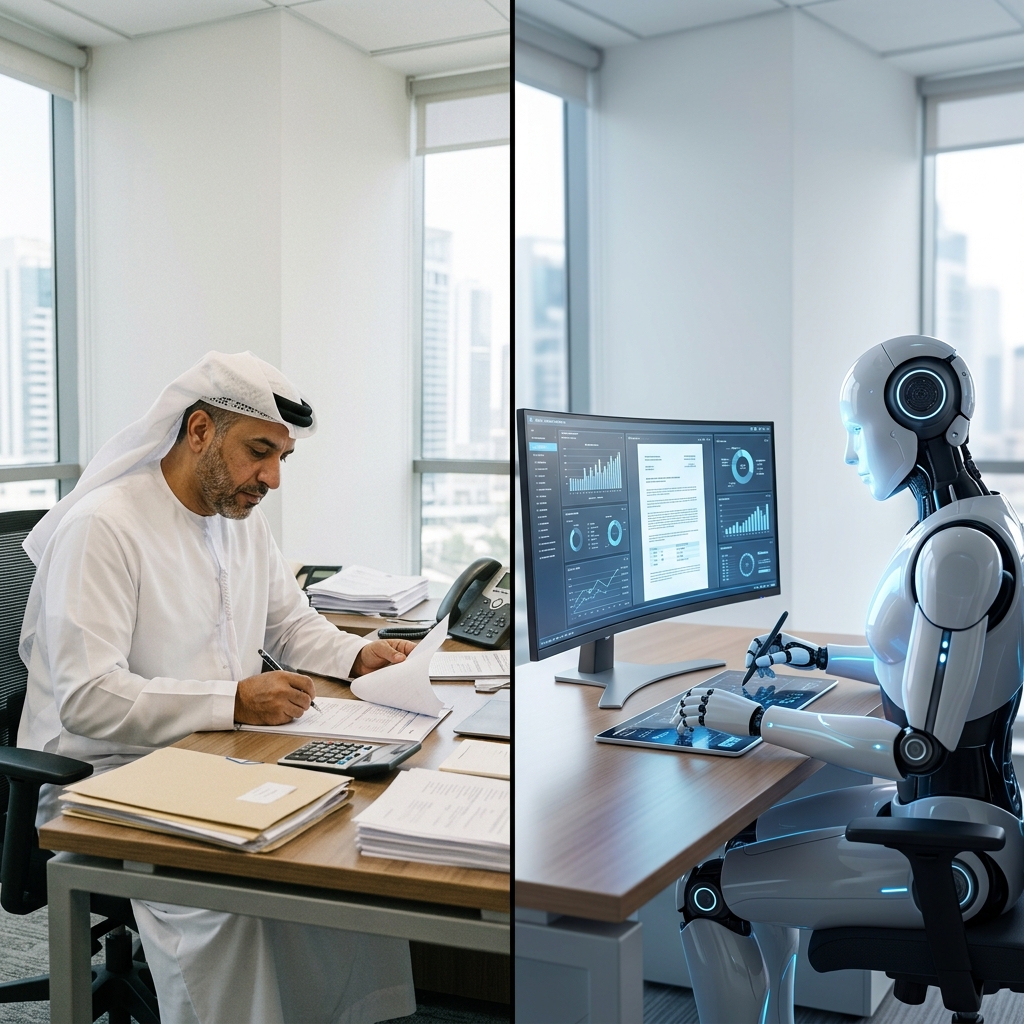
Expat workers face a compounded problem
If you are an expat working in the Gulf in a role that AI can automate, you face two pressures at once. First, the AI displacement risk itself. Second, the nationalisation programs — Emiratisation, Saudisation, Bahrainisation — that all six GCC states are pushing aggressively. Saudi Arabia's Nitaqat system already penalises companies that do not meet Saudi employee quotas. Bahrain launched a wage support program specifically designed to make hiring Bahraini nationals cheaper than expat alternatives.
When a role gets automated, companies will often use the opportunity to restructure around nationalisation targets. The expat holding the job being replaced is unlikely to be redeployed.
What governments are doing
The GCC governments are spending heavily on the transition, at least for their own nationals. The UAE's National Program for Coders set a target of training 100,000 coders by 2025 and largely hit it. Saudi Arabia's Human Capability Development Program allocated $53 billion over five years specifically for workforce upskilling. Qatar has a national AI strategy that includes worker retraining as a core pillar, connected to its 2030 National Vision.
These programs are real and reasonably well-funded. Whether they move fast enough to match the pace of AI adoption in the private sector is the open question. Most economists studying the region think there is a 5-to-7-year window before the displacement curve steepens significantly.

What workers in the Gulf can do now
The honest answer is: move up the value chain of your current role before AI arrives at your level. A bank teller who understands credit risk analysis is safer than one who doesn't. An HR coordinator who can run predictive retention analysis using AI tools is more valuable than one who only schedules interviews.
For the Gulf context specifically, Arabic-language AI skills are genuinely scarce. Most large language models still perform worse in Arabic than in English. A professional who can audit AI outputs in Arabic, spot cultural errors, or build Arabic-language prompt workflows has a skill gap in their favour right now. That window will not stay open indefinitely.
For anyone whose role is already heavily automated, the clearest path is certification in AI-adjacent tools. Microsoft and Google both have certification programs for AI tools that cost under $200 and are recognised across Gulf hiring markets. The UAE's Ministry of Human Resources and Emiratisation (MOHRE) has a subsidised digital skills passport program for residents.
Key figures
- 9 million — GCC jobs at risk of displacement by 2030 (McKinsey Global Institute)
- 14% — estimated share of current GCC workforce affected
- 30% — reduction in Emirates NBD customer service headcount over 2 years after AI triage deployment
- 1,100+ — UAE government services automated since 2021
- $53 billion — Saudi Arabia's Human Capability Development Program budget for workforce upskilling
- 100,000 — coders targeted under UAE's National Program for Coders
The verdict
AI is not taking over Gulf jobs in a sudden sweep. It is eroding them role by role, task by task, usually through efficiency gains that mean the next person who leaves a team is not replaced. The displacement is quieter than the headlines suggest, but it is real and it is accelerating.
The Gulf has a specific dynamic that most global AI-jobs analyses miss: nationalisation programs and AI adoption are happening simultaneously. That combination is sharper than either would be alone. A role that becomes automatable in Riyadh or Dubai faces pressure from two directions at once.
The workers with the most exposure are those in mid-level clerical, administrative, and processing roles who are also expat nationals in countries with active Saudisation or Emiratisation targets. 2025 and 2026 are the years to reskill.
References
- McKinsey Global Institute — "The future of work in the Middle East," 2023.
mckinsey.com - UAE Smart Government — Official portal on government service digitisation.
u.ae - Saudi Vision 2030 / HCDP — Human Capability Development Program overview.
vision2030.gov.sa - MOHRE UAE — Digital Skills Passport program for residents.
mohre.gov.ae


Was this article helpful?
Comments
Loading comments...