Pre-Startup Safety Review (PSSR): The Definitive Industrial Guide & OSHA PSM Checklist


TL;DR
The ultimate guide to Pre-Startup Safety Review (PSSR). Discover OSHA 1910.119(i) requirements, the 3 Ps of readiness, Category A vs B punch-list rules, and a full engineering verification checklist.
Table of Contents
In high-hazard process industries—from petrochemical refineries and specialty chemical plants to pharmaceutical synthesis facilities and offshore oil platforms—the startup phase is statistically the most dangerous period of an asset's lifecycle. According to the Center for Chemical Process Safety (CCPS), over 50% of process safety incidents occur during commissioning, startup, or shutdown phases. The Pre-Startup Safety Review (PSSR) is the final operational barrier and quality firewall established before introducing hazardous materials, energy, or chemical feedstocks into a new or modified system.
PSSR Essentials at a Glance
Verification that hardware matches design specifications (Plant), operating and maintenance personnel are certified (People), and validated SOPs/EOPs are accessible (Procedures).
Mandatory under OSHA Process Safety Management (PSM) and EPA RMP. Requires documented verification of 5 distinct statutory criteria before startup.
Zero Category A action items may remain open prior to chemical/feedstock introduction. Category B non-critical items must carry assigned owners and strict completion dates.
1. What is a Pre-Startup Safety Review (PSSR)?
A Pre-Startup Safety Review (PSSR) is a systematic, multidisciplinary verification process conducted immediately prior to introducing hazardous substances or process materials into new, modified, or overhauled industrial equipment. Rather than a routine administrative sign-off, a PSSR is an intensive physical, procedural, and cultural audit that confirms every engineering safeguard, instrument interlock, operating guideline, and training requirement has been satisfied in the real world.
While commissioning proves that mechanical machinery operates (e.g., motors rotate, pumps generate head pressure, and control valves modulate), the PSSR verifies that the entire sociotechnical system is safe to operate under both expected conditions and emergency upset scenarios. Modern process safety engineering breaks this verification down into the Three Ps of Startup Readiness:
1. Plant Readiness
Verification that physical hardware matches Process Safety Information (PSI). Includes inspection of pressure relief valves (PRVs), flame arrestors, safety instrumented functions (SIF), pipe support integrity, electrical grounding, leak test certificates, and equipment tagging.
2. People Readiness
Confirmation that all board operators, field operators, maintenance technicians, and emergency response crews have completed tailored training. Operators must demonstrate competency on safe operating limits (SOLs) and emergency shutdown procedures.
3. Procedural Readiness
Validation that standard operating procedures (SOPs), emergency response plans (ERPs), lock-out/tag-out (LOTO) protocols, and preventive maintenance routines are fully approved, stamped, and present in the control room and field kiosks.
2. The Regulatory Framework: OSHA 1910.119(i) and Global Mandates
In the United States, conducting a PSSR is not merely an industry best practice—it is an explicit federal mandate under OSHA 29 CFR 1910.119(i), the Process Safety Management (PSM) standard for Highly Hazardous Chemicals (HHC). Identical requirements are codified by the Environmental Protection Agency (EPA) under the Risk Management Program (40 CFR Part 68).
Under OSHA 1910.119(i)(2), an employer must perform a PSSR for new facilities and for modified facilities when the modification is significant enough to require a change in the process safety information. The regulation stipulates five non-negotiable criteria:
The 5 Mandatory Elements of OSHA 1910.119(i)(2)
-
§ (i)
Construction and Equipment Integrity: Construction and equipment must be confirmed to be in accordance with engineering design specifications and recognized manufacturer standards.
-
§ (ii)
Adequacy of Procedures: Safety, operating, maintenance, and emergency response procedures are in place and are adequate for the scope of operation.
-
§ (iii)
PHA & HAZOP Action Closure: For new facilities, a process hazard analysis (PHA) has been performed and all recommendations resolved or implemented; for modified facilities, all Management of Change (MOC) requirements have been satisfied.
-
§ (iv)
Personnel Training: Training of each employee involved in operating the process has been fully completed and documented.
-
§ (v)
MOC Formal Clearance: All engineering change approvals, technical reviews, and authorization sign-offs under the facility's Management of Change protocol are finalized.
Across international jurisdictions, similar mandates apply: in the European Union, the Seveso III Directive (Directive 2012/18/EU) requires safety management system (SMS) verification before introducing hazardous substances into major-accident hazard establishments; in the United Kingdom, the Control of Major Accident Hazards (COMAH) Regulations enforce equivalent pre-operational safety assurance.
3. When Must a PSSR Be Conducted? (The 6 Critical Triggers)
A common misconception among plant operators is that PSSR is reserved exclusively for the ribbon-cutting of brand new plants. In practice, the vast majority of PSSRs take place during the ongoing operating lifecycle of a facility. Below are the six operational triggers that mandate a PSSR:
1. Grassroots Capital Projects
Initial startup of newly constructed greenfield facilities, modular skids, distillation units, or new chemical storage terminals prior to initial raw-feed admission.
2. Management of Change (MOC) Modifications
Any physical piping reroute, metallurgy replacement, control system logic update (PLC/DCS code), or modification that alters the Safe Operating Limits (SOL) or Process Safety Information (PSI).
3. Post-Turnaround (TAR) & Overhauls
Major scheduled outages where pressure vessels were opened, blind flanges were installed/pulled, safety valves were bench-tested, or rotating equipment underwent comprehensive overhaul.
4. Post-Emergency Shutdowns (ESD)
Following an unexpected emergency trip caused by abnormal operating dynamics, critical equipment failure, runaway reaction tendencies, or automated interlock activations.
5. Remediation Following Incidents
After fires, toxic releases, deflagrations, or near-misses. PSSR confirms that root cause corrective actions and engineering modifications have been validated prior to restarting.
6. De-Mothballing & Extended Suspensions
When bringing units back online after seasonal shutdowns or multi-month mothballing. Verifies that gaskets haven't degraded, corrosion under insulation (CUI) hasn't formed, and instruments remain calibrated.
4. PSSR vs. MOC vs. Commissioning vs. HAZOP: The Distinctions
Process engineers and project managers frequently conflate safety reviews with commissioning milestones. Understanding where PSSR sits within the process safety lifecycle is essential to prevent dangerous blind spots:
| Process Element | Primary Objective | Project Lifecycle Timing | Key Output / Deliverable |
|---|---|---|---|
| HAZOP / PHA | Identify process hazards, failure nodes, and risk mitigation safeguards. | Detailed Engineering & FEED phase. | PHA Action Item Log & Safety Requirement Specs (SRS). |
| MOC (Management of Change) | Authorize, evaluate, and track physical, chemical, or organizational changes. | Initiation through engineering & procurement. | Approved MOC Package & Engineering Change Order. |
| Commissioning | Energize equipment, run motors, circulate safe fluids (water/nitrogen), test loops. | Construction completion prior to chemical introduction. | Ready for Commissioning (RFC) & Loop Check Records. |
| PSSR (Pre-Startup Safety Review) | Final gatekeeper: physically verify Plant, People, and Procedures before admitting hazardous material. | Final step immediately preceding startup / feedstock admission. | Cleared Cat A Punch List & Signed Startup Authorization. |
5. The 5-Phase PSSR Execution Workflow
To avoid treating a PSSR as a rushed checklist exercise on the eve of startup, top-tier operating facilities follow a structured, gated 5-phase methodology:
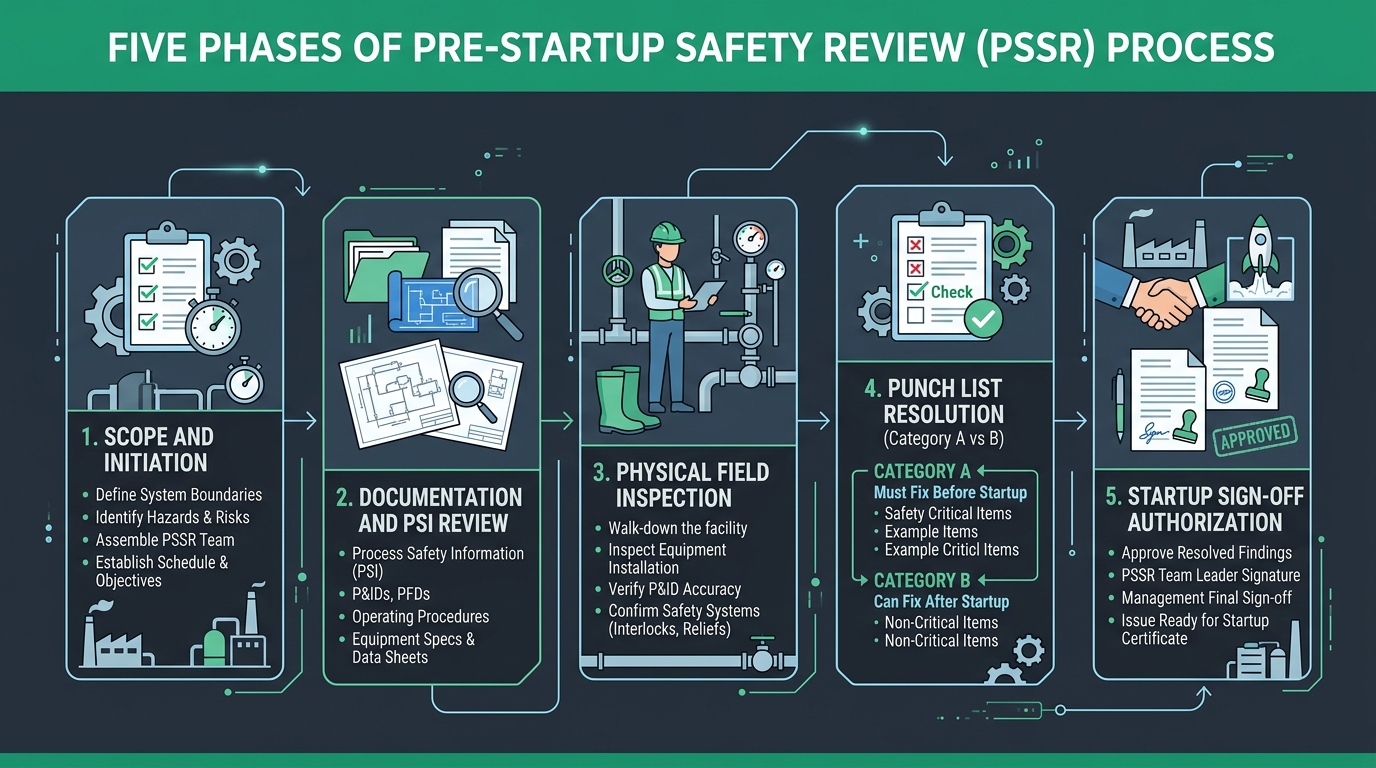
Phase 1: Initiation & Scoping
Define clear battery limits using marked-up Piping & Instrumentation Diagrams (P&IDs). Establish the multidisciplinary PSSR team, define review criteria, and schedule walkthrough milestones at least 2 to 4 weeks prior to target startup to prevent schedule compression.
Phase 2: Documentation & PSI Audit
Review all engineering deliverables: As-Built P&IDs, electrical hazardous area classification drawings, Relief Valve Calculation Sheets, Cause & Effect Matrices, Safety Integrity Level (SIL) verification calculations, and vendor Operation & Maintenance (O&M) manuals.
Phase 3: Multidisciplinary Physical Field Walkdown
The team physically walks the unit from nozzle to nozzle. Inspectors trace every process line, verify valve accessibility, check instrument tagging, ensure blinding manifolds are positioned correctly, verify safety shower water supply and eyewash pressure, and test alarm enunciators.
Phase 4: Punch-List Categorization (Category A vs. Category B)
Deficiencies identified during the walkdown are compiled into a formal punch-list register. Each deficiency is strictly categorized as Category A (must be corrected prior to introducing hazardous materials) or Category B (non-critical, post-startup resolution allowable).
Phase 5: Final Sign-Off & Startup Authorization
Once all Category A punch items are physically verified as closed in the field, the PSSR Team Lead, Operations Manager, Maintenance Superintendent, and Process Safety Manager execute the formal sign-off certificate. The system is officially handed over to Operations for chemical introduction.
6. Punch List Discipline: Category A vs. Category B Action Items
The integrity of any PSSR hinges entirely on how strictly the facility categorizes and manages its punch-list findings. Allowing a safety-critical deficiency to slip through as a "post-startup item" under project schedule pressure is the primary organizational failure behind historical startup catastrophes:
Category A (Pre-Startup Items)
Zero startup permitted until 100% verified, re-inspected, and closed.
- Uncalibrated pressure relief device or missing PRV car-seal.
- Incomplete safety instrumented system (SIS) trip logic or untested interlock.
- Missing or incomplete Standard Operating Procedures (SOPs) for startup.
- Operators not trained or certified on newly modified unit controls.
- Unclosed PHA / HAZOP critical recommendations.
- Hydrotesting or pneumatic leak test documentation missing.
- Non-explosion-proof electrical enclosure located inside a Class I, Div 1 zone.
Category B (Post-Startup Items)
Startup allowed provided items carry defined owners and 30/60-day closeout dates.
- Missing permanent equipment stainless-steel nameplates (temporary tags verified).
- Non-safety painting, touch-up insulation, or weather jacketing incomplete.
- Final CAD drafting updates for non-critical electrical conduit runs.
- Housekeeping items such as scaffolding removal outside the fire egress path.
- Routine spare parts stocking levels not yet reached in warehouse inventory.
- Non-critical preventive maintenance scheduling in the CMMS.
7. The Comprehensive Industrial PSSR Checklist Matrix
To maintain rigor across inspections, engineering teams should evaluate their systems across the following comprehensive matrix:
| Verification Discipline | Field Check Items & Physical Inspection | Mandatory Verification Evidence |
|---|---|---|
| Piping & Mechanical | Pipe wall thickness, flange ratings, torque records, gasket material compatibility, spring hanger cold settings, blind lists pulled. | Hydrostatic test charts, NDT radiographic inspection reports, bolt torquing QA logs. |
| Relief & Overpressure Systems | Relief valve set pressures match design, rupture discs oriented correctly, car-seals locked open on upstream/downstream isolation valves. | PRV shop bench calibration certificates, relief discharge piping stress calculations. |
| Electrical & Instrumentation | ATEX/IECEx hazardous area compliance, seal-offs poured, motor rotation checks, transmitter range verification, fail-safe valve action. | Loop check sheets, motor bump test records, earthing/bonding megger test reports. |
| Safety Instrumented Systems (SIS) | End-to-end trip logic testing from sensor to final control element, bypass tracking alarms, SIL proof-test execution. | Signed Cause & Effect matrix validation, Safety Requirement Specification (SRS) sign-off. |
| Process Safety Information (PSI) | As-Built P&ID field verification, safe operating limit tables posted, chemical SDS packets accessible to operators. | Redlined and stamped As-Built drawing sets, updated Chemical Inventory Registry. |
| Operating Procedures | Startup, normal, temporary, and emergency shutdown procedures reviewed and verified step-by-step with operating technicians. | Signed procedure peer-reviews, Document Management System (DMS) approved revisions. |
| Training & Human Readiness | Console and field operator walkthrough of modified control loops, review of what-if emergency scenarios. | Signed employee training attendance rosters, operator competency quiz scores. |
| Emergency Preparedness | Emergency eyewash/shower water flow and temperature checks, fire monitor coverage, gas detector alarm set points verified. | Fire & Gas (F&G) system loop test records, emergency escape route inspection logs. |
8. The Multidisciplinary PSSR Team Roles
A PSSR cannot be delegated to an individual engineer or a lone safety officer. A reliable review requires cross-functional scrutiny where each member brings specialized domain knowledge and a distinct vantage point:
Process Safety or Senior Operations Lead
Coordinates the review schedule, maintains independence from commercial deadlines, enforces punch-list rigor, and has veto power against premature startup.
Shift Supervisor or Lead Console Operator
Verifies human factor ergonomics, valve accessibility, alarm management rationality, and validates that SOP step sequences match actual field equipment layout.
Electrical & Instrumentation Engineer
Audits explosion-proof ratings, calibration certificates, SIS loop tests, instrument ranges, interlock overrides, and emergency trip bypass switches.
Reliability or Piping Engineer
Inspects pipe supports, thermal expansion loops, mechanical seals, alignment reports, pressure relief valve certifications, and hydrostatic test documentation.
PSM Coordinator / Safety Specialist
Ensures all PHA / HAZOP recommendations have been implemented, verifies MOC compliance, audits environmental containment, and checks fire & gas detection coverage.
Project Execution / Contractor Rep
Provides contractor QA/QC documentation, vendor test packets, resolves punch-list execution, and confirms mechanical completion milestones.
9. Industrial Case Study: When PSSR Fails (BP Texas City Disaster)
The catastrophic consequences of treating pre-startup safety reviews as a paper exercise were laid bare on March 23, 2005, at the BP Texas City Refinery. During the startup of the isomerization (ISOM) unit following a turnaround, hydrocarbon liquid filled a 170-foot raffinate splitter tower to overflow, triggering a massive vapor cloud explosion that killed 15 workers and injured more than 180 others.
Critical Startup Breakdowns Identified by the US Chemical Safety Board (CSB)
- Inadequate Pre-Startup Instrumentation Verification: The tower level transmitter was defective and calibrated improperly, reading that liquid level was dropping when the vessel was dangerously filling to the brim.
- Bypassed & Non-Functional Safety Alarms: A high-level alarm failed to sound because maintenance had not tested or verified switch functionality prior to unit restart.
- Outdated & Ignored Operating Procedures: The startup procedure was poorly drafted, failed to provide explicit guidelines on tower filling limits, and omitted specific safe operating parameters.
- Lack of Formal Multidisciplinary PSSR: If a rigorous, cross-functional field walkdown had verified transmitter loop calibration and tested alarm switches end-to-end, the catastrophic overfilling would have been prevented.
The CSB's investigation cemented PSSR as one of the most critical safety management pillars in global process operations: never assume an instrument works because it is newly installed; verify it in the field before introducing chemical feeds.
Frequently Asked Questions About PSSR
Who has final sign-off authority on a PSSR?
Final sign-off is a joint executive authorization typically signed by the Operations Manager / Plant Manager, the PSSR Team Leader, and the Process Safety (PSM) Manager. In high-hazard facilities, operations personnel retain the ultimate right of refusal: if operations are not satisfied with field readiness, startup cannot proceed.
Can a PSSR be conducted in stages or phased packages?
Yes. On complex megaprojects or large chemical complexes, facilities implement a Phased or Staged PSSR strategy. For example, Stage 1 may cover utility introduction (cooling water, nitrogen purge, instrument air), Stage 2 covers hot oil circulation, and Stage 3 authorizes hazardous hydrocarbon/chemical introduction. Each phase requires its own isolated battery boundaries, checklist, and sign-off.
What is the difference between a PSSR and Commissioning?
Commissioning is an engineering and construction activity focused on functional testing—energizing motors, tuning PID loops, leak-testing piping with nitrogen, and running pumps on water. PSSR is a safety assurance gatekeeper that verifies not just mechanical completion, but total operational readiness: operator training, verified SOPs, closed PHA items, and emergency preparedness.
Is a PSSR legally required for minor maintenance replacements?
Under OSHA 1910.119(i), a true "Replacement-in-Kind" (RIK)—such as swapping a defective pump with an exact identical model with matching metallurgy, electrical rating, and impeller size—does not legally trigger a full PSSR or MOC. However, if any specification changes (e.g., higher horsepower motor, alternative mechanical seal, or modified piping layout), it constitutes a modification and mandates a formal MOC and PSSR.
What happens if a Category A punch-list item cannot be resolved immediately?
Startup must be halted until the item is fully engineered, physically corrected, and re-inspected. The only allowable exception is if an engineering re-evaluation proves that an interim risk control (e.g., temporary blind flange isolation of that specific subsystem) safely reduces risk to As Low As Reasonably Practicable (ALARP), documented via a formal Management of Change with Plant Manager approval.
What documentation must be compiled prior to the PSSR field walkdown?
The PSSR package should include: Approved P&IDs with redlines, MOC documentation, PHA/HAZOP closeout sheets, Instrument Loop Test sheets, Relief Valve calibration certificates, Hydrotest/Pressure test charts, Equipment Data Sheets, Approved Standard Operating Procedures (SOPs), and Signed Operator Training Records.
How does PSSR integrate with Management of Change (MOC)?
PSSR is the final physical milestone of the MOC process. While MOC governs the design review, risk assessment, and technical approvals of a change, the PSSR verifies in the field that the change was implemented strictly according to the approved MOC specifications and that no unauthorized deviations were introduced during construction.


Was this article helpful?
Comments
Loading comments...