SEO vs. GEO: How Generative Engines are Rewriting the Rules of Search

TL;DR
Search is changing. Generative engines like ChatGPT and Perplexity require a completely new approach to visibility. Learn how to optimize for AI overviews and citations.
Table of Contents
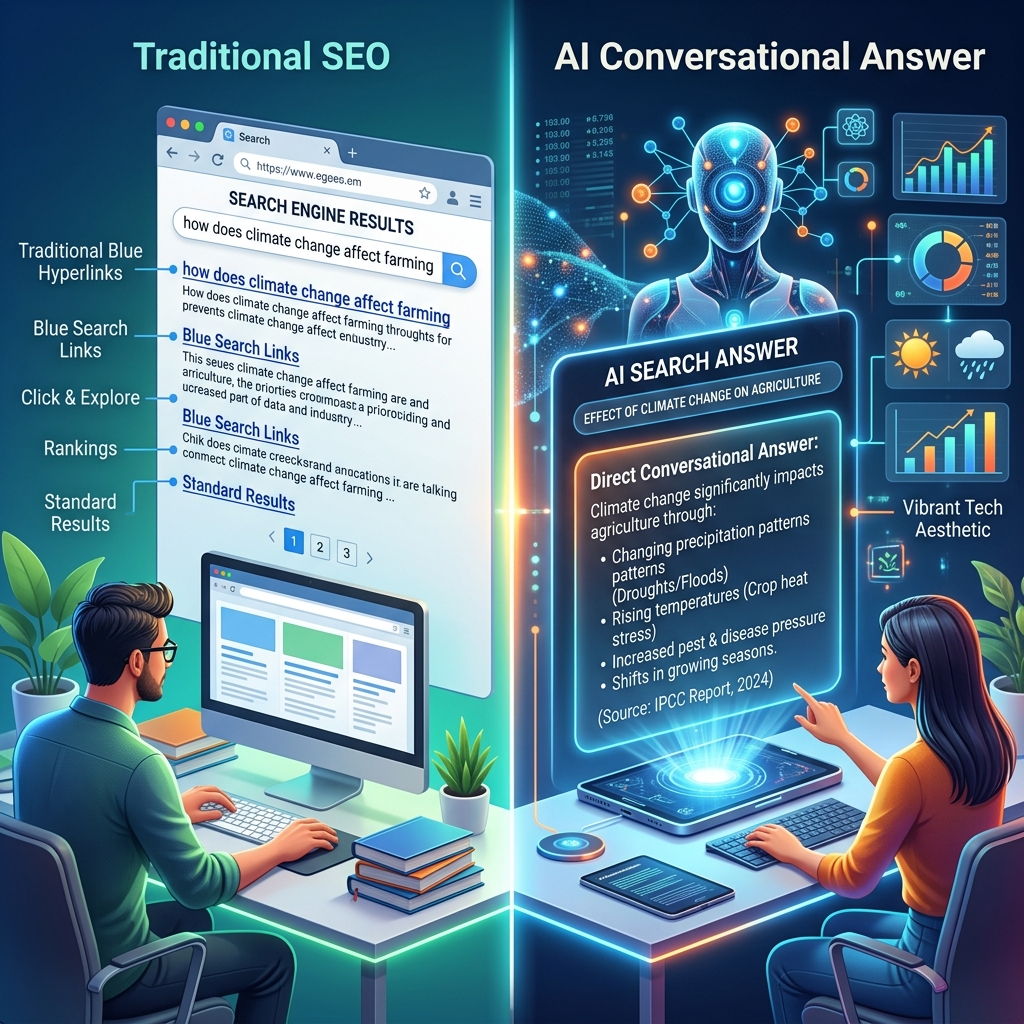
Search is changing. For twenty years, users typed fragmented queries into a box and received a list of ten blue links. They clicked through pages, navigated menus, and searched for specific paragraphs. Now, they ask complex questions and receive direct, synthesized answers from AI engines like ChatGPT, Perplexity, and Google AI Overviews. This shift requires a completely new approach to visibility.
Traditional Search Engine Optimization (SEO) focused on matching keywords to user intent to drive traffic to a website. Generative Engine Optimization (GEO) focuses on providing the exact data an AI needs to construct a factual answer, often keeping the user entirely within the chat interface. This is the death of the funnel as we know it.
The Mechanics of Generative Engine Optimization
Generative engines operate differently than traditional crawlers. A traditional search engine indexes pages and ranks them based on link authority and keyword relevance. It stores a map of the internet.
Generative engines use Retrieval-Augmented Generation (RAG). They do not just return links; they read the links. When a user asks a question, the system searches the web for source material, extracts the facts, synthesizes a new natural language response, and cites the sources it used to generate that response.

GEO ensures your content is selected during that crucial retrieval phase. The engine needs to extract facts easily. If your data is buried inside long paragraphs without clear headings, the engine will likely skip your site and use a competitor with better structure. The goal is no longer just ranking on page one; the goal is becoming the source code for the AI's answer.
AI models evaluate text probabilistically. They favor content that provides clear definitions, verifiable numbers, and structured data formats like lists and tables. They ignore filler words and decorative language.
SEO vs. GEO: The Five Major Shifts
The tactics that worked in 2020 are losing effectiveness. The focus must shift from manipulating algorithms to structuring knowledge. Here are the core differences.
1. From Keywords to Entities and Semantics
Traditional SEO obsessed over exact-match keywords. Content writers placed specific phrases like "best accounting software 2026" a precise number of times across a page. They measured keyword density and forced unnatural phrasing into headers.
GEO focuses on entities. An entity is a defined concept, person, place, or thing. AI models map the relationships between these entities in a massive knowledge graph. Instead of repeating keywords, you must explain the relationship between your topic and related concepts.
If you write about accounting software, you need to cover payroll laws, API integrations, tax compliance, and cloud security to show the model you understand the entire domain. The engine wants context, not repetition.
2. From Backlinks to Citations and Brand Mentions
Links were the primary currency of Google. A high volume of inbound links signaled authority. SEO teams spent massive budgets buying links or running outreach campaigns.
AI engines value citations and unlinked brand mentions. A citation occurs when a credible source mentions your brand, product, or data, even if they do not link to you. If industry publications mention your research, the AI model associates your brand with expertise in that subject area.
Mention volume across high-trust domains builds confidence in the RAG model. If you claim to be the best tool, but no one on Reddit, Quora, or industry forums discusses your tool, the AI will disregard your claim.
3. From Word Count to Information Gain
Many SEO managers believed longer content ranked higher. This led to padded articles filled with obvious information, long recipes with personal stories, and 3,000-word essays that could be summarized in three sentences.
GEO prioritizes information gain. Information gain is the measure of new data a page adds to a topic compared to what is already available online. If you publish an article that repeats the same ten points found on every other site, your information gain is zero. The AI model has no reason to cite you because it already learned those facts from older, more authoritative sources.

To achieve high information gain, you must introduce primary research, proprietary data, expert quotes, or a new analytical framework. You must provide facts the model cannot find elsewhere.
4. From Vague Advice to High-Density Facts
Fluff writing damages your chances of being cited. AI systems struggle to extract facts from verbose, winding sentences that use flowery metaphors or complex analogies.
You must increase your fact density. Use specific numbers. Name specific people. Cite specific dates. Instead of writing "Many businesses use our tool," write "4,200 retail businesses deployed our API in Q1 2026." The second sentence contains three specific facts the AI can extract and cite confidently.
Remove marketing adjectives. A machine does not care if your product is "industry-leading" or "revolutionary." It cares if your product "processes 10,000 requests per second."
5. From Search Volume to Conversational Intent
Traditional SEO tools rely on historical search volume. You target a keyword because 10,000 people searched for it last month.
In GEO, users do not search with keywords. They prompt the engine with specific, long-tail scenarios. Instead of "CRM software," they type "What is the best CRM software for a 50-person remote team using Slack and HubSpot, under per user?"
Historical search volume tools cannot track these hyper-specific prompts. You must anticipate the exact problems your target audience faces and answer them directly in your content.
E-E-A-T and the Trust Deficit
The internet is flooded with AI-generated text. As the volume of synthetic content increases exponentially, search engines face a massive trust deficit. They must find ways to verify which information is reliable and which is hallucinated.
They rely heavily on E-E-A-T: Experience, Expertise, Authoritativeness, and Trustworthiness. These signals help models filter out low-quality mass-produced content.

Demonstrating Experience
Experience means you have firsthand contact with the subject matter. You must prove you actually used the product, visited the location, or solved the problem. AI models cannot experience the physical world, so human experience is highly prized.
Include original photographs taken by you, screenshots of your actual software usage, and specific details about the constraints you faced. A generic review of a camera describes its megapixel count. A review built on experience describes how the camera dials feel in cold weather while wearing gloves.
Establishing Expertise
Expertise relates to the credentials of the author. AI models cross-reference author names across the internet to verify legitimacy.
If John Doe writes medical advice, the model checks if John Doe has a medical degree, works at a recognized hospital, or publishes in peer-reviewed journals. You must ensure your author bios are detailed and link to external validation sources like LinkedIn, academic profiles, or professional portfolios.
Building Authoritativeness and Trust
Authoritativeness is determined by industry recognition. You build it by speaking at conferences, appearing on industry podcasts, and earning mentions in mainstream news. The more your brand is discussed positively by other experts, the higher your authority score.
Trust is the foundation. Secure your website with HTTPS. Provide clear contact information. State your editorial guidelines. Be transparent about affiliate links or sponsorships. AI engines heavily downgrade sites that hide their ownership or lack clear privacy policies.
The Critical Role of Structured Data
You cannot rely on the AI model to guess what your page is about. You must spoon-feed the engine using Schema Markup (JSON-LD). This is the language machines speak.
When you write a review, use Review schema. When you list a product, use Product schema with exact prices, availability, and SKUs. When you answer a question, use FAQPage schema. This structured data is ingested directly by generative engines, drastically increasing the likelihood of your data being cited accurately.
Actionable Tactics for 2026 and Beyond
Adapting your content strategy for GEO requires specific, measurable actions. You must change how you format, write, and publish information.
Structure Content for Easy Extraction
AI models parse HTML. They use HTML tags to understand the hierarchy of information. You must use semantic HTML correctly.
Use H2 and H3 tags to create a logical outline. Do not skip heading levels. When providing a step-by-step process, use ordered lists (ol). When comparing data, use HTML tables. The cleaner your code structure, the easier it is for the model to extract your data and present it in an AI Overview.
For example, if you want your content to be parsed easily, try converting your standard articles using our URL to Markdown Converter to see how an extraction engine strips away the noise and views your core text.
Format Answers Directly
Dedicate specific sections of your content to answering questions directly. Place the question in an H2 tag, and provide a concise, factual answer immediately below it in a single paragraph. Follow the short answer with a detailed explanation.
This format gives the AI model exactly what it needs: a clear prompt and a clean answer it can lift directly into the chat interface.
Publish Primary Research
Primary research is the fastest way to achieve high information gain. Survey your customers. Analyze your internal data. Publish case studies detailing specific outcomes.
If you publish an original statistic, generative engines are highly likely to cite you when users ask about that specific metric. You become the source entity for that data point. Stop rewriting what others have said and start reporting what you have discovered.
Technical Note on Page Latency
RAG models operate under strict latency budgets. They must fetch data from the web, process it, and generate an answer in seconds. If your server response time is slow, the engine will drop the connection and move to a faster source. Optimize your Time to First Byte (TTFB) to ensure you stay in the retrieval window.
How to Measure GEO Success
Traditional SEO measures clicks, impressions, and rank position on page one. GEO requires new metrics because a citation in an AI answer does not always result in a click to your website.
You must track brand visibility across AI platforms. Use tools to monitor how often Perplexity or ChatGPT cite your domain. Track direct traffic increases; as users see your brand recommended by AI, they will search for your brand directly.
Measure the sentiment of the AI outputs. Does the model describe your product positively? Does it associate your brand with the correct entities? This qualitative measurement is the new standard for GEO performance.
The Future of AI Search
The interface for finding information is consolidating. Users are bypassing standard search result pages entirely. They rely on integrated AI assistants within their browsers, their phones, and their operating systems to do the heavy lifting.

Traffic patterns will permanently change. You will likely see fewer overall clicks to your website for top-of-funnel, informational queries. Users will get the answer directly in the chat interface. However, the clicks you do receive will have much higher intent. Users who click through a citation link are seeking deep expertise, validation, and specific solutions.
To survive this transition, you cannot rely on scraping competitor content. You must become a primary source of knowledge. The brands that invest in original research, rigorous fact-checking, and clear structural formatting will dominate the citations in the new generative search landscape.
Start optimizing your content structure today. Ensure your technical foundations are solid, remove filler text, and focus entirely on providing verified facts and firsthand experience. If you need help analyzing your current text structure, use our SEO Text Analyzer tool to verify your word density and sentence complexity.


Was this article helpful?
Comments
Loading comments...