The US vote split tech in two: Big Tech rallied, data-center stocks fell

TL;DR
Democrats took the House and the Senate on November 3, 2026. The next day the Dow jumped 2.9%, Amazon rose 7.4% and Apple nearly 7%, while data-center stocks fell as much as 10%. The vote did not lift all of tech. It split it.
Table of Contents
The vote moved tech stocks in two directions
The split came from two different effects of the same vote: calmer rules in Washington, and harder limits on new data centers.
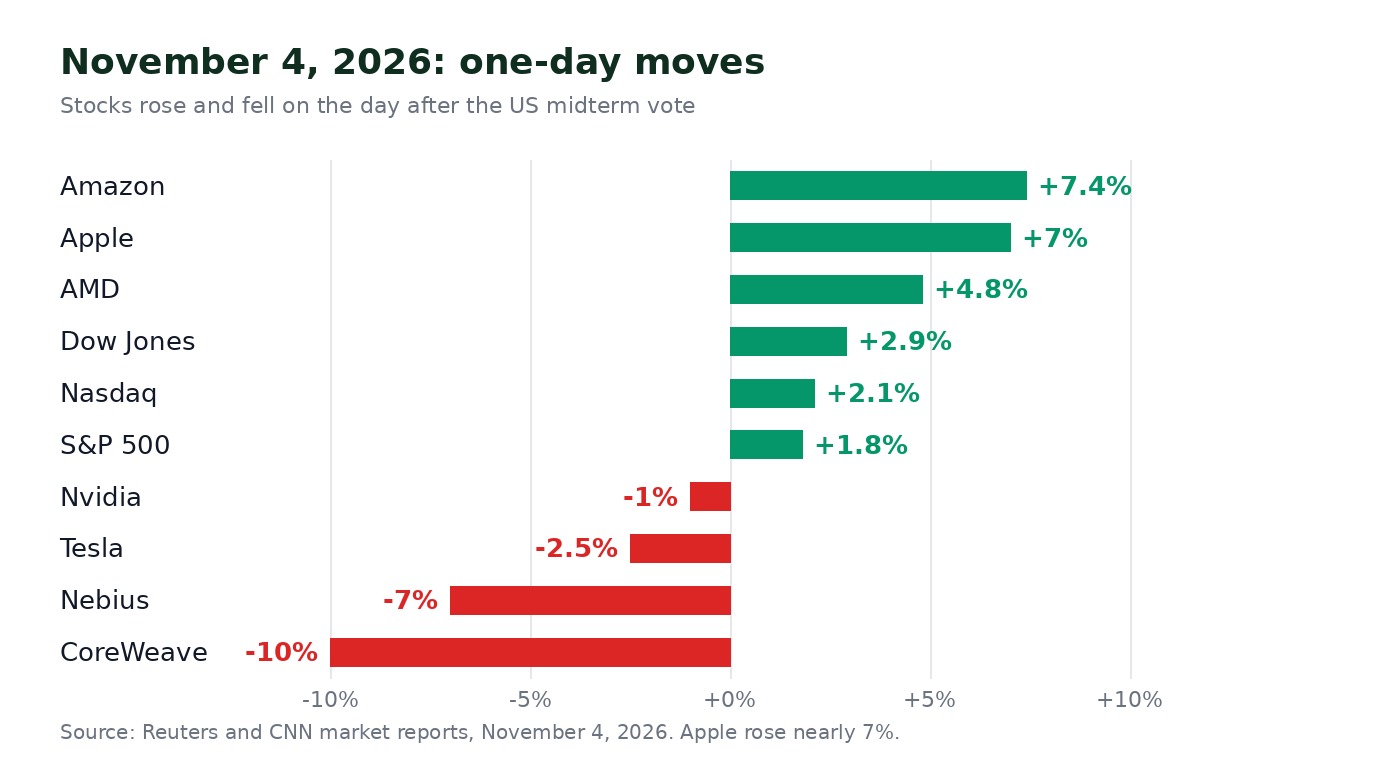
On November 4, 2026, the day after Americans voted in the midterm elections, US stocks rallied hard. The Dow Jones Industrial Average rose about 2.9%, the S&P 500 rose about 1.8%, and the Nasdaq Composite rose about 2.1%. The rally had a split inside it: the biggest technology companies surged, while the companies building and renting out AI data centers fell.
The vote gave Democrats control of both chambers of Congress. Traders first reacted with fear: S&P 500 and Nasdaq 100 futures fell about 0.6% overnight as projections showed Democratic wins. By the Wednesday open, the mood had flipped. A decisive result and a divided government, which limits sweeping policy changes, mattered more to traders than the overnight fear.
Figure 1: One-day moves on November 4, 2026. Amazon and Apple led the gainers. CoreWeave and Nebius led the fallers.
The day in numbers
The table below gives the November 3 closes, the November 4 moves, and the November 4 closes for the three main indexes. Early reports on Wednesday morning showed smaller gains: one morning snapshot had the Dow up 2.3% at 52,989.79. The rally built through the day, and the closing figures in the table are the ones to quote.
| Index | November 3 close | November 4 move | November 4 close |
|---|---|---|---|
| Dow Jones | 51,786.72 | +1,524.43 (+2.9%) | 53,311.15 |
| S&P 500 | 7,568.92 | +139.79 (+1.8%) | 7,708.71 |
| Nasdaq Composite | 25,372.01 | +534.87 (+2.1%) | 25,906.88 |
Amazon rose 7.4% to a three-month high and Apple rose nearly 7% to a record high, per Reuters. Meta, Alphabet and Microsoft gained between 2% and 6.3%. Reuters put the five companies on course to add more than $750 billion in combined market value if the gains held. AMD rose 4.8% after forecasting faster growth in 2027. Solar stocks were also among the early gainers before the open, with First Solar up 8.3% in premarket trading, per Kitco.
Why the biggest companies rallied
The first reason is the divided government itself. Investors bet that a Democratic Congress facing a Republican president would limit the scope for sharp policy shifts, Reuters reported. Fewer sweeping changes means fewer surprises for companies planning years ahead, and markets pay for that certainty.
The second reason is about who already owns capacity. Limits on new data centers help the companies that already own them. Reuters reported that investors bet curbs on new data-center construction could strengthen Big Tech's hold on scarce computing power while easing pressure on strained cash flows. The largest companies planned to spend more than $740 billion on AI this year, up from about $400 billion last year. If new builds slow, that spending pressure eases, and existing capacity becomes worth more. The same report noted the strain behind the selling of recent days: quarterly earnings showed cash-rich companies turning into heavy borrowers to fund the AI race, with Microsoft the exception Reuters named, at $18.6 billion in cash flow.
The third reason is the bounce. The Nasdaq 100 confirmed it had entered a technical correction on Monday. The Nasdaq Composite closed Monday, November 2, at 25,164, down 8.8% from its October 6 record of 27,600. The Technology Select Sector SPDR fund fell 13.8% over the same stretch, from $202.00 to $174.22. A market down that far often bounces on any clear news. The vote was the trigger, and the October slide meant prices had far to recover.
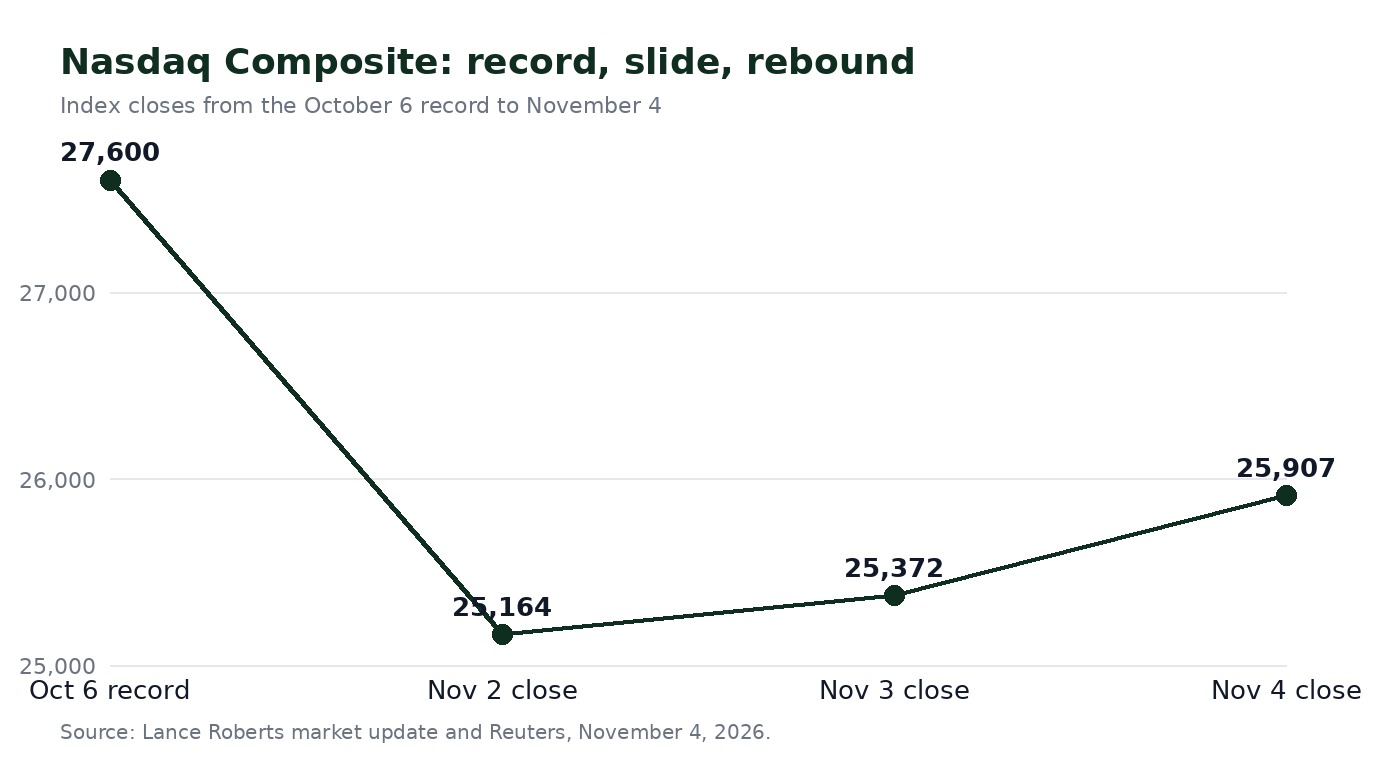
Figure 2: The Nasdaq Composite fell 8.8% from its October 6 record to its November 2 close, then rose on November 3 and 4. The November 4 rally came off a low base.
Why data-center stocks fell
Democratic wins in Texas and Georgia drew attention because both states host large data-center growth, and local opposition to that growth is strong. Data centers use large amounts of power and water, and they are noisy neighbors. Winners who oppose rapid expansion raise the odds of moratoriums or restrictions that slow new builds. Traders priced that risk in at once: IREN, Hut 8, Applied Digital and Core Scientific fell between 1.2% and 13%. CoreWeave fell 10% and Nebius fell 7%, per CNN. An exchange-traded fund tracking AI infrastructure stocks fell 10%. Nvidia fell 1%, caught in the same trade even though it sells chips rather than building data centers. Tesla fell 2.5%.
The same vote pushed both groups in opposite directions because it changed two different things: who writes the rules in Washington, and where data centers can be built. Big Tech benefits from the first change and from limits on the second. Data-center builders suffer from the second. That is why one day produced a rally and a selloff at the same time.
What history says, and what it does not
By one measure, November 4 stood out: CFRA Research, quoted by CNN, called the Dow gain its biggest post-midterm single-day gain since 1982, and the S&P 500 gain its biggest one-day post-midterm gain since 2018. The longer pattern points the same way. In 13 midterm cycles studied, the Nasdaq fell in the 3 months before the vote in 7 of them, including drops of 14.8% in 1990 and 16.5% in 2022. After those 7 pre-vote declines, the Nasdaq averaged a 23.8% gain over the next 6 months and 27.6% over the next year.
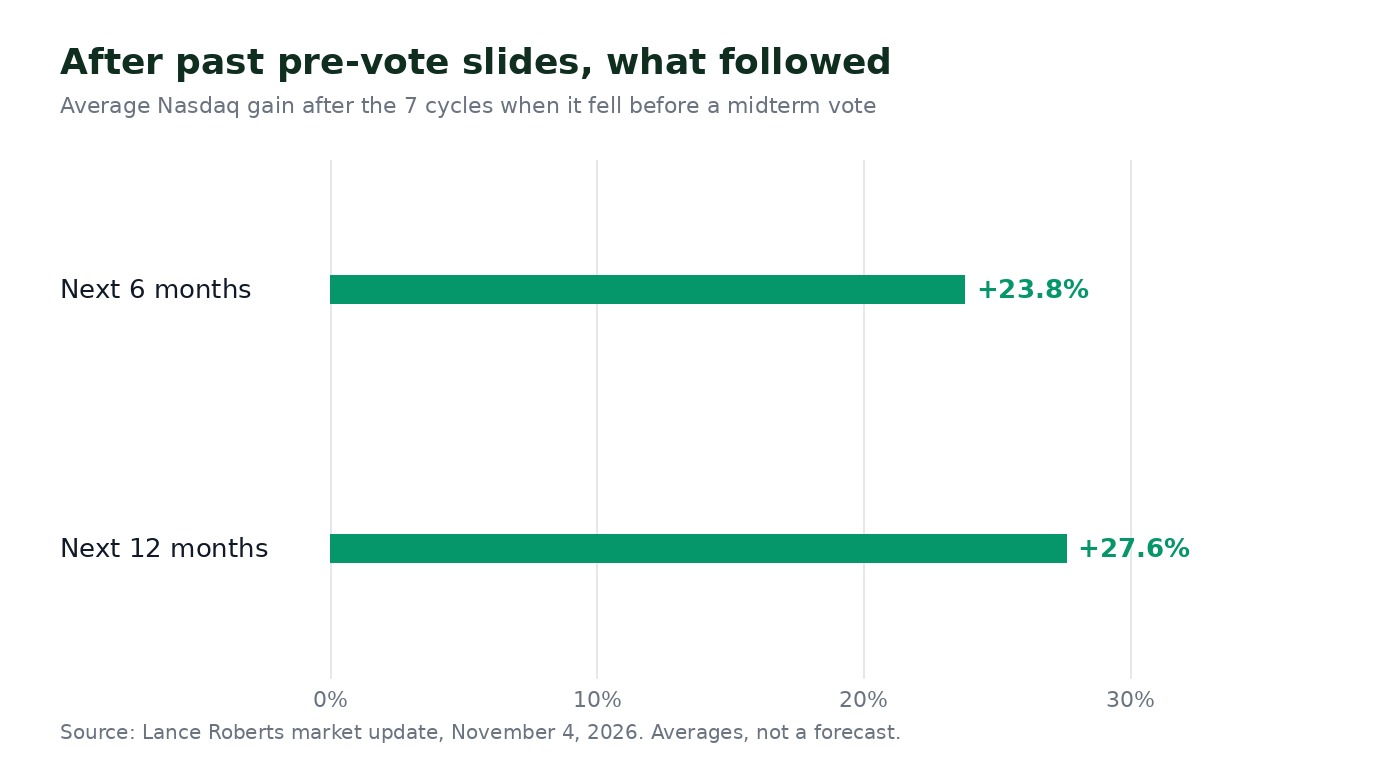
Figure 3: Average Nasdaq gains after the 7 midterm cycles when it fell before the vote. Averages hide wide differences between cycles.
Averages are not promises. They describe past cycles, not this one. One strong day is also not a trend: prices move on earnings, interest rates, wars and company news as well as votes. Nothing here is investment advice, and nothing here tells you to buy or sell any stock.
Questions people ask
Did voting cause the whole rally?
No, not alone. Three forces lined up: a decisive result with a divided government, relief for Big Tech on data-center spending, and a bounce after a steep October slide. The vote was the trigger, and the October slide meant prices had far to recover.
Why would limits on data centers help Amazon and hurt CoreWeave?
Amazon already owns large data-center capacity. CoreWeave rents out computing power and needs new sites to grow. Limits on new builds protect the value of existing capacity and slow the growth of renters. One rule, opposite effects.
Does a divided government always lift stocks?
Not always. Traders liked this result because it looked decisive and because it limits sweeping policy changes. A divided government can also block budgets and raise debt-ceiling fights, which markets dislike. The reaction follows the details of each result.
What should I watch next?
Three things: AI regulation proposals in the new Congress, data-center moratorium votes in Texas and Georgia, and the next round of Big Tech earnings, especially what they say about AI spending. Those three will show whether November 4 was a one-day bounce or the start of a longer move.
Sources: Reuters market report, November 4, 2026, on the Big Tech rally; CNN markets, November 4, 2026, on post-midterm gains; Associated Press election results, November 3, 2026; Lance Roberts market update, November 4, 2026, on index history and closes.


Was this article helpful?
Comments
Loading comments...