AI Regulation News: What Changed Globally and What to Track in 2026

TL;DR
AI regulation news in 2026: EU AI Act rollout dates, China AI content labeling, US state-by-state rules, and a practical monthly compliance checklist for product teams.
Table of Contents
If you search ai regulation news, you probably want one thing: what changed, where, and what to do next.
Here is the short version. The EU is moving through a fixed rollout schedule under the AI Act. China is enforcing AI content labeling from September 2025. The United States still runs a state-by-state model, with Colorado's AI law as one clear example. A treaty track is also active through the Council of Europe framework convention.
Why this matters now
Regulation now affects product roadmaps, procurement terms, model release timing, and support costs. Teams that wait for full legal certainty usually lose calendar time, then rush controls at the end.
If you ship AI features in more than one region, your compliance work now needs a country map, not a single policy page.
EU update: the AI Act has a live enforcement calendar
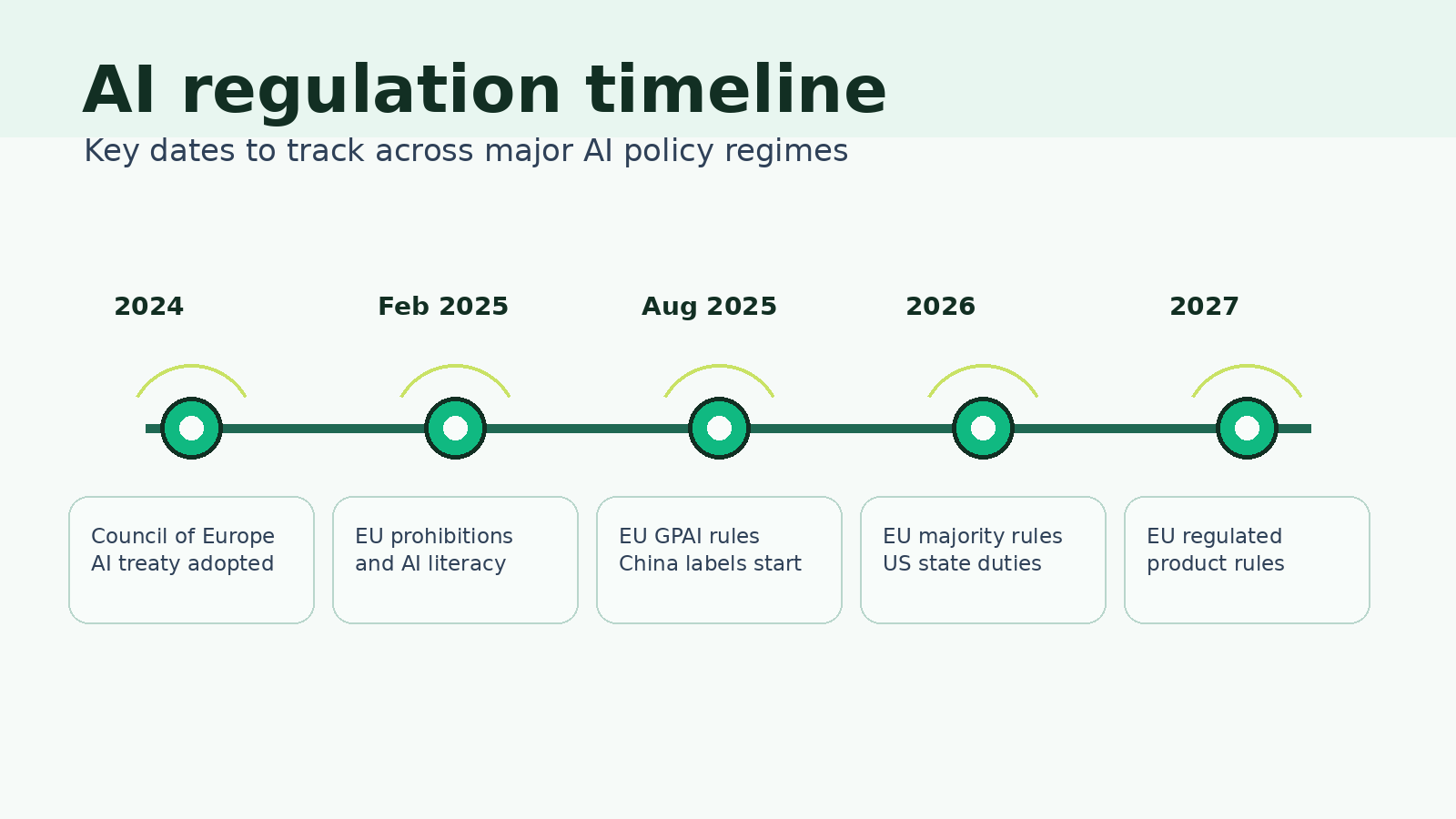
The EU AI Act is rolling out in stages, not in one launch. Based on the official timeline:
- 2 Feb 2025: general provisions and prohibitions started to apply.
- 2 Aug 2025: general-purpose AI model obligations started.
- 2 Aug 2026: most remaining rules apply, including many high-risk and transparency duties.
- 2 Aug 2027: final stage for high-risk AI in regulated products.
Source: EU AI Act implementation timeline
What teams should do now for EU exposure
- Build a system inventory by use case and owner.
- Tag systems that may fall into high-risk categories.
- Add model and content transparency checks into release workflows.
- Keep an evidence log for decisions, tests, and incidents.
China update: AI-generated content labeling is now formal policy
China published rules for labeling AI-generated and synthetic content in March 2025, with implementation from 1 Sep 2025.
The policy covers explicit labels users can see, implicit labels in metadata, platform obligations, and penalties for deleting or forging labels.
Source: Official Chinese government notice
United States update: still fragmented, with active state-level movement
The US still has no single nationwide AI law that mirrors the EU model. State laws and sector rules carry much of the current compliance load.
NCSL tracks state AI legislation in one place, and Colorado SB24-205 remains one of the clearest state frameworks for high-risk systems and algorithmic discrimination obligations.
Sources: NCSL tracker and Colorado SB24-205
International treaty track: Council of Europe framework convention
In 2024, the Council of Europe adopted a treaty-level framework for AI with a risk-based structure focused on human rights, democracy, and rule-of-law safeguards across the AI lifecycle.
Source: Council of Europe announcement
What to track each month
- Effective dates.
- Scope definitions for terms such as high-risk, deployer, and provider.
- Documentation duties and evidence requirements.
- Content transparency and labeling rules.
- State and regional divergence in legal obligations.
A practical 30-day plan for product teams
Week 1
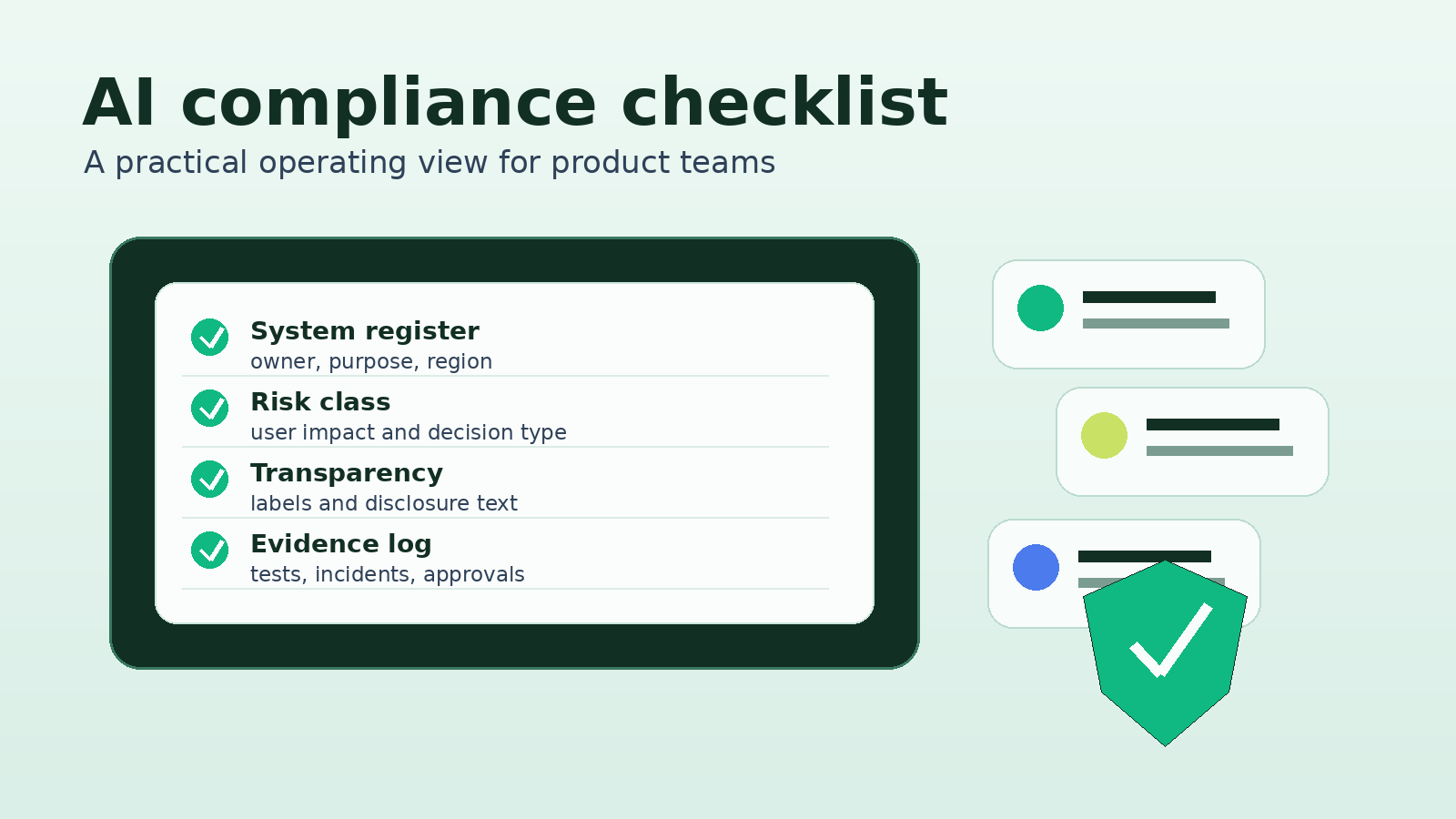
Create an AI system register and assign an owner for each system.
Week 2
Classify use cases by risk and user impact, then mark systems that make consequential decisions.
Week 3
Add release gates for testing, disclosure text, and logging. Add incident intake for model errors and user complaints.
Week 4
Run legal and product review on top risk systems, then publish an internal policy note with scope, controls, and escalation paths.
Final take
AI regulation news now means operational work, not background reading. Teams that move early and build repeatable controls will spend less time in emergency compliance cycles later.


Was this article helpful?
Comments
Loading comments...