AI Transformation Is a Problem of Governance

TL;DR
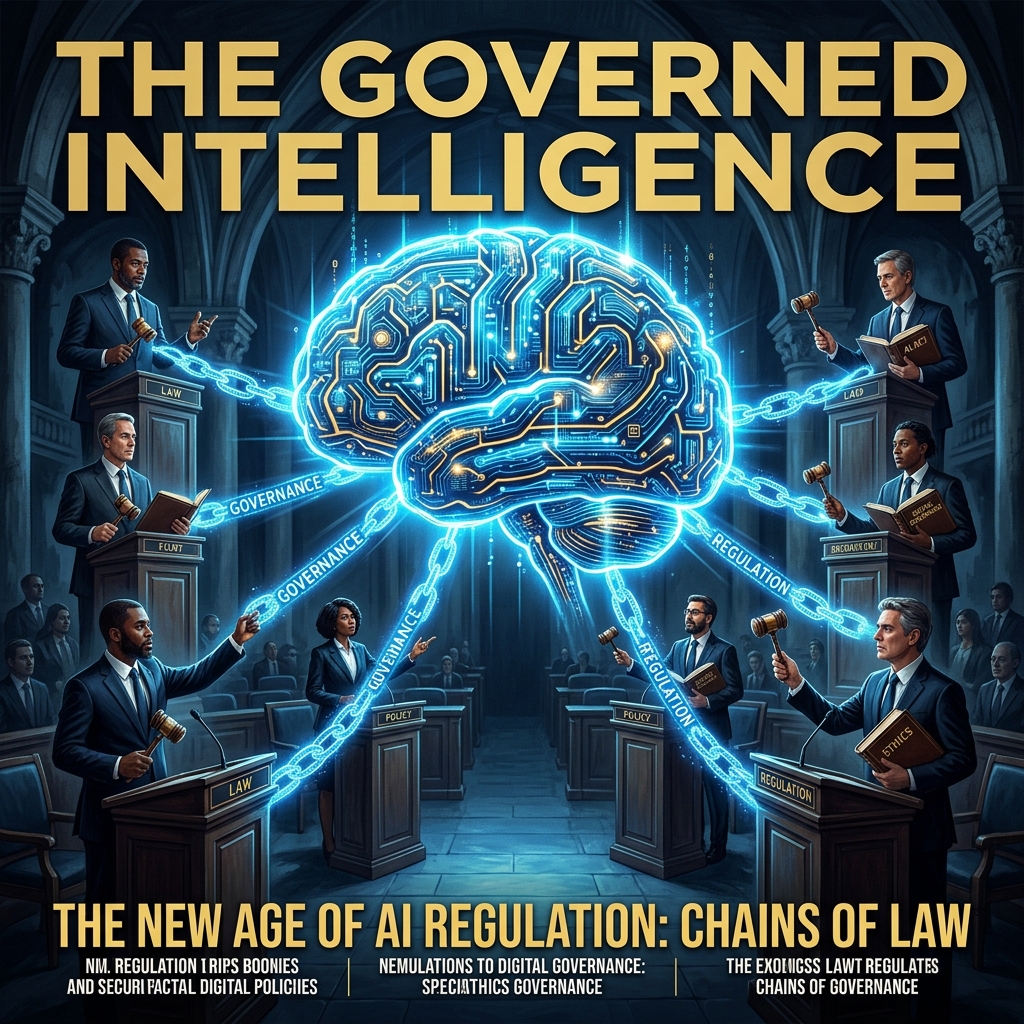
Every organization racing to deploy AI is solving the wrong problem first. The technology works. The governance doesn't. Here's why the biggest obstacle to AI transformation isn't the algorithm — it's accountability, oversight, and the structures humans put around the machine.
Table of Contents
The board wanted an AI strategy. The CTO built one in 90 days. By month six, the system was making credit decisions nobody could explain, flagging the wrong employees in HR reviews, and generating customer-facing outputs that three senior lawyers could not sign off on. The technology had not failed. The governance had never existed.
This is not an edge case. It is the pattern. Across banking, healthcare, public services, and media, the same story repeats with different names in the headlines: an organization moves fast on AI, achieves real capability gains, and then encounters a failure that was predictable — a biased output, an unaccountable decision, a data breach, a regulatory fine — not because the model broke, but because no one had designed the human structures around it.
AI transformation is routinely framed as a technology problem. Build the right model. Train on the right data. Deploy the right API. The governance question — who decides what the AI can do, who is accountable when it goes wrong, how its decisions are audited, how affected people can challenge outputs — is treated as a compliance afterthought. That framing is backwards. In 2026, with frontier models deployed in every industry and regulators on three continents issuing binding requirements, governance is not the tail of the AI story. It is the spine.
What governance actually means in AI
Governance in the context of AI is not synonymous with regulation, though they overlap. It refers to the internal and external structures that determine how AI systems are built, deployed, monitored, and held accountable. It includes: who has authority to greenlight an AI use case, what data practices are required before training begins, how model outputs are audited after deployment, what redress mechanisms exist for people affected by automated decisions, and how the organization handles a failure when it occurs.
Good governance is not bureaucracy. It is the difference between a hospital that can explain why an AI triage tool ranked one patient above another and one that cannot. It is the difference between a bank that can demonstrate its credit-scoring model is not discriminating on protected characteristics and one that discovers this in a regulatory investigation. It is the difference between a government that can audit which citizens were denied benefits by an automated system and one that finds out from a journalist.
The OECD's AI Principles, adopted by over 42 countries, include transparency, accountability, and robustness as foundational requirements. The EU AI Act, which entered enforcement in 2024 and reached full application in 2026 for high-risk systems, mandates conformity assessments, logging requirements, human oversight mechanisms, and post-market monitoring for AI deployed in critical sectors. None of these requirements are primarily technical. They are organizational. They require humans to make decisions, maintain records, and accept responsibility. That is governance.
The four failure modes that governance prevents
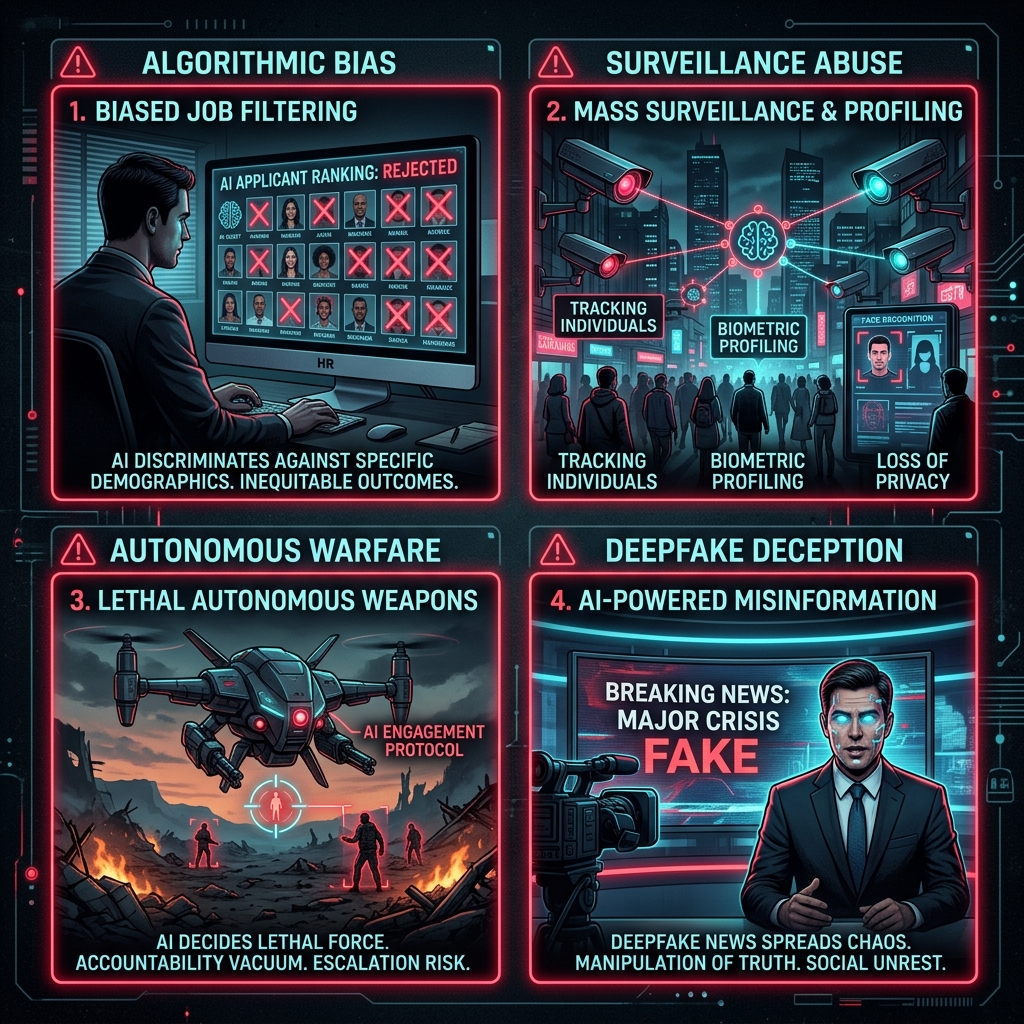
When AI governance is weak or absent, failures cluster into recognizable patterns. Understanding them is the starting point for building systems that avoid them.
1. Algorithmic bias without accountability
Amazon's internal recruiting tool, documented by Reuters in 2018, penalized résumés containing the word "women's" and downgraded graduates of all-women's colleges. The model had been trained on a decade of historical hiring data in which men dominated technical roles. It learned from that data exactly what it was supposed to learn: patterns that predicted past hires. The problem was not a technical failure. It was a governance failure: no one had established a required fairness evaluation before deployment, no one had defined who was accountable for discriminatory outputs, and no oversight mechanism existed to catch the bias in production.
The Dutch childcare benefit scandal, in which the tax authority's automated fraud detection system flagged over 26,000 families — disproportionately those with dual nationalities — for investigation, resulted in the fall of the Dutch government and a €5 billion remediation program. The system had been in operation for years. No governance structure had required the organization to audit demographic outcomes, and no escalation path existed for affected citizens to challenge the algorithm's conclusions.
2. Accountability vacuums in consequential decisions
When an AI system makes a decision that harms someone, the question of who is responsible becomes structurally ambiguous without governance. The vendor says the model performed as specified. The deploying organization says it followed the vendor's documentation. The regulator finds neither party has kept adequate records to determine what actually happened. This vacuum is not accidental; it is the predictable result of deploying consequential AI without pre-defining accountability. Governance closes the vacuum before the failure, not after it.
3. Data governance failures at the foundation
Training data that is unlicensed, unaudited, or unrepresentative creates legal and reputational exposure that compounds over time. In 2023 and 2024, multiple AI companies faced litigation over training data that included copyrighted material, personal health data, and content scraped without consent. The technical capability — a capable model — was real. The governance failure — inadequate data provenance documentation and absence of consent frameworks — was the liability. Data governance is not a legal nicety; it is the prerequisite for models that can survive the regulatory environment they will be deployed into.
4. Deployment without human oversight in high-stakes domains
AI systems making or significantly influencing decisions in healthcare diagnosis, criminal sentencing, benefits eligibility, and financial credit scoring require meaningful human oversight. "Meaningful" is the operative word. A rubber-stamp review process in which a human approves 98% of AI recommendations within 30 seconds is not oversight. It is liability diffusion. The EU AI Act requires that high-risk AI systems be designed to allow humans to understand, monitor, and override them — not just sign off on them. Building this requires deliberate product design, training for operators, and governance structures that create genuine review capacity.
The governance deficit in numbers
- Only 35% of large organizations deploying AI have a formal AI governance policy (MIT Sloan Management Review, 2025)
- €35 million — maximum fine under the EU AI Act for violations related to prohibited AI practices
- 26,000+ families incorrectly flagged by the Netherlands' automated benefits system before intervention
- $5 billion+ — estimated total cost to remediate the Dutch childcare scandal
- 42 countries have adopted the OECD AI Principles, all of which require accountability and transparency structures
- 60% of AI project failures are attributed to organizational and governance issues, not technical ones (Gartner, 2024)
What the global regulatory landscape now requires
The governance question is no longer optional for organizations operating at scale. Binding regulatory requirements now exist or are being enforced in major markets, and they are primarily organizational demands, not technical ones.

The EU AI Act establishes a risk-tiered classification system. High-risk AI — defined to include systems used in employment, education, essential services, law enforcement, migration, and the administration of justice — must meet requirements for technical documentation, transparency to users, logging of operation, human oversight design, and accuracy and robustness testing before deployment. Providers must register high-risk systems in an EU database. Post-market monitoring is required throughout the system's operational life. These are governance obligations. They require organizational infrastructure, not just model specifications.
In the United States, the 2023 Executive Order on the Safe, Secure, and Trustworthy Development and Use of AI required federal agencies and contractors to conduct safety evaluations, establish red-teaming programs, and report on AI use. The NIST AI Risk Management Framework, while voluntary for private sector organizations, has become the de facto standard referenced in federal procurement and increasingly in litigation. The FTC has pursued enforcement actions against companies making deceptive claims about AI capabilities, and the CFPB has issued guidance on the application of fair lending laws to algorithmic credit decisions.
In the UAE, the National AI Strategy 2031 and the accompanying regulatory frameworks from the UAE AI Office set governance expectations for public sector AI deployment. The Abu Dhabi Global Market and DIFC have issued AI guidance for financial services. Across the GCC, regulators in Saudi Arabia, Qatar, and Bahrain are building AI governance frameworks adapted from international models.
China's Interim Measures for the Management of Generative AI Services require providers to conduct security assessments before release, label AI-generated content, and maintain data that allows authorities to trace outputs. These are compliance burdens that are, again, organizational — they require record-keeping, labeling infrastructure, and review processes.
No major regulatory framework in any jurisdiction has demanded that AI models perform better on benchmarks. Every major framework has demanded that organizations build accountability structures around what the models do.
Building governance that actually works
Effective AI governance is not a policy document filed in a shared drive. It is an operational system. Organizations that get this right share a set of practices that are distinct from those that produce governance theater.
Pre-deployment impact assessment. Before any AI system goes into production in a consequential domain, organizations should conduct a structured assessment of who is affected, what decisions the system influences, what the failure modes are, and whether the benefits justify the risks to affected groups. This is not a one-time checkbox; it is a live document updated as the system changes.
Defined accountability owners. Every AI system in production should have a named individual or team accountable for its outcomes — not the vendor, not the model card, not the data team. A person. This individual is responsible for monitoring outputs, responding to complaints, escalating anomalies, and making the call to take the system offline if required.
Audit trails that survive the failure. When something goes wrong — and with AI systems at scale, something will eventually go wrong — the organization needs to be able to reconstruct what the system did and why. This requires logging practices established before the failure, not forensic archaeology after it.
Real human oversight mechanisms. For high-stakes decisions, oversight means more than approval workflows. It means operators who understand what they are reviewing, who have time to review it properly, and who have genuine authority to override the system. Building this requires investment in training, in process design, and in organizational culture that rewards escalation rather than punishing it.
Redress pathways for affected people. Anyone significantly affected by an automated decision should have a clear way to challenge it and a realistic prospect of getting a meaningful response. This is both an ethical requirement and, under the EU AI Act and various consumer protection frameworks, an increasingly legal one.
The governance gap is the competitive risk
The argument for speed over governance has surface appeal: competitors are deploying, the window is narrow, governance slows things down. This argument inverts the actual risk profile. Organizations that deploy AI without governance are not moving fast. They are accumulating liability, regulatory exposure, and reputational risk that materializes at the worst possible moment — when a failure occurs in public, under regulatory scrutiny, with a regulator who will find that no impact assessment was conducted, no accountability owner was named, and no audit trail exists.
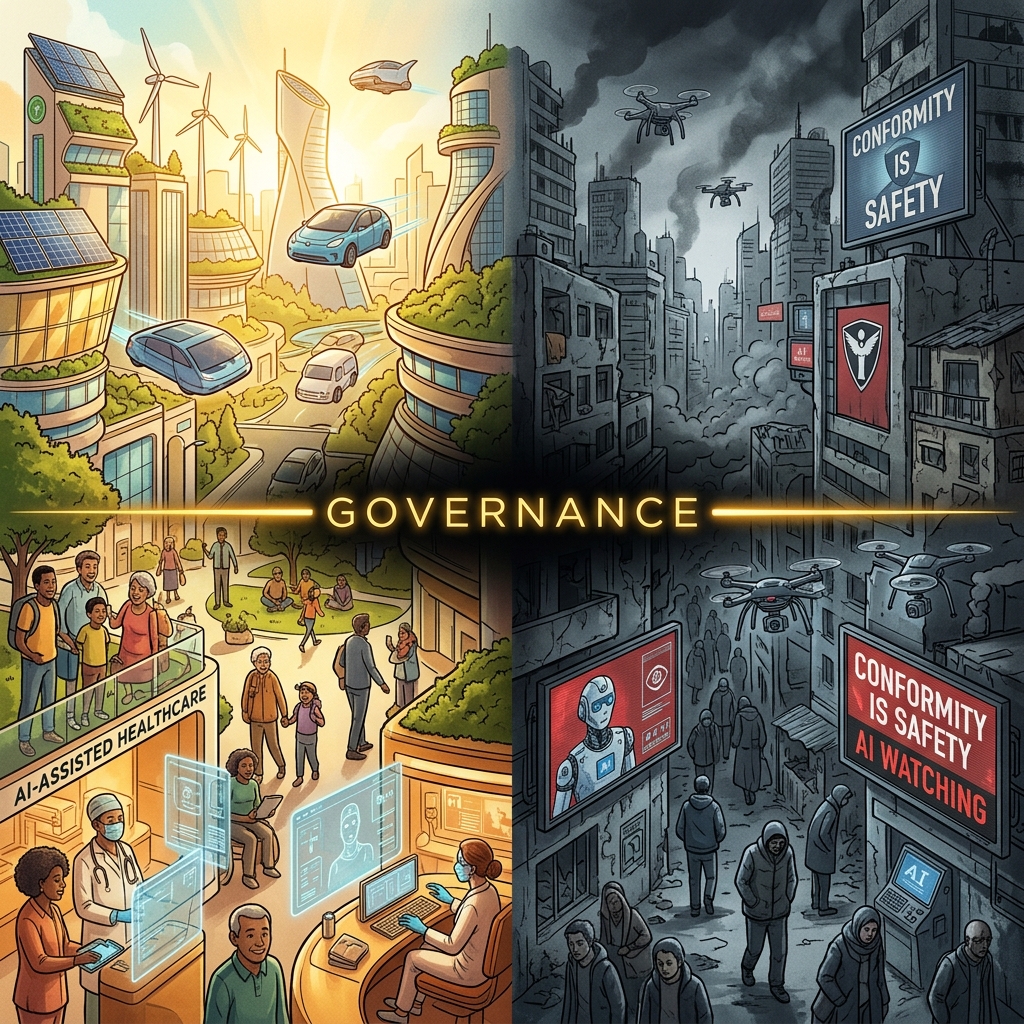
The organizations that will lead AI transformation over the next decade are not those that deployed fastest. They are those that built the governance infrastructure that allows them to deploy broadly, repeatedly, and in high-stakes domains without catastrophic failure. That infrastructure — impact assessments, accountability structures, audit trails, oversight mechanisms, redress pathways — takes time to build. It also takes time for competitors without it to catch up after a failure forces the issue.
Governance is not the cost of AI transformation. It is the mechanism by which transformation becomes durable rather than fragile. The organizations that understand this are not slower. They are building something their competitors have to rebuild after the loss.
The board wanted an AI strategy. The right answer in 2026 is: the AI strategy and the governance framework are the same document. One without the other is not a strategy. It is a schedule for a different kind of crisis.
References
- European Parliament — "EU AI Act: first regulation on artificial intelligence." Official legislative record.
europarl.europa.eu - OECD — "OECD Principles on Artificial Intelligence." OECD.AI Policy Observatory.
oecd.ai - Reuters — Jeffrey Dastin, "Amazon scraps secret AI recruiting tool that showed bias against women," October 2018.
reuters.com - Dutch Parliament — Childcare allowance scandal investigation reports, 2020–2022. Parliamentary inquiry documentation.
rijksoverheid.nl - NIST — "AI Risk Management Framework (AI RMF 1.0)," January 2023.
nist.gov - MIT Sloan Management Review — "The State of AI Governance in 2025." Research report.
sloanreview.mit.edu - Gartner — "Why AI Projects Fail: The Organizational Factors," 2024 research note.
gartner.com - UAE AI Office — National Artificial Intelligence Strategy 2031.
ai.gov.ae - Cyberspace Administration of China — "Interim Measures for the Management of Generative Artificial Intelligence Services," 2023.
cac.gov.cn

Was this article helpful?
Comments
Loading comments...