Loop Engineering for AI Agents: How Iterative Feedback Loops Fix LLM Hallucinations

TL;DR
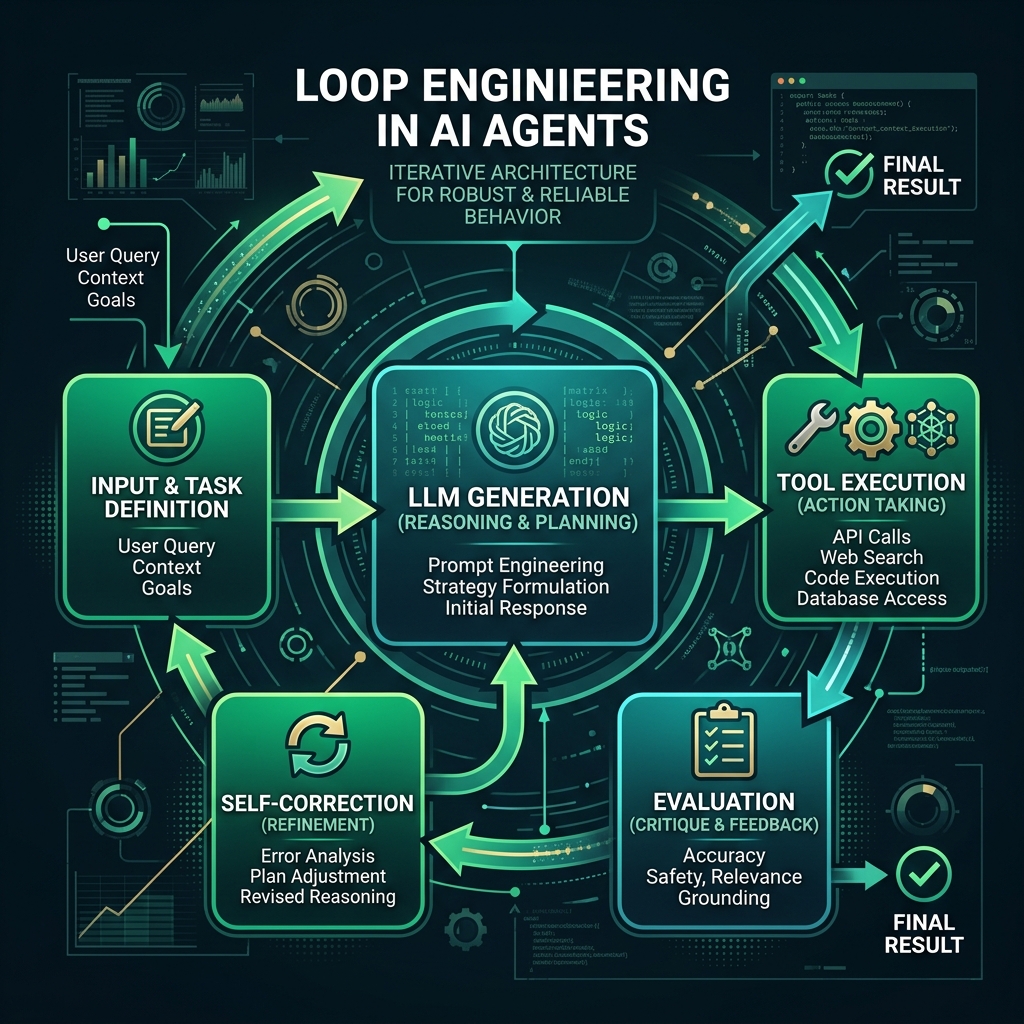
Single-shot LLM prompts fail when tasks demand precision. Loop engineering runs generative models inside execution loops to evaluate outputs, feed compiler errors back to context, and self-correct automatically.
Table of Contents
Loop engineering is a software design pattern where large language models run inside automated execution loops to test, critique, and self-correct their own output before returning a final response.
\n\nInstead of relying on a single prompt and response, loop engineering routes intermediate model outputs through deterministic code evaluators, linters, unit test runners, or secondary reviewer models. When errors occur, the diagnostic feedback feeds directly back into the context window, forcing the model to fix its mistakes automatically.
\n\n\n The 3 Core Components of a Production AI Loop
\n\nEvery loop engineering system builds on three distinct operational stages.
\n\n1. Generator (Model Execution)
\n\nThe generator takes the base system instructions and incoming user state, producing initial code, text, or structured JSON schema objects.
\n\n2. Evaluator (Deterministic Verification)
\n\nThe evaluator inspects the output against hard rules. In coding agents, the evaluator compiles code and runs unit tests. In data extraction pipelines, it validates JSON structure against TypeScript interfaces.
\n\n3. Feedback Router (Context Injector)
\n\nWhen verification fails, the feedback router formats the exact stack trace, compiler error, or missing field warning and injects it back into the model prompt as a new observation message.
\n\n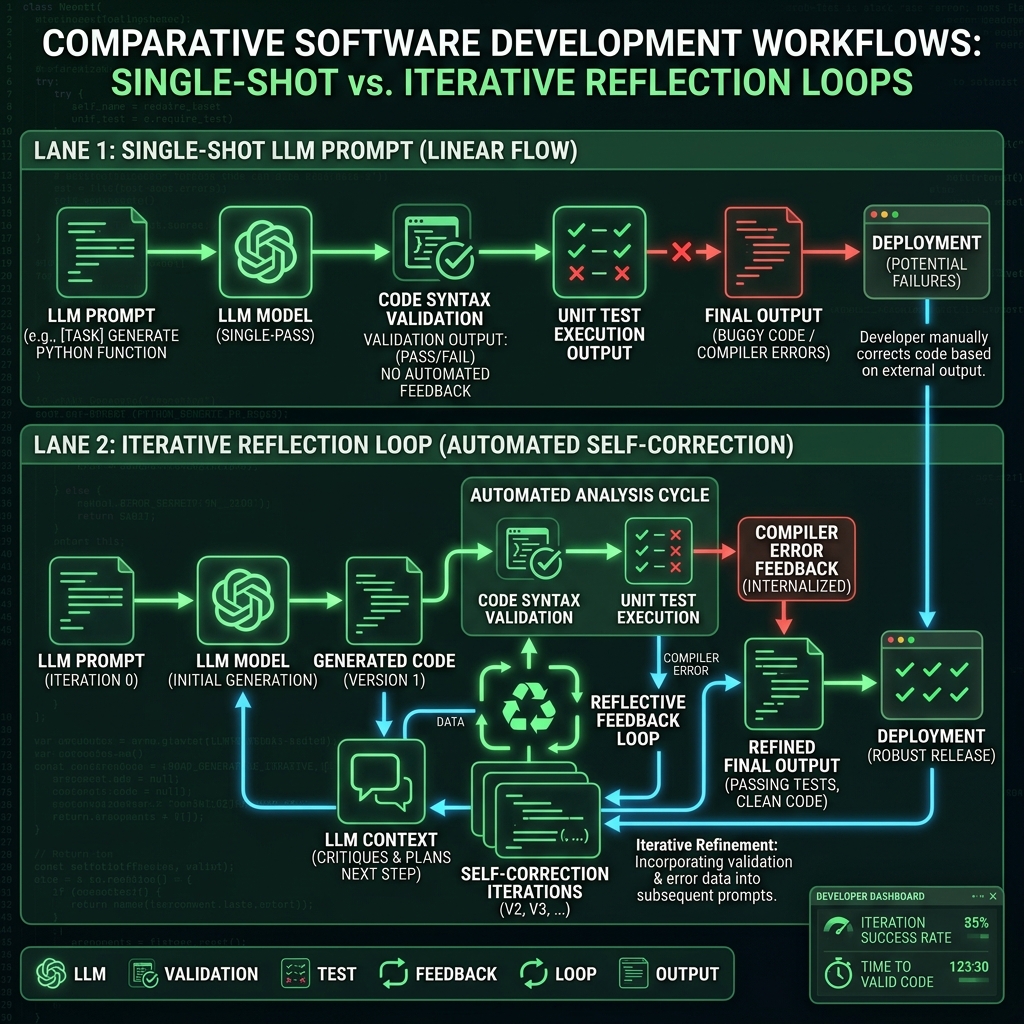 \n
\n Code Example: Python Self-Correction Loop
\n\nHere is a production python execution loop that forces an LLM to fix syntax errors before returning code to the caller:
\n\ndef generate_valid_code(prompt: str, max_retries: int = 3) -> str:
context = [{"role": "user", "content": prompt}]
for attempt in range(max_retries):
response = llm.generate(messages=context)
code = extract_code(response)
# Deterministic Evaluation
is_valid, error_msg = run_ast_and_unit_tests(code)
if is_valid:
return code
# Feedback Injection Loop
context.append({"role": "assistant", "content": response})
context.append({
"role": "user",
"content": f"Compilation failed on attempt {attempt + 1}. Error details:\n{error_msg}\nFix the bug."
})
raise RuntimeError("Loop exceeded maximum iteration limit without valid resolution.")Human-in-the-Loop (HITL) Guardrails
\n\nAutonomous loops require explicit safety boundaries to prevent infinite execution costs or accidental external side effects.
\n\nProduction agent architectures enforce Human-in-the-Loop (HITL) gates whenever an action changes external databases, transfers funds, or deletes files. If model confidence drops below 85% or an action carries high risk, the loop pauses execution and routes an approval request to a human operator.
\n\n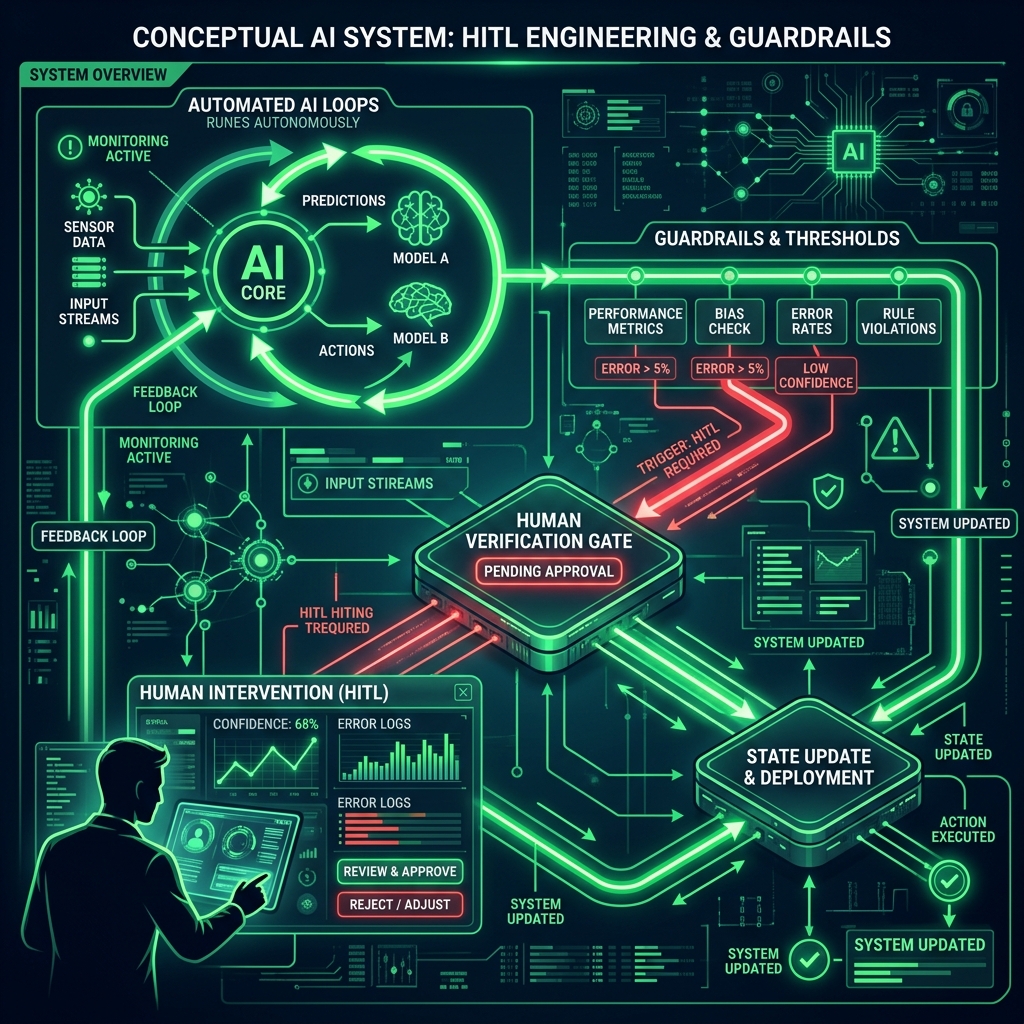 \n
\n 4 Practical Rules for Engineering AI Loops
\n\nFollow these 4 implementation constraints when deploying iterative agent loops in production.
\n\n1. Set Hard Iteration Limits
\n\nCap loops at 3 to 5 iterations max. Beyond 5 retries, LLMs rarely self-correct and instead repeat similar syntax mistakes while consuming context tokens.
\n\n2. Truncate Intermediate Tool Messages
\n\nPass only the original system prompt, latest generated code, and exact error log in retry attempts. Preserving 10 rounds of failed code attempts dilutes attention weights and causes context drift.
\n\n3. Prefer Deterministic Evaluators
\n\nUse fast code linters, regex parsers, and unit test suites rather than calling a second LLM for code evaluation. Deterministic checks run in 5 milliseconds instead of 2000 milliseconds.
\n\n4. Structure System Prompts for Tool Calling
\n\nStructure your agent prompts using proven frameworks like CO-STAR or XML tags. Use our AI Prompt Optimizer to generate clear role parameters and negative constraints for your agent system instructions.
\n

Was this article helpful?
Comments
Loading comments...