Why Fiverr Lost 1.3 Million Buyers: The AI Shift, Seller Fees, and Where Clients Went

TL;DR
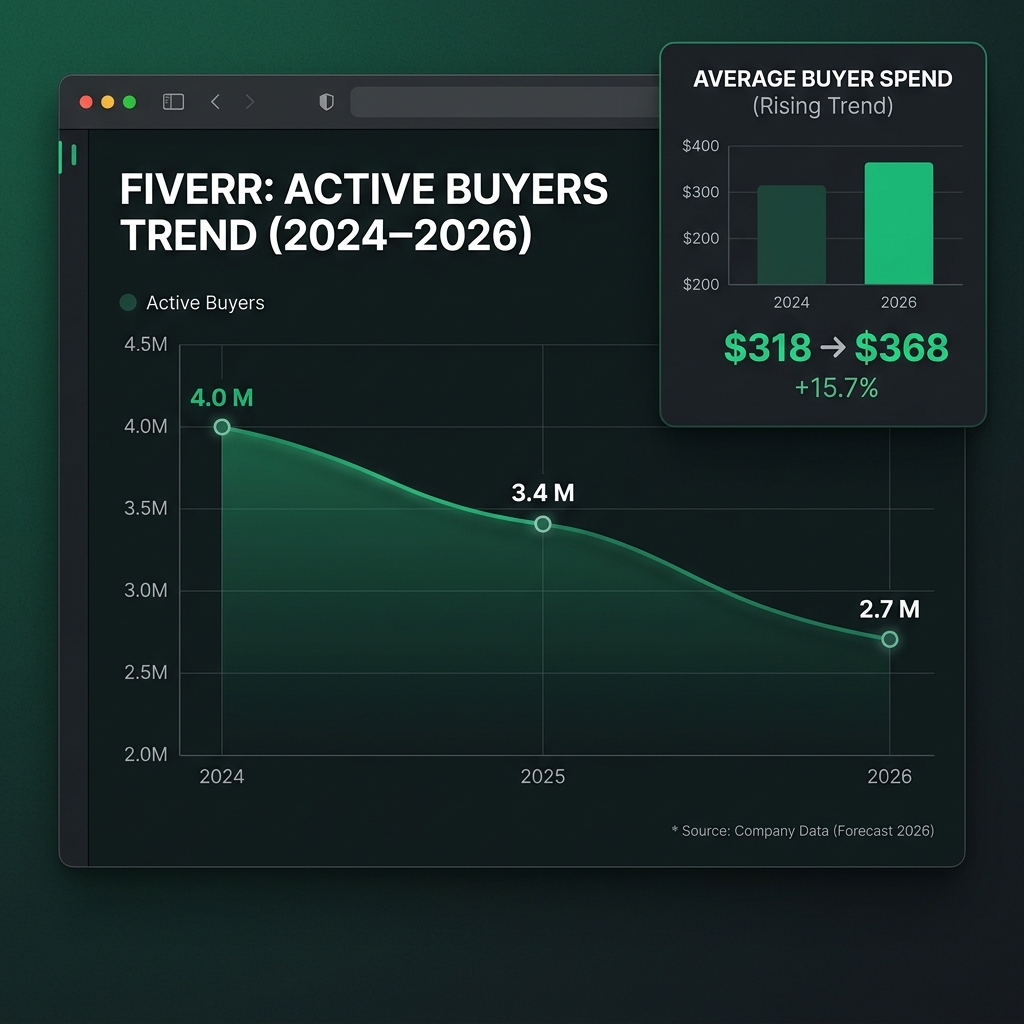
Fiverr annual active buyers fell from 4.0 million in 2024 to 2.7 million in Q2 2026. We examine quarterly earnings data, $49 monthly Seller Plus fees, AI substitution, and where clients moved.
Table of Contents
Fiverr lost 1.3 million annual active buyers between Q1 2024 and Q2 2026. The platform's active buyer count dropped from 4.0 million to 2.7 million, recording a 21.9% year-over-year decline in the second quarter of 2026. At the same time, individual sellers faced increased operational costs through $49 monthly Seller Plus subscriptions, advertising fees, and the standard 20% platform commission.
\n\nThe decline in active buyers reflects broad structural changes in the freelance marketplace sector. Generative AI tools replaced simple micro-tasks, while small businesses reduced outsourcing budgets. Fiverr leadership also directed platform changes toward enterprise accounts, pushing average annual spend per buyer from $318 to $368.
\n\n\n The Official Buyer Numbers (2024 to 2026)
\n\nFiverr's quarterly financial disclosures show steady buyer attrition across the past 9 quarters. The loss accelerated from 100,000 buyers per quarter in late 2024 to roughly 200,000 buyers per quarter throughout 2025 and 2026.
\n\n| Reporting Period | \nAnnual Active Buyers | \nYear-over-Year Change | \nAverage Annual Spend per Buyer | \n
|---|---|---|---|
| Q1 2024 | \n~4.0 million | \nBaseline | \n$318 | \n
| Q1 2025 | \n3.5 million | \n-10.6% | \n$332 | \n
| Q4 2025 | \n3.1 million | \n-13.6% | \n$348 | \n
| Q1 2026 | \n2.9 million | \n-17.8% | \n$358 | \n
| Q2 2026 | \n2.7 million | \n-21.9% | \n$368 (+15.6%) | \n
The total loss from peak levels exceeds 1.3 million accounts. While buyer counts contracted by 32.5% since early 2024, revenue per active user grew 15.6%. This reflects a corporate pivot toward larger project sizes and higher minimum prices per transaction.
\n\nThe Seller Cost Stack: Subscriptions, Ads, and Commissions
\n\nFreelancers on the platform face compounding fixed and variable costs. To maintain search placement in competitive categories, many sellers purchase add-on visibility packages.
\n\n- \n
- Base Commission: Fiverr retains 20% of every order, including tip amounts. \n
- Seller Plus Premium: The subscription costs $49 per month. Billing holds an additional $49 deposit during transaction clearing cycles. \n
- Promoted Gigs: Pay-per-click internal advertising costs typical sellers between $50 and $150 monthly. \n
- Buyer Surcharges: Clients pay a 5.5% platform fee plus a $3 service charge on small orders, increasing total checkout friction. \n
 \n
\n Consider a freelancer earning $1,000 in gross monthly revenue. The 20% platform cut removes $200. The Seller Plus subscription removes $49. A modest $50 advertising spend removes another $50. The net payout is $701, creating an effective take rate of 29.9% before personal income taxes.
\n\nWhere Did the 1.3 Million Buyers Go?
\n\nMarket data and industry studies identify 4 primary destinations for departing freelance buyers.
\n\n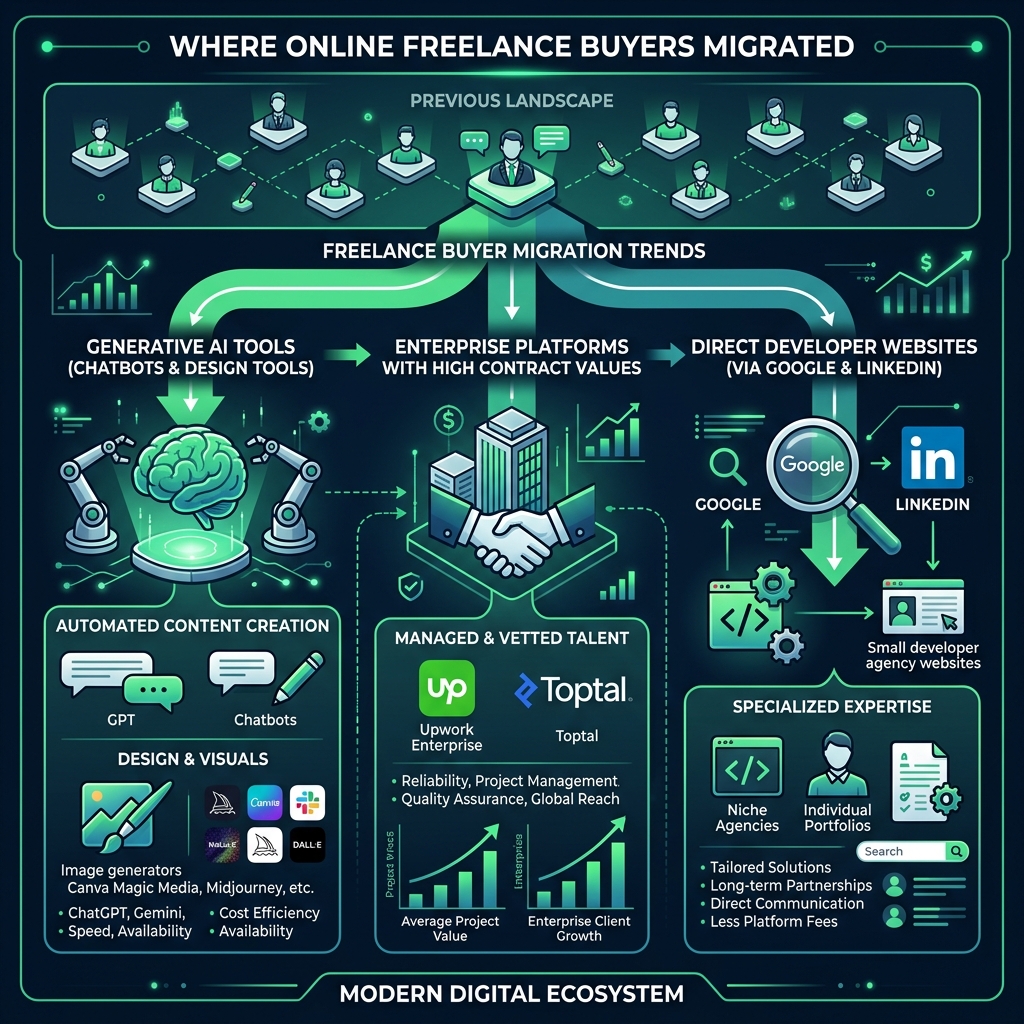 \n
\n 1. Direct Generative AI Substitution
\n\nEntry-level digital tasks shifted directly to software. Buyers who previously paid $10 for 500-word blog summaries, $15 for vector icon adjustments, or $20 for basic JavaScript snippets now use large language models and design interfaces directly.
\n\nResearch from economic institutes tracking online labor platforms recorded a sharp drop in demand for basic copy editing, translation, and stock graphic work following the rapid adoption of generative tools. These clients exited the freelance marketplace category entirely.
\n\n2. Migration to Enterprise Platforms
\n\nCompanies managing multi-month software builds, mobile apps, or cloud systems migrated to platforms designed for dedicated contracts. Upwork reported 796,000 active clients in Q2 2025 with an average annualized spend of $5,002 per client.
\n\nMid-sized businesses requiring vetted software developers, DevOps administrators, or security professionals often prioritize platforms offering hourly time tracking, payroll compliance, and dedicated account management over single-deliverable gig catalogs.
\n\n3. Direct Client Relationships
\n\nFiverr financial filings indicate that repeat buyers generate 68% of total marketplace revenue. Once trust is established between a client and a service provider, both parties face financial incentives to transact directly.
\n\nDirect invoicing removes the 20% seller fee and the buyer's 5.5% processing surcharge. On an ongoing $2,000 monthly retainer, moving to direct contracts saves the client $110 per month and yields the freelancer an extra $400 per month.
\n\n4. Small Business In-House Retention
\n\nMacroeconomic pressure caused micro-businesses and solo founders to consolidate overhead. Tasks that once required external assistance, such as simple newsletter formatting or social media resizing, are now handled internally by founders using standard web utilities.
\n\nFiverr's Corporate Repositioning Strategy
\n\nFiverr executive commentary during 2026 earnings presentations confirms this transition is intentional. Leadership described a multi-year shift from a transaction-oriented gig catalog to a work platform focused on complex, high-value outcomes.
\n\nThe platform implemented category-specific minimum price floors to discourage low-margin gigs. By focusing on higher spend per transaction, Fiverr protects revenue stability with 2.7 million buyers spending $368 rather than 4 million buyers spending $150.
\n\nKey Takeaway from Company Filings
\nFiverr is deliberately trading low-value transaction volume for larger corporate contracts. Freelancers offering commoditized micro-services face shrinking demand, while professionals providing complex technical solutions retain viable platform visibility.
\nBuilding an Independent Client Acquisition Pipeline
\n\nRelying on a single third-party marketplace creates substantial platform risk. Algorithm updates, fee increases, or account reviews can disrupt a freelancer's income stream overnight. Developers and technical specialists build resilience by establishing direct client channels.
\n\n- \n
- Personal Domain & Web Presence: Publishing technical case studies and live demonstrations on your own website establishes direct search discoverability. \n
- Inbound Content & Tools: Building free web utilities or writing in-depth tutorials attracts prospective clients through Google and LinkedIn. You can measure article lengths and readability using our Word Counter Tool and refine technical copy with our AI Prompt Optimizer. \n
- Retainer Contracts: Securing 5 long-term clients at $1,500 monthly generates $7,500 in recurring revenue with zero marketplace commission deductions. \n
- Public Code Artifacts: Maintaining public GitHub repositories and open-source contributions provides verifiable proof of technical competence to prospective hiring managers. \n
Conclusion
\n\nFiverr's loss of 1.3 million active buyers signals a permanent shift in the online labor market. As generative software handles routine tasks, marketplaces are raising fees and shifting toward enterprise contracts.
\n\nFor freelance professionals, the practical response is clear: develop high-complexity technical skills, maintain direct client communication, and build an independent web presence to capture high-value contracts without intermediate platform taxes.


Was this article helpful?
Comments
Loading comments...