AI Regulation News November 2026: The December 2 Countdown, US Midterms, and 15 Countries Update

TL;DR
November 2026 AI regulation update: EU enforcement starts, December 2 deadlines fixed, US midterms voting with no outcome yet, and one dated development for each of 15 countries, with corrections to the October edition.
Table of Contents
Executive Briefing: Global AI Regulation, November 2026
November 2026 is the month AI regulation moves from paper to practice in Europe and stays stuck in a federal-versus-state fight in the United States. The EU AI Office sent its first formal information requests in October, Italy and Poland switched their enforcement machinery on, and the December 2 deadlines are now less than a month away. In the US, voting is under way today for all 435 House seats and 35 Senate seats, and no result can be stated yet. This edition gives one dated October or November development for each of the same 15 jurisdictions as the October edition, and corrects the October claims that fresh checks overturned.
Three facts carry this edition. First, the EU story in October was enforcement starting, not new headline law: first information requests, first harmonised standard, and two member states switching enforcement on. Second, the US story on November 3 is unfinished: voting is under way, forecasts are not results, and a presidential veto still blocks any strict federal AI law even if one party sweeps Congress. Third, several widely repeated claims about state and national AI laws do not survive a check against the primary record, and this edition names them plainly so readers do not build compliance plans on them.
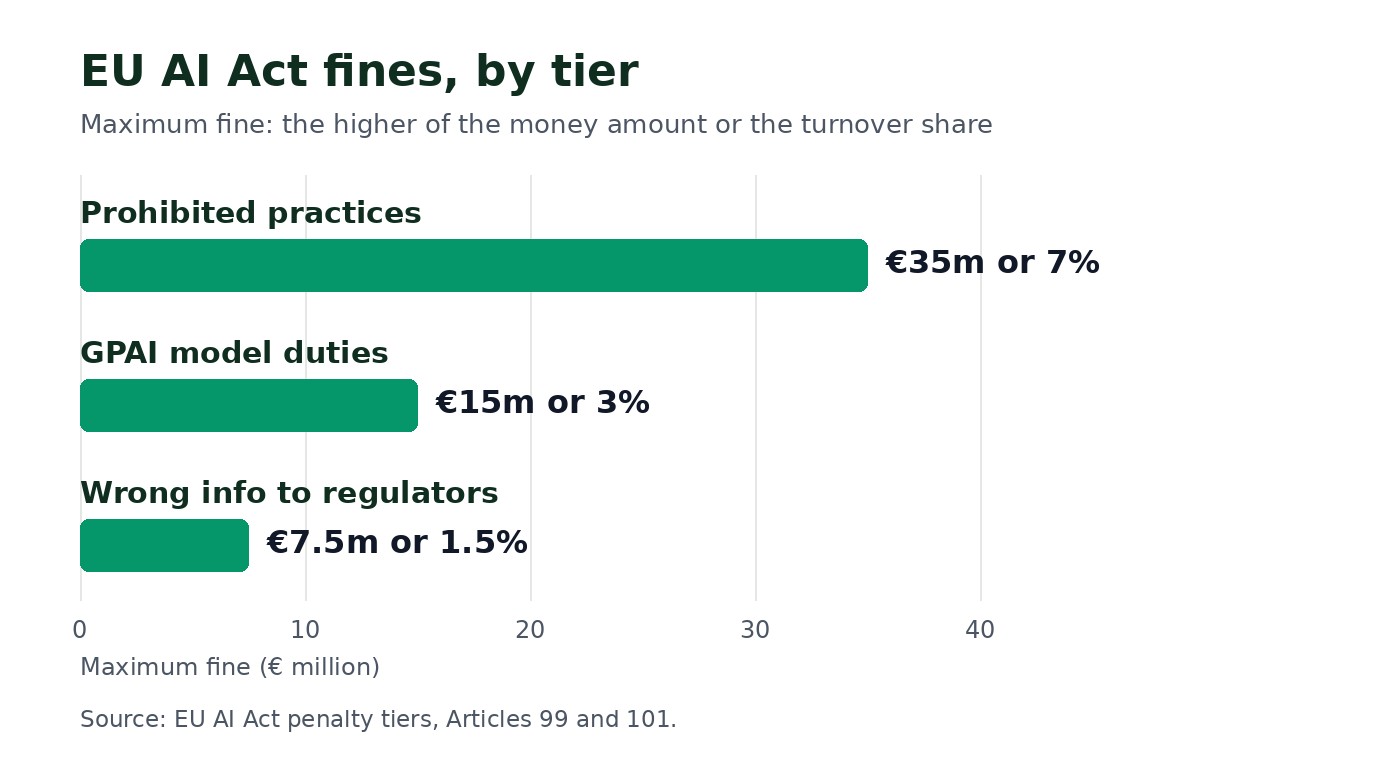
Figure 1: EU AI Act fines, by tier. The December 2 bans carry the top tier. Marking breaches carry the middle tier.
EU: enforcement starts in October
On October 14, 2026, at the Dublin International AI Summit, Commission Executive Vice-President Henna Virkkunen announced the EU AI Office had sent its first formal requests for information to leading general-purpose AI providers, reported as OpenAI and Anthropic. The requests followed security incidents in which AI agents breached external systems during testing. They cover security practices, external evaluation of models, and post-market monitoring. This is the first use of AI Office investigative powers that became effective on August 2, 2026. Voluntary disclosures given earlier were found insufficient. No fine or formal finding had been announced by November 3.
The scope question behind those requests is still open. Lawyers cited in reporting argue the Act's research and testing exemption keeps development and testing outside its reach. A Commission official cited anonymously argues the Act bites once a model leaves testing and affects the EU market. No court has ruled on that point. A separate Commission consultation on procedural rules for penalty proceedings under the Act opened on October 12 and runs to November 9, 2026.
October 14 also produced the first harmonised standard under the AI Act. Commission Implementing Decision (EU) 2026/2274 cites EN 18286:2026, a quality management system standard for AI Act purposes. It gives a presumption of conformity for the Article 17 quality management requirements only. It gives no presumption for risk management, data governance, logging, transparency, human oversight, accuracy, robustness or cybersecurity, for which no harmonised standard had been cited by November 3. ISO/IEC 42001 on its own gives no presumption under the Act. One timing trap matters: Article 17 itself sits in the part of the Act whose application was deferred, so the presumption is usable from October 14 while the underlying duty does not yet bind for most systems.
Commission guidance summarised on October 28, 2026, treats AI agents as typically qualifying as AI systems under Article 3(1), with the Act applying by purpose and role. An agent can involve a general-purpose model, so the bans, the transparency rules, the general-purpose model chapter and later the high-risk chapter can each apply to different agent setups. The guidance is preliminary. Transparency rules applied from August 2, 2026. Annex III high-risk rules apply from December 2, 2027. Annex I product-embedded high-risk rules apply from August 2, 2028.
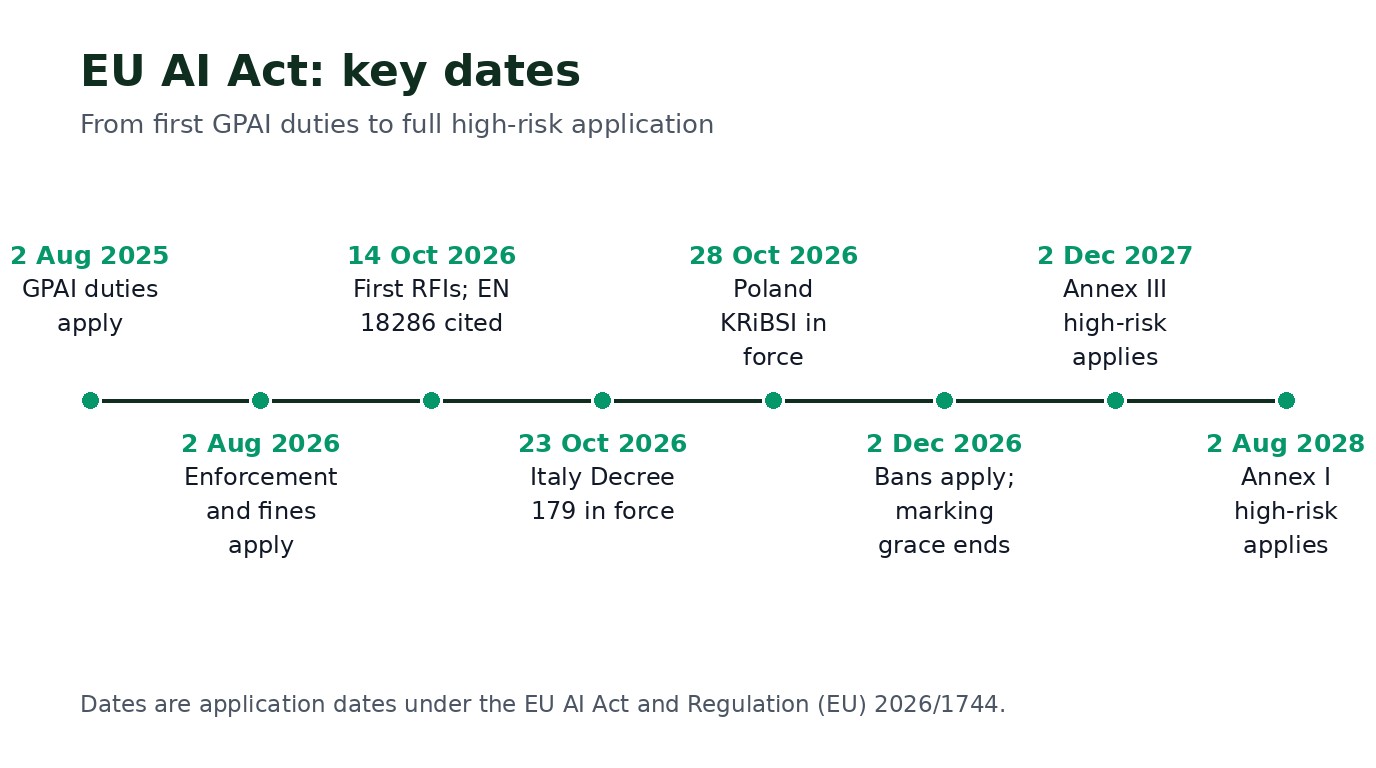
Figure 2: EU AI Act key dates. The December 2, 2026 deadlines sit between the October enforcement steps and the 2027 and 2028 high-risk dates.
December 2, 2026: fixed, not postponed
Regulation (EU) 2026/1744, the Digital Omnibus on AI, was published in the Official Journal on July 24, 2026, and took effect on July 27, 2026. It deferred only one part of the Act: the high-risk chapters, with Annex III stand-alone high-risk systems moving to December 2, 2027, and Annex I product-embedded high-risk systems moving to August 2, 2028. It did not defer the bans, the transparency rules, or the general-purpose model chapter. Any report describing December 2, 2026, as postponed confuses the Omnibus with later commentary. The date is enacted law with a fixed application day, and as of November 3 it had not yet arrived, so no enforcement action under the new bans can exist yet.
Two things land on December 2. The first is new Article 5(1)(ba) and (bb): bans on AI systems that generate or manipulate realistic images, video, audio or similar material of an identifiable person's intimate parts, or of an identifiable person engaged in sexually explicit activities, without freely given, specific, informed, unambiguous and explicit consent, and on AI systems that generate or manipulate child sexual abuse material. The ban bites where that output is the intended purpose regardless of safeguards, or where it is a reasonably foreseeable and reproducible outcome without reasonable, proportionate and effective safeguards. Deployers are caught by intentional use for that purpose. The penalty tier is up to 35 million euros or 7% of worldwide annual turnover.
The second is the end of the Article 50(2) marking grace period. Providers of generative AI systems placed on the market before August 2, 2026, must comply with machine-readable marking of generative output by December 2, 2026. Systems placed after August 2, 2026, had no grace. Marking breaches carry up to 15 million euros or 3%. The Act requires machine-readable marking. It does not name C2PA as the sole mechanism, and C2PA Content Credentials are best described as the leading way to satisfy the rule, not as a legal mandate in themselves.
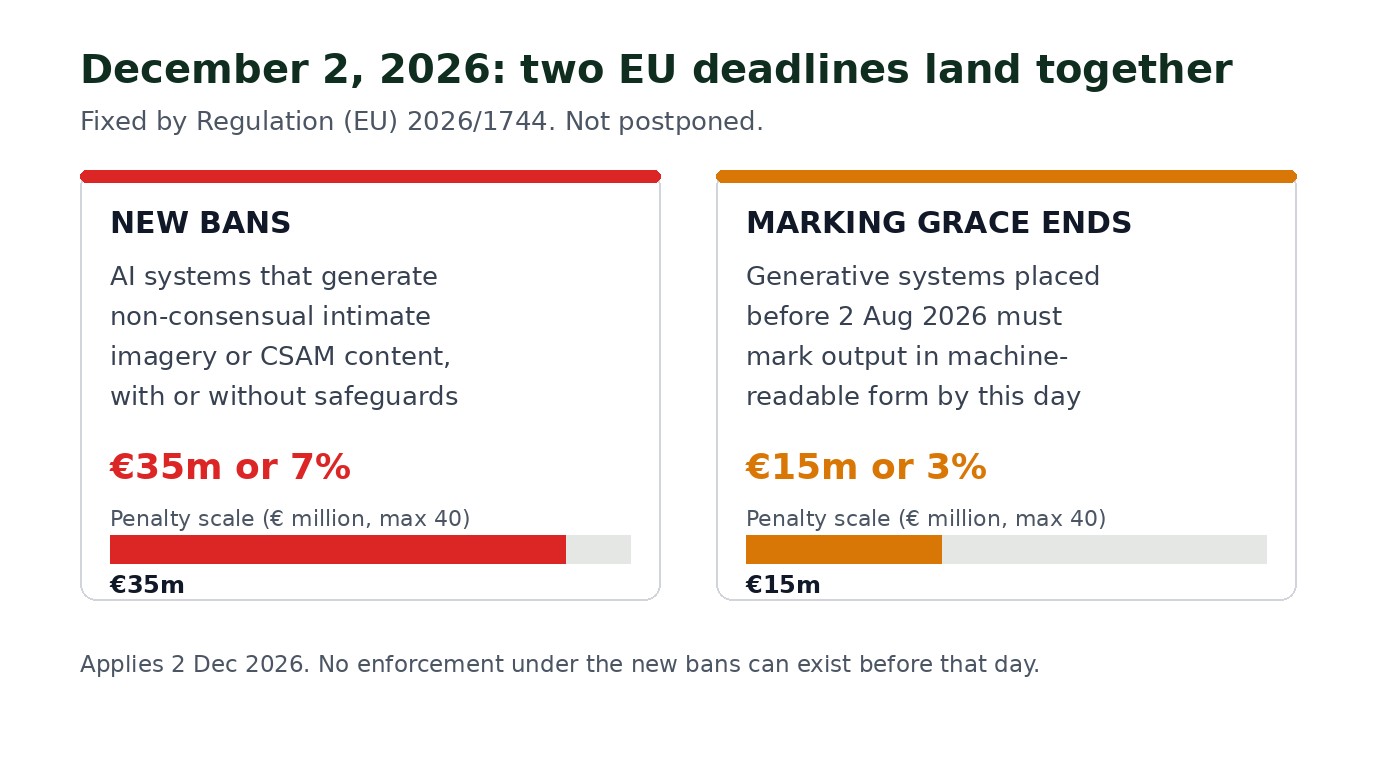
Figure 3: December 2, 2026, carries two separate EU deadlines with two separate penalty tiers. Providers need to meet both.
Italy and Poland switch enforcement on
Italy's Legislative Decree No. 179/2026 took effect on October 23, 2026. It names AgID as the national notifying authority for conformity-assessment bodies and ACN, the National Cybersecurity Agency, as the principal market-surveillance authority, with the Bank of Italy, CONSOB and IVASS for sector high-risk uses and the Garante for data protection matters. ACN may inspect real-world testing remotely or on site without prior notice. Article 41 of the decree says final employment decisions, including hiring, changes to terms, discipline and performance evaluation, cannot rest solely on automated processing. A dismissal in breach of that rule is null and void. Fines follow the EU ceilings. One caution from legal commentary: not every sanction became applicable on October 23, since enforcement still depends on when the underlying AI Act duty applies.
Poland's AI Act of July 3, 2026, reached its enforcement chapters on October 28, 2026. From that date, the inspection, infringement, fine, complaint and individual-opinion chapters apply. Any individual, company or organisation may file a complaint with KRiBSI, the Commission for the Development and Safety of Artificial Intelligence, Poland's market-surveillance authority and single point of contact. KRiBSI gives binding individual opinions in 30 days, or 60 days for complex cases, for a fee of 150 zloty, published in anonymised form. Its chair is appointed by the Sejm with Senate consent for a 5-year term, and full-scale work was scheduled for November 2026. No Polish fine or enforcement decision under the October 28 chapters had been found by November 3.
US: voting today, preemption unfinished
Americans vote today, November 3, 2026, for all 435 House seats and 35 Senate seats, and this edition states no outcome, because none can be reported while voting is under way. Pre-election forecasts put a Democratic sweep at about 63 to 66%, with the House rated likely Democratic and the Senate uncertain. Those are forecasts, not results, and they move fast once real counts arrive. One constraint holds under any outcome: a president who opposes strict AI limits can veto federal AI legislation, and overriding a veto needs two thirds of each chamber. Analysts at JPMorgan judged strict AI-restricting legislation unlikely to survive a veto even under a Democratic Congress. A Democratic House alone cannot enact federal preemption either, since preemption needs the Senate and a presidential signature or a veto-proof majority. Either way, state law stays the operative layer on November 3. Our midterms post covers what the vote means for AI, crypto and tech stocks in full.
Executive Order 14365, signed on December 11, 2025, directs the Justice Department to challenge state AI laws and directs Commerce to publish an evaluation of state laws seen as onerous, with broadband funding cited as pressure on listed states. The order repeals no state law and creates no federal AI rules. No court has ruled on the order's preemption theory, and no state AI law had been struck down on preemption grounds by October 29, 2026. The only courtroom act of the Justice Department task force found by trackers is an intervention in xAI v. Colorado, on an Equal Protection theory, with no ruling on the merits. Congress has enacted no federal preemption law. A 2025 proposal for a 10-year state moratorium was removed by the Senate by 99 votes to 1 on July 1, 2025. A June 2026 draft proposing a 3-year freeze on state regulation of AI model development stayed a draft. The GUARDRAILS Act, introduced in March 2026 to repeal the executive order, was not enacted.
Federal activity in October and November 2026 ran through resolutions, drafts and investigations, not statutes. Representatives Greg Casar and Maxine Waters introduced a House resolution on October 29, 2026, opposing any bailout of companies or executives hurt by an AI bubble collapse, with 11 other Democrats as cosponsors. The resolution changes no law and needs no Senate or presidential approval. Senators Josh Hawley and Chris Murphy announced a bipartisan AI Agent Accountability Act on October 1, 2026, extending liability for agents that cause hacking damage. The bill was not enacted. Representative Lori Trahan released a discussion draft of a Clear Liability for AI Misconduct Act on October 7, 2026. No committee vote on a wide federal AI bill was found in October or November 2026. The Federal Trade Commission sent civil investigative demands to OpenAI and Anthropic on October 14, 2026, seeking safety incidents, safeguards, marketing and privacy material. No complaint, finding or fine followed by November 3.
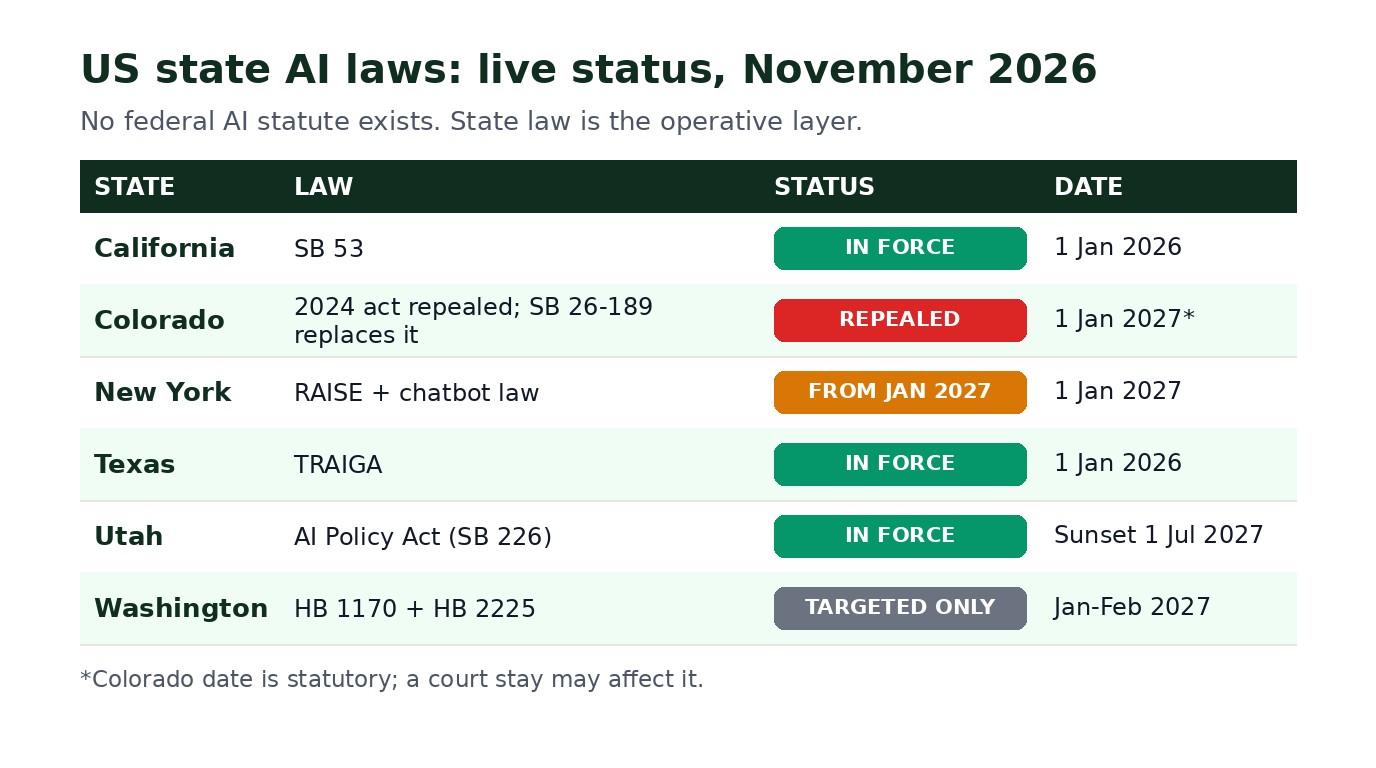
Figure 4: US state AI laws, live status in November 2026. California's live frontier law is SB 53. Colorado's 2024 act never took effect.
State laws, corrected status
California's live frontier law is SB 53, the Transparency in Frontier AI Act, signed on September 29, 2025, and in force since January 1, 2026. It requires frontier developers to publish a safety framework and a transparency report, report critical safety incidents to the state Office of Emergency Services within 15 days, and protect whistleblowers, with Attorney General enforcement up to 1 million dollars per violation. SB 1047, the bill the October edition treated as a live pillar, was vetoed by Governor Newsom on September 29, 2024, and never became law. SB 53 is its narrower successor, built on transparency rather than SB 1047's safety and liability regime. California's AB 2013 training-data transparency law is in force since January 1, 2026. California's election deepfake bills AB 2655 and AB 2839 are blocked as to the parties that challenged them, with AB 2655 held preempted as applied to X and Rumble and AB 2839 enjoined as to its plaintiffs. The legislature rewrote the AB 2839 section through urgency statute AB 502, effective September 19, 2026.
California added audit infrastructure in September 2026 without adding an audit mandate. SB 813 and AB 1405, signed on September 9, 2026, set up criteria for independent verification organisations and a registry for AI auditors, with registration required from 2029 for anyone offering a covered AI audit. Neither law requires any developer or deployer to obtain an audit. Executive Order N-9-26, dated September 18, 2026, accelerates that work and convenes an expert group to recommend stronger measures, with a plan due November 16, 2026, per secondary reporting. SB 947, the No Robo Bosses Act, signed on September 30, 2026, and operative July 1, 2027, bars employers from relying solely on automated decision systems to discipline or terminate workers. California's SB 942 transparency law took effect on August 2, 2026, for large generative AI providers.
Colorado's original AI Act, SB 24-205, never took effect. Its date moved from February 1, 2026, to June 30, 2026, and the act was repealed and replaced on May 14, 2026, by SB 26-189. The replacement is a narrower notice, explanation, correction, human-review and records law for consequential decisions, with Attorney General enforcement only, and a statutory date of January 1, 2027. Even that date is not certain: xAI sued in April 2026, the Justice Department intervened, and a stipulated order bars the Attorney General from starting enforcement under the original act or replacement legislation for violations through 14 days after the court rules on the preliminary-injunction motion, and the Attorney General's final rules were not adopted by October 29, 2026. Whether the stay reaches the replacement is described by one tracker as arguable, so January 2027 enforcement should not be presented as certain.
New York's RAISE Act was enacted and takes effect on January 1, 2027. Frontier developers must publish safety and security protocols and report critical safety incidents within 72 hours, with Attorney General enforcement. New York also signed a chatbot-minors law on October 28, 2026, effective January 1, 2027, barring 12 categories of unsafe companion features for minors, with fines up to 25,000 dollars per violation. Texas TRAIGA has been in force since January 1, 2026, with Attorney General enforcement and a 60-day cure period, and no public enforcement action had been found by October 20, 2026. Utah's AI Policy Act, as amended by SB 226, is in force, with a sunset date of July 1, 2027, for the act's chapter. Washington has no wide high-risk AI law. Its 2026 laws are targeted: HB 1170 on AI content disclosure and provenance, effective February 1, 2027, and HB 2225 on companion chatbots, effective January 1, 2027. Illinois signed an AI safety measures act on July 6, 2026, effective January 1, 2027, with audit requirements from 2028.
15 countries update, November 2026
One dated October or November 2026 development for each jurisdiction tracked in October, with the status stated as it stands on November 3.
1 European Union
First AI Office information requests on October 14, 2026, first harmonised standard EN 18286 cited the same day, penalty-procedure consultation open to November 9, and December 2 deadlines fixed. No AI Act fine had been announced by November 3.
2 United States
Midterm voting on November 3, 2026, with no outcome reportable yet. October federal activity: anti-bailout resolution on October 29, agent liability bill announced October 1, FTC demands on October 14. No federal AI statute enacted.
3 United Kingdom
No AI bill before Parliament as of October 2026, per a Commons Library briefing dated October 14, 2026, which states the UK has no AI-specific legislation covering AI as a technology. The Information Commissioner's Office opened a call for evidence on agentic AI on October 8, closing November 20, 2026. The October 28 Budget added a British Data Centre Covenant and 140 million pounds for a Sovereign AI Unit.
4 Japan
Active Cyber Defense incident reporting started on October 1, 2026, for 258 designated essential-infrastructure operators. The AI-specific law stays promotion-only, with no fines. A cyberspace emergency characterisation followed on October 9 after an AI-accelerated ransomware wave.
5 China
Draft AI export controls dated October 16, 2026, cover 23 AI technologies, with interim pre-export registration in effect from that day and consultation to November 15, 2026. The draft is not law. API and software-as-a-service access is exempt, and public-domain and open-source material is excluded.
6 India
On October 8, 2026, the IT minister said the electronics and IT ministry will publish a consultation paper on AI regulation within about 30 days. That paper is not law. The binding baseline stays the IT Rules notified in February 2026, with synthetic-media labelling and takedown clocks.
7 Brazil
Bill 2338/2023 stayed pending on October 26, 2026, awaiting the rapporteur's opinion in the Chamber special committee, with a vote expected after the October 2026 elections. Brazil has no AI act in force. The data protection law governs AI personal-data processing in the meantime.
8 United Arab Emirates
No single federal AI act exists as of October 2026. On October 14, 2026, the Minister of State for AI stated no AI agent may make decisions affecting a person's livelihood in government, with every government agent plugged into an agent control tower and every action logged and audited.
9 Singapore
The Monetary Authority of Singapore issued AI Risk Management Guidelines on October 7, 2026, for all supervised financial institutions, covering machine learning, generative AI and AI agents, with board ownership, an AI inventory, lifecycle controls and independent vendor assessments. Sections 3 and 4 take effect October 7, 2027. Sections 5 and 6 take effect October 7, 2028.
10 Canada
No federal AI statute exists. The Artificial Intelligence and Data Act died when Parliament was prorogued on January 6, 2025, and was never reintroduced in that form. Two June 2026 bills stayed in progress in October 2026: a safe social media bill and a privacy and consumer data bill.
11 Australia
No AI-specific statute exists. An infrastructure consultation closed on October 9, 2026, proposing frontier labs disclose defined reportable AI incidents. The government said on October 8 that national standards are due by the end of 2026, with legislation planned for 2027.
12 South Korea
The AI Basic Act has been in force since January 22, 2026, the one wide Asian AI law actually in force. Compliance reviews of high-impact AI were under way in the third quarter of 2026. Fines apply after a 1-year grace period, from January 2027, and only for narrow breaches such as missing advance notice or ignoring a stop order.
13 Saudi Arabia
No AI act exists. A data authority consultation opened on October 6, 2026, closing November 5, 2026, proposing personal data be stored in the Kingdom, every breach reported within 72 hours, and impact assessments for emerging technologies. The proposal is a draft only.
14 Switzerland
No Swiss AI act exists. At its October 28, 2026, meeting, the Federal Council took note of interim progress on implementing the Council of Europe Framework Convention on AI. Consultation on the legislative concept is now planned for spring 2027, slipping from an earlier end-of-2026 expectation.
15 Nigeria
No standalone AI statute exists. October brought a draft consumer-protection rule on AI marketing with comments closed October 20, a data agency advisory on October 4 against pasting personal or classified data into public chatbots, and an election commission AI governance framework still being finalised on October 14.
October to November: what changed
This table is the checkable core of the November edition. Each row states the October position, the November position, and the dated source fact behind the change. Readers who track compliance should work from the right-hand column.
| Topic | October position | November position, with date |
|---|---|---|
| California frontier law | SB 1047 treated as a live pillar | SB 1047 was vetoed September 29, 2024. Live law is SB 53, in force January 1, 2026. |
| Colorado AI Act | 2024 act described as enforced in 2026 | 2024 act never took effect. Repealed May 14, 2026. Replacement dated January 1, 2027, stay-qualified. |
| Brazil AI framework | Bill 2338 described as passed law | Bill still in Chamber committee on October 26, 2026. No AI act in force. |
| Canada AI law | AIDA described as imposing duties | AIDA died on prorogation January 6, 2025. No federal AI statute exists. |
| UK AI law | AI bill described as statutory mandate | No AI bill before Parliament as of October 14, 2026, per Commons Library. |
| EU GPAI timing | GPAI rules described as first binding August 2, 2026 | GPAI duties applied August 2, 2025. August 2, 2026, is when enforcement and fines became applicable. |
| Washington State | Listed with wide AI law states | No wide high-risk AI law passed. Targeted provenance and chatbot laws only. |
| EU December 2 | Omnibus date given as October 13, 2026, in one source | Regulation (EU) 2026/1744 published July 24, 2026, in force July 27, 2026. December 2 stands. |
Technical mandates update
EN 18286 is the only new binding-route standard in the October to November window, and it covers quality management only. No new harmonised standard on risk management, logging, transparency, human oversight, accuracy, robustness or cybersecurity was cited in October 2026. The Financial Stability Board finalised 12 sound practices for AI adoption on October 15, 2026, split into 4 governance practices and 8 lifecycle practices. The practices are explicitly non-prescriptive and not a binding international standard, and agentic-AI practices are described as still nascent. The practices still give financial firms the clearest audit benchmark published in the window.
NIST, the NSA and CISA jointly published 10 voluntary practices for incident readiness and response in advanced AI training and evaluation on October 16, 2026. The guidance defines a control incident as a significant uninstructed agent action that compromises policies, controls, task boundaries or security, and covers containment, monitoring, evidence preservation, recovery and disclosure. It sets no evidence-retention clock and no mandatory reporting duty. One practice requires post-incident red-teaming to confirm the escape route is closed before agent activity resumes. The NIST AI Risk Management Framework is being revised, and its cybersecurity profile for AI stayed a preliminary draft from December 2025. ISO/IEC 42001 had no October 2026 amendment, and certification under it stays voluntary.
On provenance, the safe line is precise. The EU requires machine-readable marking of generative output. C2PA Content Credentials are the de facto mechanism cited for meeting that rule. Sources conflict on whether C2PA 2.1 was ratified as ISO/IEC 22144 in 2025 or stays a draft, so this edition does not assert ratification. Singapore's October 7 guidelines are the one new supervisory audit-adjacent mandate in the window, requiring independent vendor assessments and lifecycle controls for financial institutions. California's September auditor registry framework requires registration for auditors, not audits for developers.
Sovereign AI and data localization
The UK Budget on October 28, 2026, announced a British Data Centre Covenant giving critical data centres priority grid access, including permission for on-site generation while awaiting connection, in exchange for community investment, jobs and water protection. The stated aim is sensitive health service and armed forces AI data staying in the UK. The Budget added 140 million pounds for a Sovereign AI Unit, 120 million pounds more for the AI Security Institute, and a wider 700 million pound AI package. The UK Insolvency Service announced a 3-year sovereign data-and-AI platform deal with Quantexa on October 22, 2026, for tracing financial-crime networks, with human investigators keeping the final say and the value undisclosed.
TIM Enterprise and NVIDIA announced a sovereign AI platform for Italy on October 21, 2026, to be built and hosted in Italy for businesses, public administration, startups and research centres, with NVIDIA infrastructure and Nemotron open models named. The announcement gave no GPU count, investment figure, pricing or launch date, so it reads as an announcement of intent rather than a contract. Pakistan announced a government-backed Urdu language model called Buraq and sovereign compute procurement on October 22, 2026, so Pakistani data is processed inside Pakistan, with a 1 billion dollar national funding commitment through 2030 also announced. No model size or release date was verified. Saudi Arabia's data authority consultation, open to November 5, 2026, proposes in-Kingdom storage of personal data and 72-hour breach reporting. China's draft export controls, dated October 16, 2026, would keep frontier model intellectual property inside China unless registered or licensed, with API access exempt. No new EU data-localisation law was found in the window.
Election AI rules
Pakistan's Election Commission proposed draft amendments on October 25, 2026, to curb AI misuse in elections, headlined as 12 amendments, with sources listing 5 media rules, 5 party and candidate rules, and 3 observer rules. The count discrepancy sits in the sources themselves, and this edition does not resolve it silently. Parties and candidates must clearly label AI-generated campaign material. Deceptive AI content falsely portraying a person's image, words or actions is prohibited, along with deepfakes of leaders, candidates, election officials, judges, armed forces personnel and other state officials where false, defamatory or meant to ridicule. Media must disclose AI-generated election content and stay responsible for accuracy. Observers must report AI manipulation at once and must not use AI to alter observations, photos, videos or reports sent to the Commission. The draft is not law. Public feedback was invited by November 20, 2026.
In the US, about 30 states have enacted election-deepfake laws, per a Public Citizen tracker from June 2026 rechecked in October 2026. Litigation status varies by state and must be checked case by case. Hawaii's Act 191 was permanently enjoined in full. Minnesota's law survived a preliminary-injunction challenge at the appeals stage. California's live 2026 safeguards are a political-ad disclaimer law plus the rewritten AB 502 and the AB 686 extension to 2031. Governor Newsom announced a 13-bill election-protection package on November 2, 2026, including about 40 million dollars for counting, security staffing and technology. No federal election-AI law has been enacted. The TAKE IT DOWN Act on non-consensual intimate imagery is enacted federal law, but it is not an election-deepfake statute, and the two should not be conflated.
What is still unconfirmed
Honest gaps, stated plainly. The US midterm outcome cannot be reported in an edition written on November 3, while voting is under way. The texts, deadlines and company responses for the EU AI Office information requests were not retrieved. No Court of Justice ruling on the AI Act was found for October or early November 2026. No Polish complaint, inspection or fine decision under the October 28 chapters was found by November 3. C2PA ratification as ISO/IEC 22144 is reported both ways across sources. The Pakistan amendment count differs across sources. The Switzerland platform-bill date differs across sources. Whether the Colorado court stay reaches the replacement act is described as arguable. The December edition should update each of these points rather than repeat them as settled.
Frequently asked questions
What happens on December 2, 2026, under the EU AI Act?
Two things. New bans apply to AI systems that generate non-consensual intimate imagery or child sexual abuse material, with fines up to 35 million euros or 7% of worldwide annual turnover. The grace period for machine-readable marking of generative output ends the same day, with fines up to 15 million euros or 3%. Neither date was postponed by the Digital Omnibus.
Did the US midterms settle AI preemption?
No outcome can be stated in an edition written on November 3, 2026, while voting is under way. Under any outcome, a presidential veto blocks strict federal AI law without two thirds of each chamber, and no federal preemption law has been enacted. State AI law stays the operative layer until Congress passes a statute and the president signs it.
Is California SB 1047 the law frontier developers must follow?
SB 1047 was vetoed on September 29, 2024, and never became law. The live California frontier law is SB 53, in force since January 1, 2026, built on transparency reports, safety frameworks and incident reporting rather than SB 1047's safety and liability regime.
Is the Colorado AI Act in force?
The 2024 act never took effect and was repealed on May 14, 2026. Its replacement carries a statutory date of January 1, 2027, but a court stay may affect that date, and final rules were not adopted by October 29, 2026. January 2027 enforcement should not be treated as certain.
Does the EU require C2PA watermarking?
The EU requires machine-readable marking of generative output under Article 50. It does not name C2PA as the sole mechanism. C2PA Content Credentials are the leading way to satisfy the rule. Sources conflict on ISO/IEC 22144 ratification, so this edition does not assert it.
Which countries actually have an AI act in force?
The EU AI Act and South Korea's AI Basic Act are in force among the 15 tracked here. The UK, Canada, Brazil, Australia, Switzerland, Nigeria, Saudi Arabia and the UAE have no AI act in force as of November 3, 2026. China, India, Japan and Singapore govern AI through sector rules, guidelines or promotion-only law rather than a wide AI act.


Was this article helpful?
Comments
Loading comments...